(Peer-Reviewed) Updates on CRISPR-based gene editing in HIV-1/AIDS therapy
Zhihao Zhang, Wei Hou 侯炜, Shuliang Chen 陈述亮
Institute of Medical Virology, School of Basic Medical Sciences, Wuhan University, Wuhan 430071, China
中国 武汉 武汉大学基础医学院 医学病毒学研究所
Abstract
Although tremendous efforts have been made to prevent and treat HIV-1 infection, HIV-1/AIDS remains a major threat to global human health. The combination antiretroviral therapy (cART), although able to suppress HIV-1 replication, cannot eliminate the proviral DNA integrated into the human genome and thus requires lifelong treatment that may lead to various side effects.
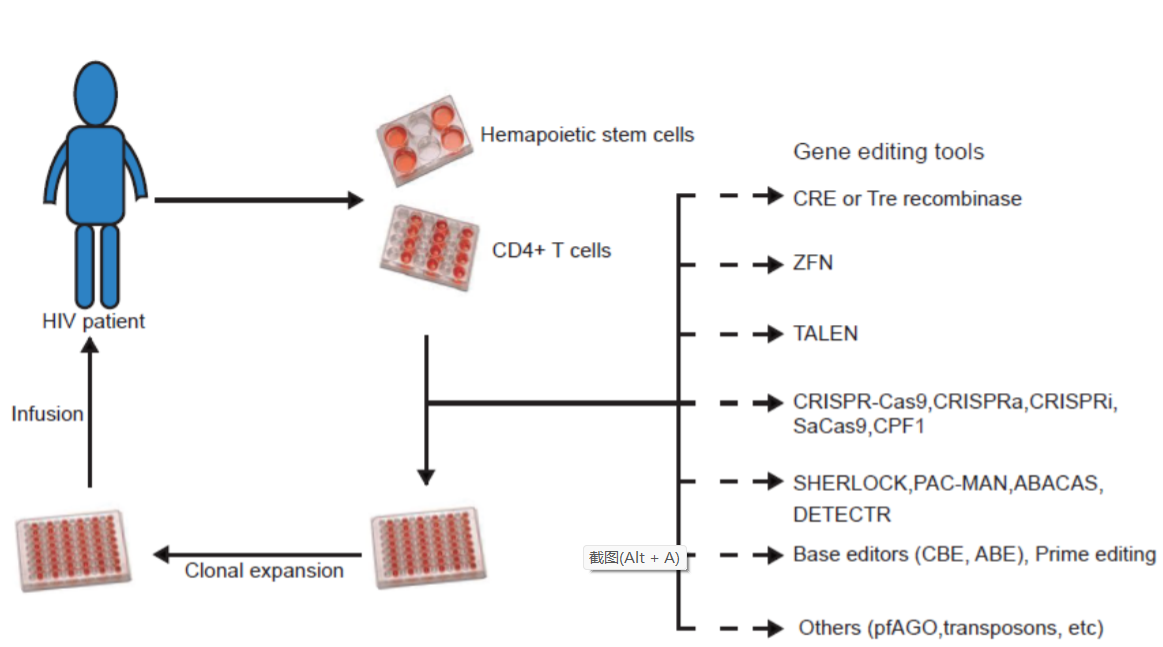
In recent years, clustered regularly interspaced short palindromic repeat (CRISPR)-associated nuclease 9 (Cas9) related gene-editing systems have been developed and designed as effective ways to treat HIV-1 infection. However, new gene-targeting tools derived from or functioning like CRISPR/Cas9, including base editor, prime editing, SHERLOCK, DETECTR, PAC-MAN, ABACAS, pfAGO, have been developed and optimized for pathogens detection and diseases correction.
Here, we summarize recent studies on HIV-1/AIDS gene therapy and provide more gene-editing targets based on studies relating to the molecular mechanism of HIV-1 infection. We also identify the strategies and potential applications of these new gene-editing technologies for HIV-1/AIDS treatment in the future. Moreover, we discuss- the caveats and problems that should be addressed before the clinical use of these versatile CRISPR- based gene targeting tools. Finally, we offer alternative solutions to improve the practice of gene targeting in HIV-1/AIDS gene therapy.
Ultrafast all-optical modulation of wide-bandwidth pulses enabled by silicon-metasurfaces
Kaloyan Georgiev, Khosro Zangeneh Kamali, Anton A. Trifonov, Giulia Crotti, Lyuben Petrov, Stefan Georgiev, Hristo Iliev, Lei Xu, Unai Arregui Leon, Mohsen Rahmani, Giuseppe Della Valle, Ivan Buchvarov, Dragomir Neshev
Opto-Electronic Advances
2026-09-15
Physics-informed neural fields enable blind aberration correction for partially coherent quantitative phase imaging
Shun Zhou, Xingyu Huang, Linpeng Lu, Habib Ullah, Kaiyu Du, Maciej Trusiak, Malgorzata Kujawinska, Yuzhen Zhang, Yao Fan, Qian Chen, Qinrong Zhang, Chao Zuo
Opto-Electronic Science
2026-08-26
Heterogeneously integrated micro-ring with SnS₂ for dual-functional optical modulation and photodetection
Jinyi Du, Lidan Lu, Xu Zhang, Bofei Zhu, Wenbo Bo, Yingjie Xu, Guang Chen, Yanlin He, Guanghui Ren, Xiaoping Lou, Zheng You, Lianqing Zhu
Opto-Electronic Advances
2026-08-25
Hardware-aware lightweight photonic spiking neural network for pattern classification
Shuiying Xiang, Yahui Zhang, Shangxuan Shi, Haowen Zhao, Dianzhuang Zheng, Xingxing Guo, Yanan Han, Ye Tian, Liyue Zhang, Yuechun Shi, Yue Hao
Opto-Electronic Advances
2026-08-25
PhyspeNet: An empirical physics-aware network for adaptive speckle reconstructive spectrometry
Junrui Liang, Min Jiang, Jun Li, Zhongming Huang, Junhong He, Yanting Guo, Yanzhao Ke, Jun Ye, Jiangming Xu, Jinyong Leng, Pu Zhou
Opto-Electronic Advances
2026-08-25
A 36 × 240 Gbps hybrid mode/wavelength division multiplexing transmitter using lithium niobate on insulator
Mingyu Zhu, Weihan Wang, Ruitao Ma, Aoyun Gao, Chun Gao, Zexu Wang, Fei Huang, Zhenyuan Bao, Dajian Liu, Jiaxuan Gan, Zejie Yu, Huan Li, Weike Zhao, Daoxin Dai
Opto-Electronic Advances
2026-08-25