(Peer-Reviewed) Amphiphilic small molecular mates match hydrophobic drugs to form nanoassemblies based on drug-mate strategy
Leiqiang Han 韩雷强, Shuang Liang 梁爽, Weiwei Mu 牟伟伟, Zipeng Zhang 张自鹏, Limin Wang, Shumin Ouyang, Bufan Yao, Yongjun Liu 刘永军, Na Zhang 张娜
Department of Pharmaceutics, Key Laboratory of Chemical Biology (Ministry of Education), School of Pharmaceutical Sciences, Cheeloo College of Medicine, Shandong University, Jinan 250012, China
中国 济南 山东大学齐鲁医学院药学院 化学生物学教育部重点实验室
Abstract
Nanomedicine has made great progress in the targeted therapy of cancer. Here, we established a novel drug-mate strategy by studying the formulation of nanodrugs at the molecular level.
In the drug-mate combination, the drug is a hydrophobic drug that is poorly soluble in water, and the mate is an amphiphilic small molecule (SMA) that has both hydrophilic and lipophilic properties. We proposed that the hydrophobic drug could co-assemble with a suitable SMA on a nanoscale without additive agents. The proof-of-concept methodology and results were presented to support our hypothesis.
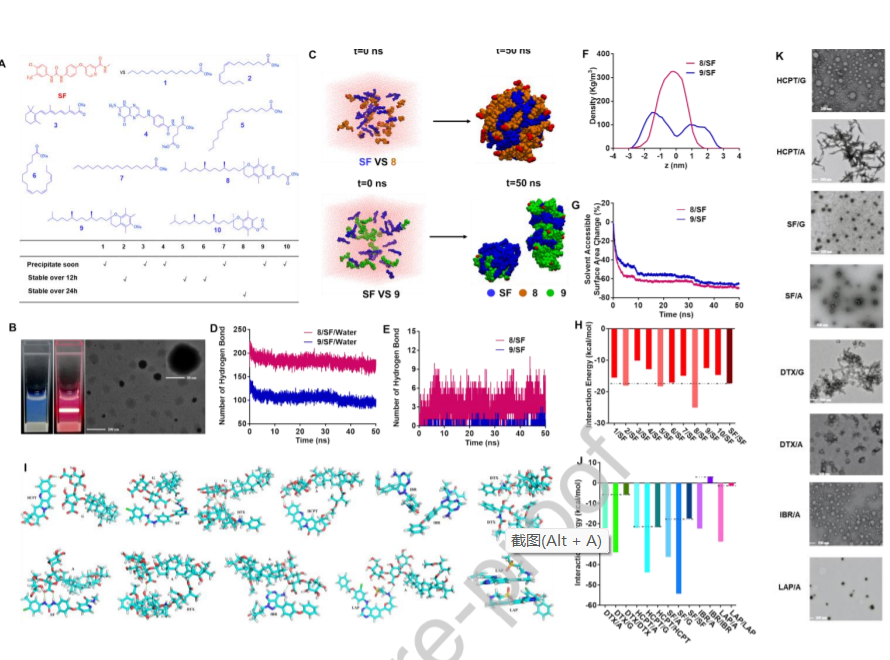
We selected five hydrophobic drugs and more than ten amphiphilic small molecules to construct a library. Through molecular dynamic simulation and quantum chemistry computation, we speculated that the formation of nanoassemblies was related to the binding energy of the drug-mate, and the drug-mate interaction must overcome drug-drug interaction.
Furthermore, the obtained SF/VECOONa nanoassemblieswas selected as a model, which had an ultra-high drug loading content (46%), improved pharmacokinetics, increased bioavailability, and enhanced therapeutic efficacy. In summary, the drug-mate strategy is an essential resource to design exact SMA for many hydrophobic drugs and provides a reference for the design of a carrier-free drug delivery system.
Ultrafast all-optical modulation of wide-bandwidth pulses enabled by silicon-metasurfaces
Kaloyan Georgiev, Khosro Zangeneh Kamali, Anton A. Trifonov, Giulia Crotti, Lyuben Petrov, Stefan Georgiev, Hristo Iliev, Lei Xu, Unai Arregui Leon, Mohsen Rahmani, Giuseppe Della Valle, Ivan Buchvarov, Dragomir Neshev
Opto-Electronic Advances
2026-09-15
Physics-informed neural fields enable blind aberration correction for partially coherent quantitative phase imaging
Shun Zhou, Xingyu Huang, Linpeng Lu, Habib Ullah, Kaiyu Du, Maciej Trusiak, Malgorzata Kujawinska, Yuzhen Zhang, Yao Fan, Qian Chen, Qinrong Zhang, Chao Zuo
Opto-Electronic Science
2026-08-26
Heterogeneously integrated micro-ring with SnS₂ for dual-functional optical modulation and photodetection
Jinyi Du, Lidan Lu, Xu Zhang, Bofei Zhu, Wenbo Bo, Yingjie Xu, Guang Chen, Yanlin He, Guanghui Ren, Xiaoping Lou, Zheng You, Lianqing Zhu
Opto-Electronic Advances
2026-08-25
Hardware-aware lightweight photonic spiking neural network for pattern classification
Shuiying Xiang, Yahui Zhang, Shangxuan Shi, Haowen Zhao, Dianzhuang Zheng, Xingxing Guo, Yanan Han, Ye Tian, Liyue Zhang, Yuechun Shi, Yue Hao
Opto-Electronic Advances
2026-08-25
PhyspeNet: An empirical physics-aware network for adaptive speckle reconstructive spectrometry
Junrui Liang, Min Jiang, Jun Li, Zhongming Huang, Junhong He, Yanting Guo, Yanzhao Ke, Jun Ye, Jiangming Xu, Jinyong Leng, Pu Zhou
Opto-Electronic Advances
2026-08-25
A 36 × 240 Gbps hybrid mode/wavelength division multiplexing transmitter using lithium niobate on insulator
Mingyu Zhu, Weihan Wang, Ruitao Ma, Aoyun Gao, Chun Gao, Zexu Wang, Fei Huang, Zhenyuan Bao, Dajian Liu, Jiaxuan Gan, Zejie Yu, Huan Li, Weike Zhao, Daoxin Dai
Opto-Electronic Advances
2026-08-25