(Peer-Reviewed) Chiral detection of biomolecules based on reinforcement learning
Yuxiang Chen 陈宇翔 ¹, Fengyu Zhang 张凤宇 ² ⁴, Zhibo Dang 党郅博 ¹, Xiao He 何霄 ¹, Chunxiong Luo 罗春雄 ² ⁴, Zhengchang Liu 刘正昌 ³, Pu Peng 彭璞 ¹, Yuchen Dai 戴宇琛 ³, Yijing Huang 黄逸婧 ¹, Yu Li 李瑜 ³, Zheyu Fang 方哲宇 ¹ ³
¹ School of Physics, Peking University, Beijing 100871, China
中国 北京 北京大学物理学院
² The State Key Laboratory for Artificial Microstructures and Mesoscopic Physics, School of Physics & Center for Quantitative Biology, Academy for Advanced Interdisciplinary Studies, Peking University, Beijing 100871, China
中国 北京 北京大学 前沿交叉学科研究院 定量生物学中心 物理学院 人工微结构和介观物理国家重点实验室
³ Academy for Advanced Interdisciplinary Studies, Peking University, Beijing 100871, China
中国 北京 北京大学 前沿交叉学科研究院
⁴ Wenzhou Institute, University of Chinese Academy of Sciences, Wenzhou 325001, China
中国 温州 中国科学院大学温州研究院
Opto-Electronic Science
, 2023-02-09
Abstract
Chirality plays an important role in biological processes, and enantiomers often possess similar physical properties and different physiologic functions. In recent years, chiral detection of enantiomers become a popular topic.
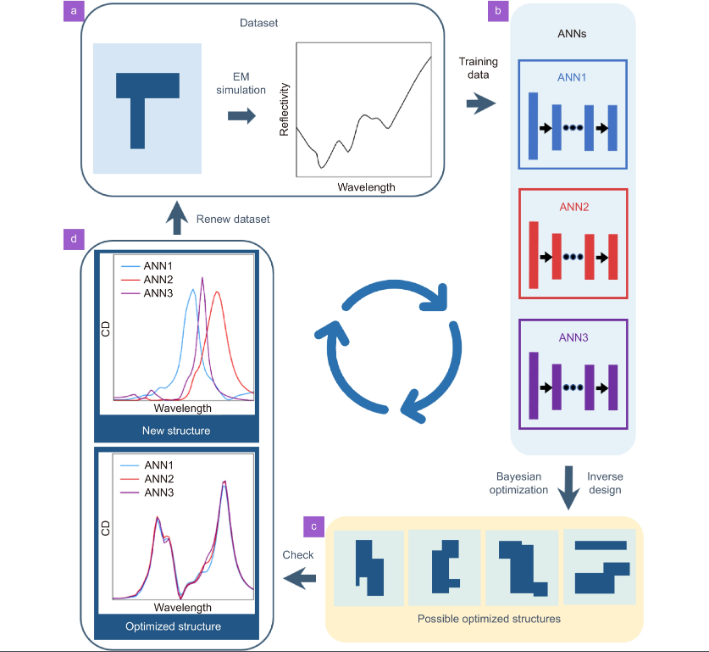
Plasmonic metasurfaces enhance weak inherent chiral effects of biomolecules, so they are used in chiral detection. Artificial intelligence algorithm makes a lot of contribution to many aspects of nanophotonics. Here, we propose a nanostructure design method based on reinforcement learning and devise chiral nanostructures to distinguish enantiomers.
The algorithm finds out the metallic nanostructures with a sharp peak in circular dichroism spectra and emphasizes the frequency shifts caused by nearfield interaction of nanostructures and biomolecules. Our work inspires universal and efficient machine-learning methods for nanophotonic design.
Ultrafast all-optical modulation of wide-bandwidth pulses enabled by silicon-metasurfaces
Kaloyan Georgiev, Khosro Zangeneh Kamali, Anton A. Trifonov, Giulia Crotti, Lyuben Petrov, Stefan Georgiev, Hristo Iliev, Lei Xu, Unai Arregui Leon, Mohsen Rahmani, Giuseppe Della Valle, Ivan Buchvarov, Dragomir Neshev
Opto-Electronic Advances
2026-09-15
Physics-informed neural fields enable blind aberration correction for partially coherent quantitative phase imaging
Shun Zhou, Xingyu Huang, Linpeng Lu, Habib Ullah, Kaiyu Du, Maciej Trusiak, Malgorzata Kujawinska, Yuzhen Zhang, Yao Fan, Qian Chen, Qinrong Zhang, Chao Zuo
Opto-Electronic Science
2026-08-26
Heterogeneously integrated micro-ring with SnS₂ for dual-functional optical modulation and photodetection
Jinyi Du, Lidan Lu, Xu Zhang, Bofei Zhu, Wenbo Bo, Yingjie Xu, Guang Chen, Yanlin He, Guanghui Ren, Xiaoping Lou, Zheng You, Lianqing Zhu
Opto-Electronic Advances
2026-08-25
Hardware-aware lightweight photonic spiking neural network for pattern classification
Shuiying Xiang, Yahui Zhang, Shangxuan Shi, Haowen Zhao, Dianzhuang Zheng, Xingxing Guo, Yanan Han, Ye Tian, Liyue Zhang, Yuechun Shi, Yue Hao
Opto-Electronic Advances
2026-08-25
PhyspeNet: An empirical physics-aware network for adaptive speckle reconstructive spectrometry
Junrui Liang, Min Jiang, Jun Li, Zhongming Huang, Junhong He, Yanting Guo, Yanzhao Ke, Jun Ye, Jiangming Xu, Jinyong Leng, Pu Zhou
Opto-Electronic Advances
2026-08-25
A 36 × 240 Gbps hybrid mode/wavelength division multiplexing transmitter using lithium niobate on insulator
Mingyu Zhu, Weihan Wang, Ruitao Ma, Aoyun Gao, Chun Gao, Zexu Wang, Fei Huang, Zhenyuan Bao, Dajian Liu, Jiaxuan Gan, Zejie Yu, Huan Li, Weike Zhao, Daoxin Dai
Opto-Electronic Advances
2026-08-25