(Peer-Reviewed) Holocene dust storm variations over northern china: transition from a natural forcing to an anthropogenic forcing
Shengqian Chen 陈圣乾 ¹, Jianbao Liu 刘建宝 ¹ ² ³, Xin Wang 王鑫 ¹, Shuang Zhao 赵爽 ¹ ⁴, Jianhui Chen 陈建徽 ¹, Mingrui Qiang 强明瑞 ¹ ⁵, Bing Liu 刘冰 ⁶, Qinghai Xu 许清海 ⁷, Dunsheng Xia 夏敦胜 ¹, Fahu Chen 陈发虎 ¹ ² ³
¹ Key Laboratory of Western China's Environmental Systems (Ministry of Education), College of Earth and Environmental Science, Lanzhou University, Lanzhou 730000, China. 兰州大学 地球与环境科学学院 西部环境教育部重点实验室
² Group of Alpine Paleoecology and Human Adaptation, State Key Laboratory of Tibetan Plateau Earth System, Resources and Environment, Institute of Tibetan Plateau Research, Chinese Academy of Sciences, Beijing 100101, China. 中国科学院 青藏高原研究所
³ Center for Excellence in Tibetan Plateau Earth Sciences, Chinese Academy of Sciences, Beijing 100101, China. 中国科学院 青藏高原地球科学卓越创新中心
⁴ College of Geography and Tourism, Qufu Normal University, Rizhao 276826, China 曲阜师范大学 地理与旅游学院
⁵ School of Geography, South China Normal University, Guangzhou 510631, China. 华南师范大学地理科学学院
⁶ Key Laboratory of Desert and Desertification, Northwest Institute of Eco-Environment and Resources, Chinese Academy of Sciences, Lanzhou 730000, China. 中国科学院 西北生态环境资源研究院 沙漠与沙漠化重点实验室
⁷ College of Resources and Environment, Hebei Normal University, Shijiazhuang 050024, China. 河北师范大学 资源与环境科学学院
Science Bulletin
, 2021-08-11
Abstract
Asian dust storms have long been a major environmental concern in China, affecting the lives of about one billion people. However, it is unclear whether the mechanisms responsible for Asian dust storms during the Holocene varied on different timescales, and thus it is unclear whether there was a shift from a natural forcing to an anthropogenic forcing of dust storms.
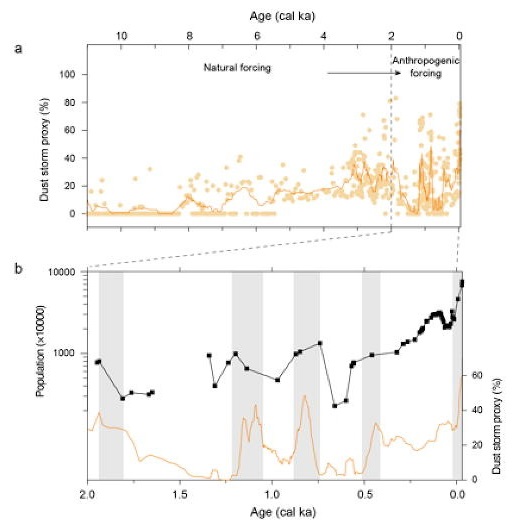
We reconstructed a high-resolution Holocene record of dust storms from the sediments of an undisturbed alpine lake on the Chinese Loess Plateau. We found that Asian dust storm activity generally increased during the Holocene, with the largest fluctuations occurring during the past 2000 years. The increase in dust storm activity was in contrast to the decrease in East Asian winter monsoon (EAWM) intensity during the Holocene, indicating that the EAWM played a limited role in modulating dust storms.
By contrast, the increase in dust storms corresponded to a decrease in East Asian summer monsoon (EASM) precipitation. This demonstrates that EASM precipitation was the dominant control of dust storm activity on a millennial timescale, because decreased EASM precipitation expanded the desert area and thus increased the dust storm activity.
The increasing intensity of human activity in the region since the Bronze Age resulted in an acceleration of dust storm activity against the background of decreased EASM precipitation. As human disturbance continued to intensify, beginning at least at ∼2 cal ka BP, increased dust storms were closely linked to increasing human populations in the dust source regions, and there is a strong temporal coherence between increased dust storms and higher EASM precipitation.
This was completely different from when natural processes are dominant. During that period, fewer dust storms occurred during periods of a strengthened EASM. Therefore, there was a shift from a natural forcing to an anthropogenic forcing of dust storms on a multi-decadal to centennial timescale, and was a mode in which "human activity overtook the EASM as the dominant control of the Earth surface system".
Ultrafast all-optical modulation of wide-bandwidth pulses enabled by silicon-metasurfaces
Kaloyan Georgiev, Khosro Zangeneh Kamali, Anton A. Trifonov, Giulia Crotti, Lyuben Petrov, Stefan Georgiev, Hristo Iliev, Lei Xu, Unai Arregui Leon, Mohsen Rahmani, Giuseppe Della Valle, Ivan Buchvarov, Dragomir Neshev
Opto-Electronic Advances
2026-09-15
Physics-informed neural fields enable blind aberration correction for partially coherent quantitative phase imaging
Shun Zhou, Xingyu Huang, Linpeng Lu, Habib Ullah, Kaiyu Du, Maciej Trusiak, Malgorzata Kujawinska, Yuzhen Zhang, Yao Fan, Qian Chen, Qinrong Zhang, Chao Zuo
Opto-Electronic Science
2026-08-26
Heterogeneously integrated micro-ring with SnS₂ for dual-functional optical modulation and photodetection
Jinyi Du, Lidan Lu, Xu Zhang, Bofei Zhu, Wenbo Bo, Yingjie Xu, Guang Chen, Yanlin He, Guanghui Ren, Xiaoping Lou, Zheng You, Lianqing Zhu
Opto-Electronic Advances
2026-08-25
Hardware-aware lightweight photonic spiking neural network for pattern classification
Shuiying Xiang, Yahui Zhang, Shangxuan Shi, Haowen Zhao, Dianzhuang Zheng, Xingxing Guo, Yanan Han, Ye Tian, Liyue Zhang, Yuechun Shi, Yue Hao
Opto-Electronic Advances
2026-08-25
PhyspeNet: An empirical physics-aware network for adaptive speckle reconstructive spectrometry
Junrui Liang, Min Jiang, Jun Li, Zhongming Huang, Junhong He, Yanting Guo, Yanzhao Ke, Jun Ye, Jiangming Xu, Jinyong Leng, Pu Zhou
Opto-Electronic Advances
2026-08-25
A 36 × 240 Gbps hybrid mode/wavelength division multiplexing transmitter using lithium niobate on insulator
Mingyu Zhu, Weihan Wang, Ruitao Ma, Aoyun Gao, Chun Gao, Zexu Wang, Fei Huang, Zhenyuan Bao, Dajian Liu, Jiaxuan Gan, Zejie Yu, Huan Li, Weike Zhao, Daoxin Dai
Opto-Electronic Advances
2026-08-25