(Peer-Reviewed) Exploring the pharmacological mechanism of danhe granules against hyperlipidemia by means of network pharmacology and verified by preliminary experiments
Zhi-Qing Zhang 张志清 ¹, Ai-Ping Chen ¹, Tong Yu 于彤 ¹, Shuang-Jie Yang 杨双杰 ¹, De-Shuai Yu 俞德帅 ², Ran Yang 杨然 ³, Xin-Lou Chai 柴欣楼 ¹
¹ School of Traditional Chinese Medicine, Beijing University of Chinese Medicine, Beijing, China
中国 北京 北京中医药大学中医学院
² Dongzhimen Hospital, Beijing University of Chinese Medicine, Beijing, China
中国 北京 北京中医药大学东直门医院
³ Department of Cardiology, Guang'anmen Hospital, China Academy of Chinese Medical Sciences, Beijing, China
中国 北京 中国中医科学院广安门医院 心血管内科
Objective
This study explored the multicomponent, multitarget, and multipathway mechanism of Danhe granules (DG) against hyperlipidemia through network pharmacology. The relevant targets and pathways were verified by preliminary experiments.
Methods
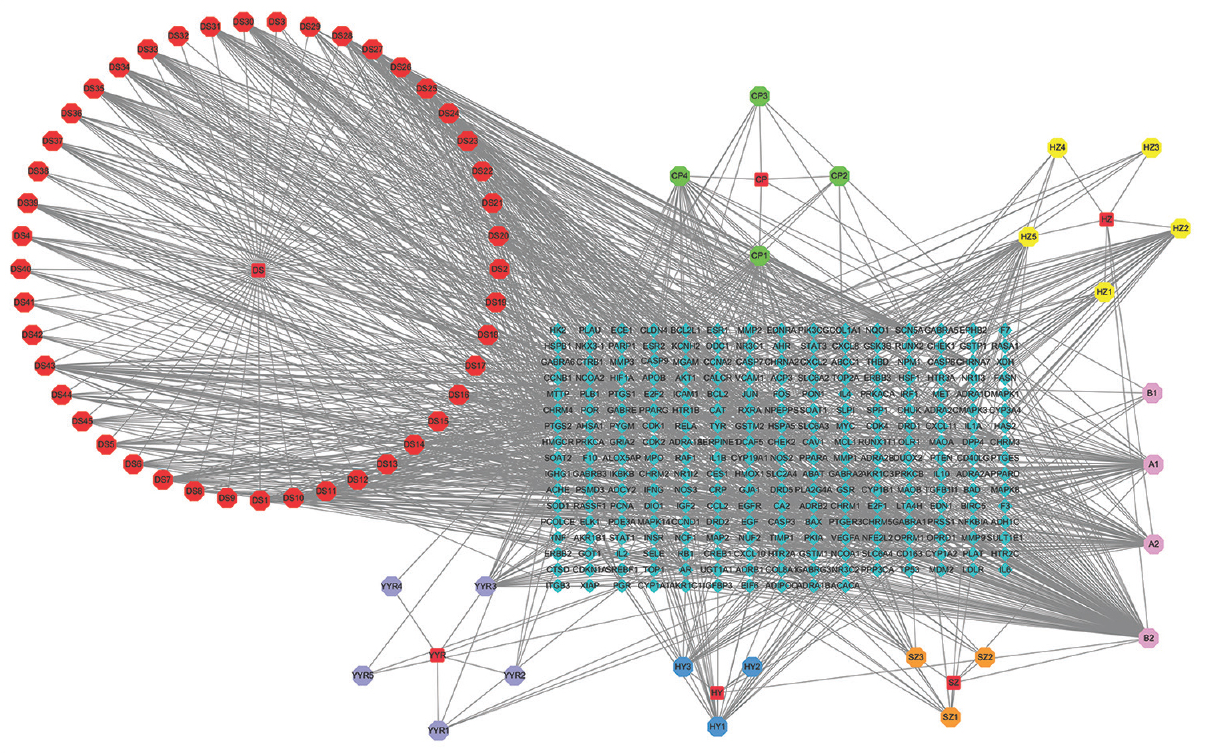
The active components of DG were selected by TCMSP and TCMIP database, and the component-target network diagram was constructed by Cytoscape 3.7.1. The protein–protein interaction network of targets was constructed and core targets were screened out by STRING11.0 database. Metascape database and Cytoscape 3.7.1 were used to enrich the target and establish a hyperlipidemia model in Sprague-Dawley (SD) rats to detect blood lipid and oxidative stress indexes and observed pathological changes of aorta by H and E staining.
Results
The results showed that a total of seven active components of DG were screened out, including quercetin, sitosterol, luteolin, kaempferol, etc. There were 127 corresponding targets, including AKT1, tumor necrosis factor, TP53, interleukin-6, RELA, vascular endothelial growth factor, superoxide dismutases, and catalase. It is mainly involved in biological processes such as drug response, regulation of apoptosis, redox reaction, and lipid reaction. There were 573 signal pathways corresponding to the target, including HIF-1 signal pathway, TNF signal pathway, VEGF signal pathway, nonalcoholic fatty liver disease, etc. The experiment verified that DG can reduce the blood lipid of SD rats by regulating the process of oxidative stress.
Conclusions
This study made a preliminary study on the pharmacological mechanism of DG against hyperlipidemia and laid the foundation for the research and development of new drugs and subsequent in-depth research.
Ultrafast all-optical modulation of wide-bandwidth pulses enabled by silicon-metasurfaces
Kaloyan Georgiev, Khosro Zangeneh Kamali, Anton A. Trifonov, Giulia Crotti, Lyuben Petrov, Stefan Georgiev, Hristo Iliev, Lei Xu, Unai Arregui Leon, Mohsen Rahmani, Giuseppe Della Valle, Ivan Buchvarov, Dragomir Neshev
Opto-Electronic Advances
2026-09-15
Physics-informed neural fields enable blind aberration correction for partially coherent quantitative phase imaging
Shun Zhou, Xingyu Huang, Linpeng Lu, Habib Ullah, Kaiyu Du, Maciej Trusiak, Malgorzata Kujawinska, Yuzhen Zhang, Yao Fan, Qian Chen, Qinrong Zhang, Chao Zuo
Opto-Electronic Science
2026-08-26
Heterogeneously integrated micro-ring with SnS₂ for dual-functional optical modulation and photodetection
Jinyi Du, Lidan Lu, Xu Zhang, Bofei Zhu, Wenbo Bo, Yingjie Xu, Guang Chen, Yanlin He, Guanghui Ren, Xiaoping Lou, Zheng You, Lianqing Zhu
Opto-Electronic Advances
2026-08-25
Hardware-aware lightweight photonic spiking neural network for pattern classification
Shuiying Xiang, Yahui Zhang, Shangxuan Shi, Haowen Zhao, Dianzhuang Zheng, Xingxing Guo, Yanan Han, Ye Tian, Liyue Zhang, Yuechun Shi, Yue Hao
Opto-Electronic Advances
2026-08-25
PhyspeNet: An empirical physics-aware network for adaptive speckle reconstructive spectrometry
Junrui Liang, Min Jiang, Jun Li, Zhongming Huang, Junhong He, Yanting Guo, Yanzhao Ke, Jun Ye, Jiangming Xu, Jinyong Leng, Pu Zhou
Opto-Electronic Advances
2026-08-25
A 36 × 240 Gbps hybrid mode/wavelength division multiplexing transmitter using lithium niobate on insulator
Mingyu Zhu, Weihan Wang, Ruitao Ma, Aoyun Gao, Chun Gao, Zexu Wang, Fei Huang, Zhenyuan Bao, Dajian Liu, Jiaxuan Gan, Zejie Yu, Huan Li, Weike Zhao, Daoxin Dai
Opto-Electronic Advances
2026-08-25