(Peer-Reviewed) Essential role of MALAT1 in reducing traumatic brain injury
Na Wu ¹, Chong-Jie Cheng 程崇杰 ¹, Jian-Jun Zhong 钟建军 ¹, Jun-Chi He 何骏驰 ¹, Zhao-Si Zhang 张兆斯 ¹, Zhi-Gang Wang ¹, Xiao-Chuan Sun 孙晓川 ¹, Han Liu 刘汉 ¹ ²
¹ Department of Neurosurgery, The First Affiliated Hospital of Chongqing Medical University, Chongqing, China
中国 重庆 重庆医科大学附属第一医院神经外科
² Department of Neurosurgery, Qilu Hospital of Shandong University (Qingdao Campus), Qingdao, Shandong Province, China
中国 山东 青岛 山东大学齐鲁医院(青岛)神经外科
Abstract
As a highly evolutionary conserved long non-coding RNA, metastasis associated lung adenocarcinoma transcript 1 (MALAT1) was first demonstrated to be related to lung tumor metastasis by promoting angiogenesis. To investigate the role of MALAT1 in traumatic brain injury, we established mouse models of controlled cortical impact and cell models of oxygen-glucose deprivation to mimic traumatic brain injury in vitro and in vivo.
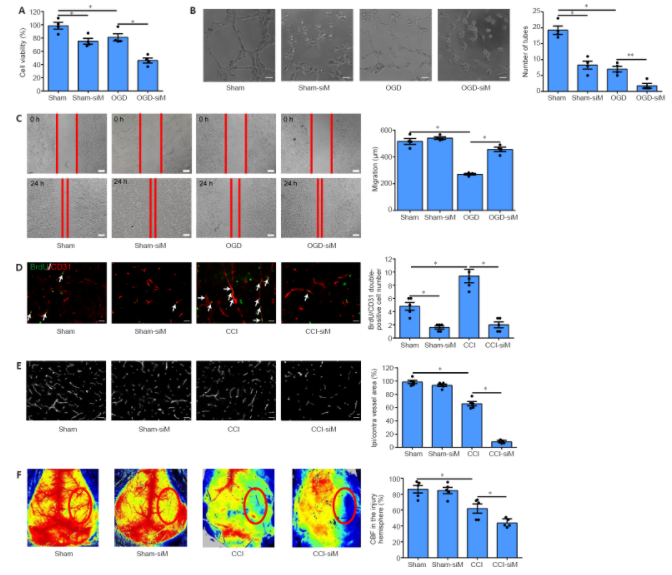
The results revealed that MALAT1 silencing in vitro inhibited endothelial cell viability and tube formation but increased migration. In MALAT1-deficient mice, endothelial cell proliferation in the injured cortex, functional vessel density and cerebral blood flow were reduced. Bioinformatic analyses and RNA pull-down assays validated enhancer of zeste homolog 2 (EZH2) as a downstream factor of MALAT1 in endothelial cells.
Jagged-1, the Notch homolog 1 (NOTCH1) agonist, reversed the MALAT1 deficiency-mediated impairment of angiogenesis. Taken together, our results suggest that MALAT1 controls the key processes of angiogenesis following traumatic brain injury in an EZH2/NOTCH1-dependent manner.
Ultrafast all-optical modulation of wide-bandwidth pulses enabled by silicon-metasurfaces
Kaloyan Georgiev, Khosro Zangeneh Kamali, Anton A. Trifonov, Giulia Crotti, Lyuben Petrov, Stefan Georgiev, Hristo Iliev, Lei Xu, Unai Arregui Leon, Mohsen Rahmani, Giuseppe Della Valle, Ivan Buchvarov, Dragomir Neshev
Opto-Electronic Advances
2026-09-15
Physics-informed neural fields enable blind aberration correction for partially coherent quantitative phase imaging
Shun Zhou, Xingyu Huang, Linpeng Lu, Habib Ullah, Kaiyu Du, Maciej Trusiak, Malgorzata Kujawinska, Yuzhen Zhang, Yao Fan, Qian Chen, Qinrong Zhang, Chao Zuo
Opto-Electronic Science
2026-08-26
Heterogeneously integrated micro-ring with SnS₂ for dual-functional optical modulation and photodetection
Jinyi Du, Lidan Lu, Xu Zhang, Bofei Zhu, Wenbo Bo, Yingjie Xu, Guang Chen, Yanlin He, Guanghui Ren, Xiaoping Lou, Zheng You, Lianqing Zhu
Opto-Electronic Advances
2026-08-25
Hardware-aware lightweight photonic spiking neural network for pattern classification
Shuiying Xiang, Yahui Zhang, Shangxuan Shi, Haowen Zhao, Dianzhuang Zheng, Xingxing Guo, Yanan Han, Ye Tian, Liyue Zhang, Yuechun Shi, Yue Hao
Opto-Electronic Advances
2026-08-25
PhyspeNet: An empirical physics-aware network for adaptive speckle reconstructive spectrometry
Junrui Liang, Min Jiang, Jun Li, Zhongming Huang, Junhong He, Yanting Guo, Yanzhao Ke, Jun Ye, Jiangming Xu, Jinyong Leng, Pu Zhou
Opto-Electronic Advances
2026-08-25
A 36 × 240 Gbps hybrid mode/wavelength division multiplexing transmitter using lithium niobate on insulator
Mingyu Zhu, Weihan Wang, Ruitao Ma, Aoyun Gao, Chun Gao, Zexu Wang, Fei Huang, Zhenyuan Bao, Dajian Liu, Jiaxuan Gan, Zejie Yu, Huan Li, Weike Zhao, Daoxin Dai
Opto-Electronic Advances
2026-08-25