(Peer-Reviewed) Experimental investigation of migration and solidification of molten salt leaking through tank cracks
Hua Shi, Hao Zhou 周昊, Peng-nan Ma 马鹏楠, Jian-kang Wang, Hao Fang, Jia-wei Luo, Kun-zan Qiu 邱坤赞
State Key Laboratory of Clean Energy Utilization, Institute for Thermal Power Engineering, Zhejiang University, Hangzhou 310027, China
中国 浙江 杭州 浙江大学热能工程研究所 能源清洁利用国家重点实验室
Abstract
Molten salt is often used for heat transfer and thermal energy storage in concentrated solar power. molten salt leakage and migration is a significant issue in its application. molten salt migration and solidification in thermal porous foundation materials through cracks are experimentally investigated.
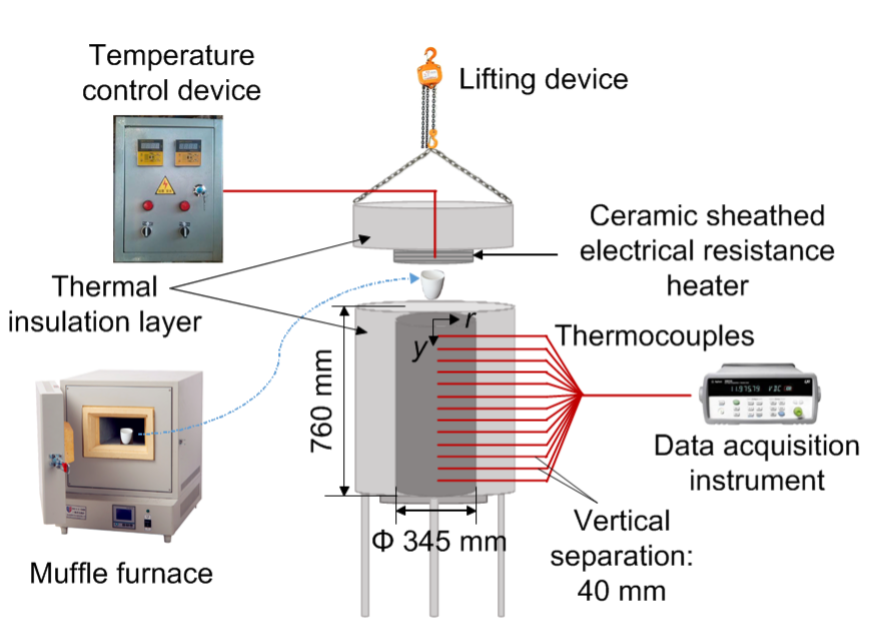
The impact of factors, including crack length and width, operation temperature, and leakage mass of molten salt, are studied through an experimental device modeling the leakage of the actual molten salt storage tank. Experimental results show that the crack width and length slightly affect the migration depth, but directly affect the shape of the agglomeration of solidified salt and porous foundation material.
The most important factor affecting the migration depth of molten salt leaking through cracks is the tank operating temperature. The molten salt migration depth when the operating temperature is 500 °C is 95.8% higher than that with an operating temperature of 300 °C. As the leakage molten salt mass reached 400 g, the average migration width increased by 23.6%, but the migration depth only increased by 5.2%. It is found that the foundation material temperatures after leakage accidents increase with an increase in the mass of leaked molten salt.
Ultrafast all-optical modulation of wide-bandwidth pulses enabled by silicon-metasurfaces
Kaloyan Georgiev, Khosro Zangeneh Kamali, Anton A. Trifonov, Giulia Crotti, Lyuben Petrov, Stefan Georgiev, Hristo Iliev, Lei Xu, Unai Arregui Leon, Mohsen Rahmani, Giuseppe Della Valle, Ivan Buchvarov, Dragomir Neshev
Opto-Electronic Advances
2026-09-15
Physics-informed neural fields enable blind aberration correction for partially coherent quantitative phase imaging
Shun Zhou, Xingyu Huang, Linpeng Lu, Habib Ullah, Kaiyu Du, Maciej Trusiak, Malgorzata Kujawinska, Yuzhen Zhang, Yao Fan, Qian Chen, Qinrong Zhang, Chao Zuo
Opto-Electronic Science
2026-08-26
Heterogeneously integrated micro-ring with SnS₂ for dual-functional optical modulation and photodetection
Jinyi Du, Lidan Lu, Xu Zhang, Bofei Zhu, Wenbo Bo, Yingjie Xu, Guang Chen, Yanlin He, Guanghui Ren, Xiaoping Lou, Zheng You, Lianqing Zhu
Opto-Electronic Advances
2026-08-25
Hardware-aware lightweight photonic spiking neural network for pattern classification
Shuiying Xiang, Yahui Zhang, Shangxuan Shi, Haowen Zhao, Dianzhuang Zheng, Xingxing Guo, Yanan Han, Ye Tian, Liyue Zhang, Yuechun Shi, Yue Hao
Opto-Electronic Advances
2026-08-25
PhyspeNet: An empirical physics-aware network for adaptive speckle reconstructive spectrometry
Junrui Liang, Min Jiang, Jun Li, Zhongming Huang, Junhong He, Yanting Guo, Yanzhao Ke, Jun Ye, Jiangming Xu, Jinyong Leng, Pu Zhou
Opto-Electronic Advances
2026-08-25
A 36 × 240 Gbps hybrid mode/wavelength division multiplexing transmitter using lithium niobate on insulator
Mingyu Zhu, Weihan Wang, Ruitao Ma, Aoyun Gao, Chun Gao, Zexu Wang, Fei Huang, Zhenyuan Bao, Dajian Liu, Jiaxuan Gan, Zejie Yu, Huan Li, Weike Zhao, Daoxin Dai
Opto-Electronic Advances
2026-08-25