(Peer-Reviewed) Multiphysics optimization framework for high-power fiber amplifiers
Wei Liu 刘伟 ¹ ² ³, Zan Cheng 程赞 ¹, Pengfei Ma 马鹏飞 ¹ ² ³, Yisha Chen 陈益沙 ¹ ² ³, Huan Yang 杨欢 ¹ ² ³, Zhiyong Pan 潘志勇 ¹ ² ³, Zefeng Wang 王泽锋 ¹ ² ³, Jinbao Chen 陈金宝 ¹ ² ³
¹ College of Advanced Interdisciplinary Studies, National University of Defense Technology, Changsha 410073, China
中国 长沙 国防科技大学前沿交叉学科学院
² Nanhu Laser Laboratory, National University of Defense Technology, Changsha 410073, China
中国 长沙 国防科技大学南湖之光实验室
³ Hunan Provincial Key Laboratory of High Energy Laser Technology, National University of Defense Technology, Changsha 410073, China
中国 长沙 国防科技大学高能激光技术湖南省重点实验室
Opto-Electronic Science
, 2026-09-20
Abstract
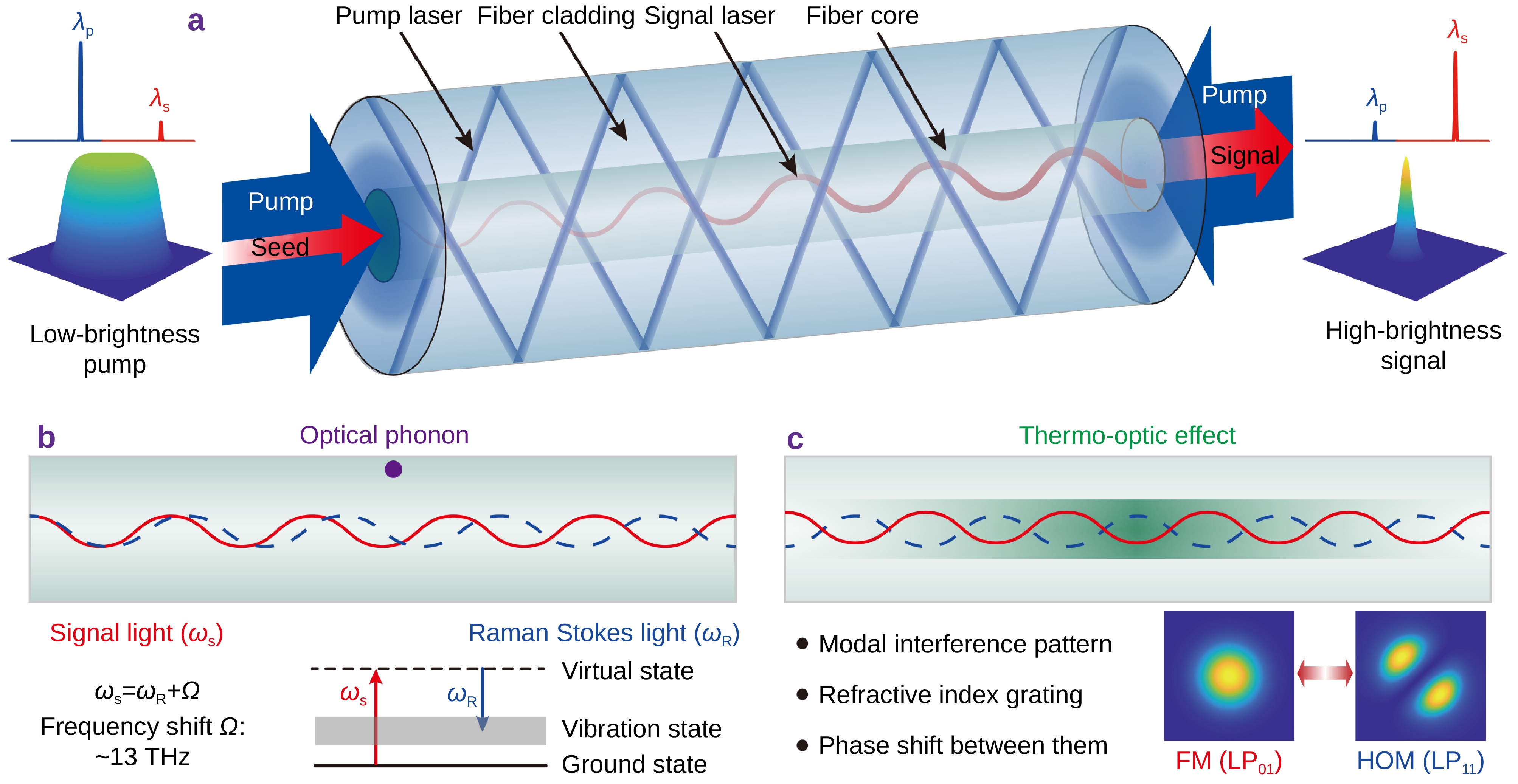
The interplay of nonlinear and thermal dynamics fundamentally constrains the power scalability of fiber lasers. Conventional development cycles rely on heuristic iterations between modeling and experiment, inevitably leading to extensive resource consumption and suboptimal architectures. In this work, we demonstrate a predictive in silico design paradigm for high-power fiber amplifiers by integrating a coupled multiphysics model with a physics-informed, surrogate-assisted optimization algorithm.
This framework enables the efficient co-optimization of macroscopic configurations and internal waveguide parameters, thereby directly identifying the system-level optimum under rigorous physical constraints. Computationally directed by this method, we designed an optimal gain fiber featuring a numerical aperture of 0.0585 and a centrally depressed refractive index profile. Upon physical fabrication and integration into a 0.5-nm-linewidth setup, the amplifier delivered an output power of 7.68 kW with high optical-to-optical efficiency (84%) and excellent beam quality (M2<1.5), setting a new power record for sub-nanometer-linewidth fiber lasers.
This generalizable framework paves the way to unlock previously inaccessible performance regimes in high-power lasers and accelerate the realization of fully functional digital twins for next-generation photonic systems.
Ultrafast all-optical modulation of wide-bandwidth pulses enabled by silicon-metasurfaces
Kaloyan Georgiev, Khosro Zangeneh Kamali, Anton A. Trifonov, Giulia Crotti, Lyuben Petrov, Stefan Georgiev, Hristo Iliev, Lei Xu, Unai Arregui Leon, Mohsen Rahmani, Giuseppe Della Valle, Ivan Buchvarov, Dragomir Neshev
Opto-Electronic Advances
2026-09-15
Physics-informed neural fields enable blind aberration correction for partially coherent quantitative phase imaging
Shun Zhou, Xingyu Huang, Linpeng Lu, Habib Ullah, Kaiyu Du, Maciej Trusiak, Malgorzata Kujawinska, Yuzhen Zhang, Yao Fan, Qian Chen, Qinrong Zhang, Chao Zuo
Opto-Electronic Science
2026-08-26
Heterogeneously integrated micro-ring with SnS₂ for dual-functional optical modulation and photodetection
Jinyi Du, Lidan Lu, Xu Zhang, Bofei Zhu, Wenbo Bo, Yingjie Xu, Guang Chen, Yanlin He, Guanghui Ren, Xiaoping Lou, Zheng You, Lianqing Zhu
Opto-Electronic Advances
2026-08-25
Hardware-aware lightweight photonic spiking neural network for pattern classification
Shuiying Xiang, Yahui Zhang, Shangxuan Shi, Haowen Zhao, Dianzhuang Zheng, Xingxing Guo, Yanan Han, Ye Tian, Liyue Zhang, Yuechun Shi, Yue Hao
Opto-Electronic Advances
2026-08-25
PhyspeNet: An empirical physics-aware network for adaptive speckle reconstructive spectrometry
Junrui Liang, Min Jiang, Jun Li, Zhongming Huang, Junhong He, Yanting Guo, Yanzhao Ke, Jun Ye, Jiangming Xu, Jinyong Leng, Pu Zhou
Opto-Electronic Advances
2026-08-25
A 36 × 240 Gbps hybrid mode/wavelength division multiplexing transmitter using lithium niobate on insulator
Mingyu Zhu, Weihan Wang, Ruitao Ma, Aoyun Gao, Chun Gao, Zexu Wang, Fei Huang, Zhenyuan Bao, Dajian Liu, Jiaxuan Gan, Zejie Yu, Huan Li, Weike Zhao, Daoxin Dai
Opto-Electronic Advances
2026-08-25