(Peer-Reviewed) 3D-printed copper water cooling system assisted fabrication of 10.6-μm high-power CO₂ laser resistance reflectors
Hongfei Jiao 焦宏飞 ¹ ² ³, Binbin Jiang 姜斌斌 ¹ ² ³, Xinshang Niu 钮信尚 ¹ ² ³, Yifan Wang 王一凡 ¹ ² ³, Dongdong Li 李冬冬 ¹ ² ³, Jun Yu 余俊 ¹ ² ³, Xiaochuan Ji 汲小川 ¹ ² ³, Jingjing Xia 夏菁菁 ¹ ² ³, Jinlong Zhang 张锦龙 ¹ ² ³, Xinbin Cheng 程鑫彬 ¹ ² ³, Zhanshan Wang 王占山 ¹ ² ³
¹ MOE Key Laboratory of Advanced Micro-Structured Materials, Tongji University, Shanghai 200092, China
中国 上海 同济大学先进微结构材料教育部重点实验室
² Institute of Precision Optical Engineering, School of Physics Science and Engineering, Tongji University, Shanghai 200092, China
中国 上海 同济大学精密光学工程技术研究所
³ Shanghai Professional Technical Service Platform for Full-Spectrum and High-Performance Optical Thin Film Devices and Applications, Shanghai 200092, China
中国 上海 上海市全光谱高性能光学薄膜器件及应用专业技术服务平台
Opto-Electronic Advances
, 2026-09-15
Abstract
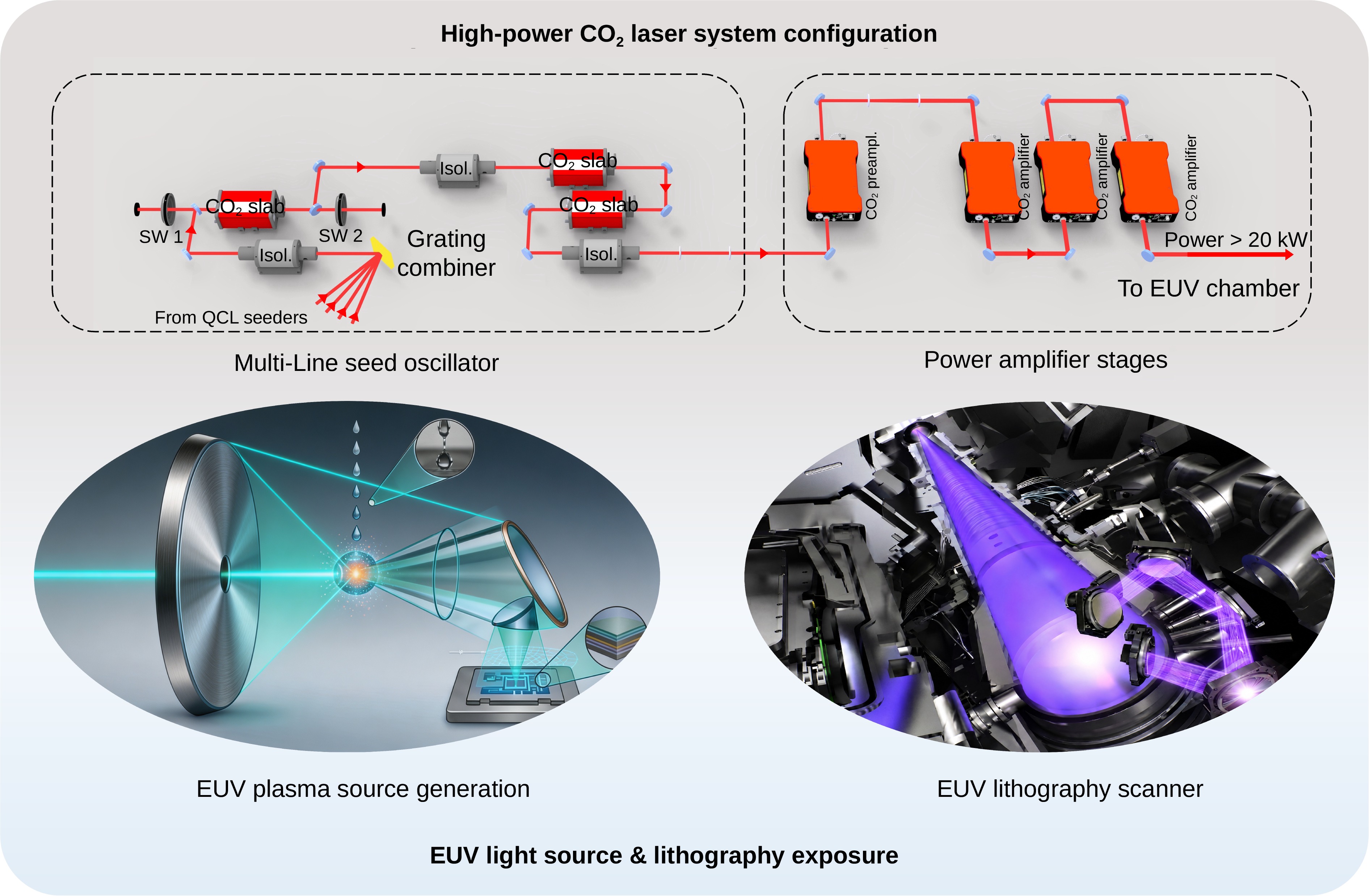
The rapid advance of high-power CO₂ laser systems is urgently calling the innovation of laser beam reflectors with a high laser-induced damage threshold (LIDT) above 10000 W/cm² for their stable operation in extreme conditions. In this work, we integrated a 3D-printed copper water-cooling system (laser powder bed fusion fabricated) with a multilayer coating technique to promote the LIDT of 10.6 μm reflectors, surface modification using electron beam evaporation ion beam assisted deposition (IAD) of Cu films, and 10.6 μm reflective films of 3251 nm in thickness (800 nm-Ge/699 nm-ZnS/779 nm-Ge/863 nm-ZnS/100 nm-Au/10 nm-Cr).
After integration of a water-cooling system, the surface temperature upon of 5093 W/cm² drops 53% (45.00 °C vs. 84.20 °C) and the LIDT increased by 60% (8488 ± 127 to 13581 ± 203 W/cm2), demonstrating a performance enhancement while reflectance of >99.50% at 45°. Cu-modified layer’s high thermal conductivity (401 W/(m·K)) suppresses thermal accumulation, thermal deformation peak-to-valley falls from 12292 nm (1.16 λ) to 3082 nm (0.29 λ). While keeping the reflective multi-layer and just changing of the 1st-layer coating, Cu-modified layer is found to exhibit superior thermal dissipation properties over Ni-modified layer.
This work is instructive regarding for realizing better thermal control of reflectors for high-power laser-containing high-end equipment such as EUV lithography.
Ultrafast all-optical modulation of wide-bandwidth pulses enabled by silicon-metasurfaces
Kaloyan Georgiev, Khosro Zangeneh Kamali, Anton A. Trifonov, Giulia Crotti, Lyuben Petrov, Stefan Georgiev, Hristo Iliev, Lei Xu, Unai Arregui Leon, Mohsen Rahmani, Giuseppe Della Valle, Ivan Buchvarov, Dragomir Neshev
Opto-Electronic Advances
2026-09-15
Physics-informed neural fields enable blind aberration correction for partially coherent quantitative phase imaging
Shun Zhou, Xingyu Huang, Linpeng Lu, Habib Ullah, Kaiyu Du, Maciej Trusiak, Malgorzata Kujawinska, Yuzhen Zhang, Yao Fan, Qian Chen, Qinrong Zhang, Chao Zuo
Opto-Electronic Science
2026-08-26
Heterogeneously integrated micro-ring with SnS₂ for dual-functional optical modulation and photodetection
Jinyi Du, Lidan Lu, Xu Zhang, Bofei Zhu, Wenbo Bo, Yingjie Xu, Guang Chen, Yanlin He, Guanghui Ren, Xiaoping Lou, Zheng You, Lianqing Zhu
Opto-Electronic Advances
2026-08-25
Hardware-aware lightweight photonic spiking neural network for pattern classification
Shuiying Xiang, Yahui Zhang, Shangxuan Shi, Haowen Zhao, Dianzhuang Zheng, Xingxing Guo, Yanan Han, Ye Tian, Liyue Zhang, Yuechun Shi, Yue Hao
Opto-Electronic Advances
2026-08-25
PhyspeNet: An empirical physics-aware network for adaptive speckle reconstructive spectrometry
Junrui Liang, Min Jiang, Jun Li, Zhongming Huang, Junhong He, Yanting Guo, Yanzhao Ke, Jun Ye, Jiangming Xu, Jinyong Leng, Pu Zhou
Opto-Electronic Advances
2026-08-25
A 36 × 240 Gbps hybrid mode/wavelength division multiplexing transmitter using lithium niobate on insulator
Mingyu Zhu, Weihan Wang, Ruitao Ma, Aoyun Gao, Chun Gao, Zexu Wang, Fei Huang, Zhenyuan Bao, Dajian Liu, Jiaxuan Gan, Zejie Yu, Huan Li, Weike Zhao, Daoxin Dai
Opto-Electronic Advances
2026-08-25