(Peer-Reviewed) Factors Defining the Development of Severe Illness in Patients with COVID-19: A Retrospective Study
XIONG Yi Bai 熊一白 ¹, TIAN Ya Xin 田亚欣 ¹, MA Yan 马艳 ¹, YANG Wei 杨伟 ¹, LIU Bin 刘斌 ¹, RUAN Lian Guo 阮连国 ², LU Cheng 吕诚 ¹, HUANG Lu Qi 黄璐琦 ³
¹ Institute of Basic Research in Clinical Medicine, China Academy of Chinese Medical Sciences, Beijing 100700, China
中国 北京 中国中医科学院中医临床基础医学研究所
² Department of Infectious Diseases, JinYinTan Hospital, Wuhan 430024, Hubei, China
中国 湖北 武汉 金银潭医院感染性疾病科
³ National Resource Center for Chinese Materia Medica, China Academy of Chinese Medical Sciences, Beijing 100700, China
中国 北京 中国中医科学院中药资源中心
Objective
Early triage of patients with coronavirus disease 2019 (COVID-19) is pivotal in managing the disease. However, studies on the clinical risk score system of the risk factors for the development of severe disease are limited. Hence, we conducted a clinical risk score system for severe illness, which might optimize appropriate treatment strategies.
Methods
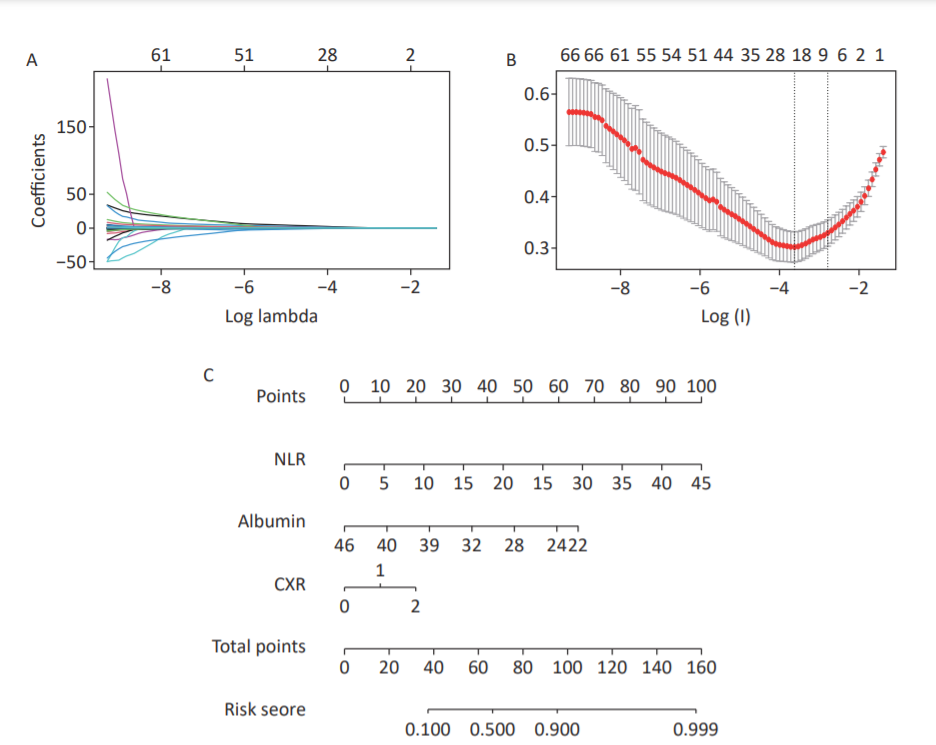
We conducted a retrospective, single-center study at the JinYinTan Hospital from January 24, 2020 to March 31, 2020. We evaluated the demographic, clinical, and laboratory data and performed a 10-fold cross-validation to split the data into a training set and validation set. We then screened the prognostic factors for severe illness using the least absolute shrinkage and selection operator (LASSO) and logistic regression, and finally conducted a risk score to estimate the probability of severe illness in the training set. Data from the validation set were used to validate the score.
Results
A total of 295 patients were included. From 49 potential risk factors, 3 variables were measured as the risk score: neutrophil to lymphocyte ratio (OR, 1.27; 95% CI, 1.15–1.39), albumin (OR, 0.76; 95% CI, 0.70–0.83), and chest computed tomography abnormalities (OR, 2.01; 95% CI, 1.41–2.86) and the AUC of the validation cohort was 0.822 (95% CI, 0.7667–0.8776).
Conclusion
This report may help define the potential of developing severe illness in patients with COVID-19 at an early stage, which might be related to the neutrophil to lymphocyte ratio, albumin, and chest computed tomography abnormalities.
Ultrafast all-optical modulation of wide-bandwidth pulses enabled by silicon-metasurfaces
Kaloyan Georgiev, Khosro Zangeneh Kamali, Anton A. Trifonov, Giulia Crotti, Lyuben Petrov, Stefan Georgiev, Hristo Iliev, Lei Xu, Unai Arregui Leon, Mohsen Rahmani, Giuseppe Della Valle, Ivan Buchvarov, Dragomir Neshev
Opto-Electronic Advances
2026-09-15
Physics-informed neural fields enable blind aberration correction for partially coherent quantitative phase imaging
Shun Zhou, Xingyu Huang, Linpeng Lu, Habib Ullah, Kaiyu Du, Maciej Trusiak, Malgorzata Kujawinska, Yuzhen Zhang, Yao Fan, Qian Chen, Qinrong Zhang, Chao Zuo
Opto-Electronic Science
2026-08-26
Heterogeneously integrated micro-ring with SnS₂ for dual-functional optical modulation and photodetection
Jinyi Du, Lidan Lu, Xu Zhang, Bofei Zhu, Wenbo Bo, Yingjie Xu, Guang Chen, Yanlin He, Guanghui Ren, Xiaoping Lou, Zheng You, Lianqing Zhu
Opto-Electronic Advances
2026-08-25
Hardware-aware lightweight photonic spiking neural network for pattern classification
Shuiying Xiang, Yahui Zhang, Shangxuan Shi, Haowen Zhao, Dianzhuang Zheng, Xingxing Guo, Yanan Han, Ye Tian, Liyue Zhang, Yuechun Shi, Yue Hao
Opto-Electronic Advances
2026-08-25
PhyspeNet: An empirical physics-aware network for adaptive speckle reconstructive spectrometry
Junrui Liang, Min Jiang, Jun Li, Zhongming Huang, Junhong He, Yanting Guo, Yanzhao Ke, Jun Ye, Jiangming Xu, Jinyong Leng, Pu Zhou
Opto-Electronic Advances
2026-08-25
A 36 × 240 Gbps hybrid mode/wavelength division multiplexing transmitter using lithium niobate on insulator
Mingyu Zhu, Weihan Wang, Ruitao Ma, Aoyun Gao, Chun Gao, Zexu Wang, Fei Huang, Zhenyuan Bao, Dajian Liu, Jiaxuan Gan, Zejie Yu, Huan Li, Weike Zhao, Daoxin Dai
Opto-Electronic Advances
2026-08-25