(Peer-Reviewed) Power grid fault diagnosis based on a deep pyramid convolutional neural network
Xu Zhang 张旭, Huiting Zhang 张慧婷, Dongying Zhang 张东英, Yixian Wang 王仪贤, Ruiting Ding 丁睿婷, Yuchuan Zheng 郑钰川, Yongxu Zhang 张永旭
School of Electrical & Electronic Engineering, North China Electric Power University, Beijing, 102206, China
中国 北京 华北电力大学电气与电子工程学院
Abstract
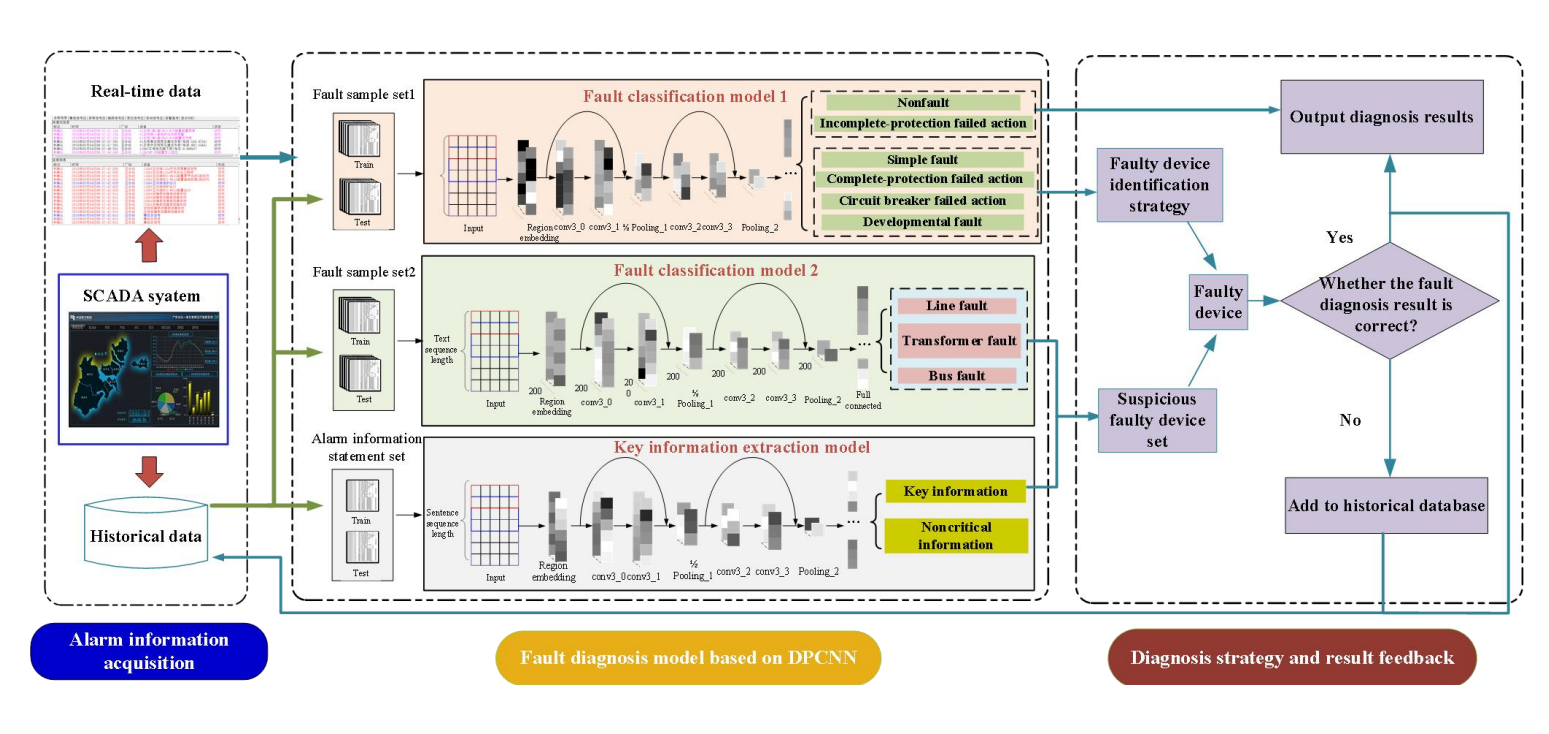
Existing power grid fault diagnosis methods rely on manual experience to design diagnosis models, lack the ability to extract fault knowledge, and are difficult to adapt to complex and changeable engineering sites. In this context, this paper proposes a power grid fault diagnosis method based on a deep pyramid convolutional neural network for the alarm information set.
This approach uses the deep feature extraction ability of the network to extract fault feature knowledge from alarm information texts and achieve end-to-end fault classification and fault device identification. First, a deep pyramid convolutional neural network model for extracting the overall characteristics of fault events is constructed to identify fault types. Second, a deep pyramidal convolutional neural network model for alarm information text is constructed, the text description characteristics associated with alarm information text are extracted, the key information corresponding to faults in the alarm information set is identified, and suspicious faulty devices are selected.
Then, a fault device identification strategy that integrates fault-type and time sequence priorities is proposed to identify faulty devices. Finally, the actual fault cases and the fault cases generated by simulation are studied, and the results verify the effectiveness and practicability of the method presented in this paper.
Ultrafast all-optical modulation of wide-bandwidth pulses enabled by silicon-metasurfaces
Kaloyan Georgiev, Khosro Zangeneh Kamali, Anton A. Trifonov, Giulia Crotti, Lyuben Petrov, Stefan Georgiev, Hristo Iliev, Lei Xu, Unai Arregui Leon, Mohsen Rahmani, Giuseppe Della Valle, Ivan Buchvarov, Dragomir Neshev
Opto-Electronic Advances
2026-09-15
Physics-informed neural fields enable blind aberration correction for partially coherent quantitative phase imaging
Shun Zhou, Xingyu Huang, Linpeng Lu, Habib Ullah, Kaiyu Du, Maciej Trusiak, Malgorzata Kujawinska, Yuzhen Zhang, Yao Fan, Qian Chen, Qinrong Zhang, Chao Zuo
Opto-Electronic Science
2026-08-26
Heterogeneously integrated micro-ring with SnS₂ for dual-functional optical modulation and photodetection
Jinyi Du, Lidan Lu, Xu Zhang, Bofei Zhu, Wenbo Bo, Yingjie Xu, Guang Chen, Yanlin He, Guanghui Ren, Xiaoping Lou, Zheng You, Lianqing Zhu
Opto-Electronic Advances
2026-08-25
Hardware-aware lightweight photonic spiking neural network for pattern classification
Shuiying Xiang, Yahui Zhang, Shangxuan Shi, Haowen Zhao, Dianzhuang Zheng, Xingxing Guo, Yanan Han, Ye Tian, Liyue Zhang, Yuechun Shi, Yue Hao
Opto-Electronic Advances
2026-08-25
PhyspeNet: An empirical physics-aware network for adaptive speckle reconstructive spectrometry
Junrui Liang, Min Jiang, Jun Li, Zhongming Huang, Junhong He, Yanting Guo, Yanzhao Ke, Jun Ye, Jiangming Xu, Jinyong Leng, Pu Zhou
Opto-Electronic Advances
2026-08-25
A 36 × 240 Gbps hybrid mode/wavelength division multiplexing transmitter using lithium niobate on insulator
Mingyu Zhu, Weihan Wang, Ruitao Ma, Aoyun Gao, Chun Gao, Zexu Wang, Fei Huang, Zhenyuan Bao, Dajian Liu, Jiaxuan Gan, Zejie Yu, Huan Li, Weike Zhao, Daoxin Dai
Opto-Electronic Advances
2026-08-25