(Peer-Reviewed) Deep-learning-based ciphertext-only attack on optical double random phase encryption
Meihua Liao 廖美华 ¹, Shanshan Zheng 郑珊珊 ² ³, Shuixin Pan ¹, Dajiang Lu 卢大江 ¹, Wenqi He 何文奇 ¹, Guohai Situ 司徒国海 ² ³ ⁴, Xiang Peng 彭翔 ¹
¹ Key Laboratory of Optoelectronic Devices and System of Ministry of Education and Guangdong Province, College of Physics and Optoelectronic Engineering, Shenzhen University, Shenzhen 518060, China
中国 深圳 深圳大学物理与光电工程学院 光电子器件与系统教育部/广东省重点实验室
² Shanghai Institute of Optics and Fine Mechanics, Chinese Academy of Sciences, Shanghai 201800, China
中国 上海 中国科学院上海光学精密机械研究所
³ Center of Materials Science and Optoelectronics Engineering, University of Chinese Academy of Sciences, Beijing 100049, China
中国 北京 中国科学院大学材料科学与光电技术学院
⁴ Hangzhou Institute for Advanced Study, University of Chinese Academy of Sciences, Hangzhou 310000, China
中国 杭州 中国科学院大学杭州高等研究院
Opto-Electronic Advances
, 2021-05-20
Abstract
Optical cryptanalysis is essential to the further investigation of more secure optical cryptosystems. Learning-based attack of optical encryption eliminates the need for the retrieval of random phase keys of optical encryption systems but it is limited for practical applications since it requires a large set of plaintext-ciphertext pairs for the cryptosystem to be attacked.
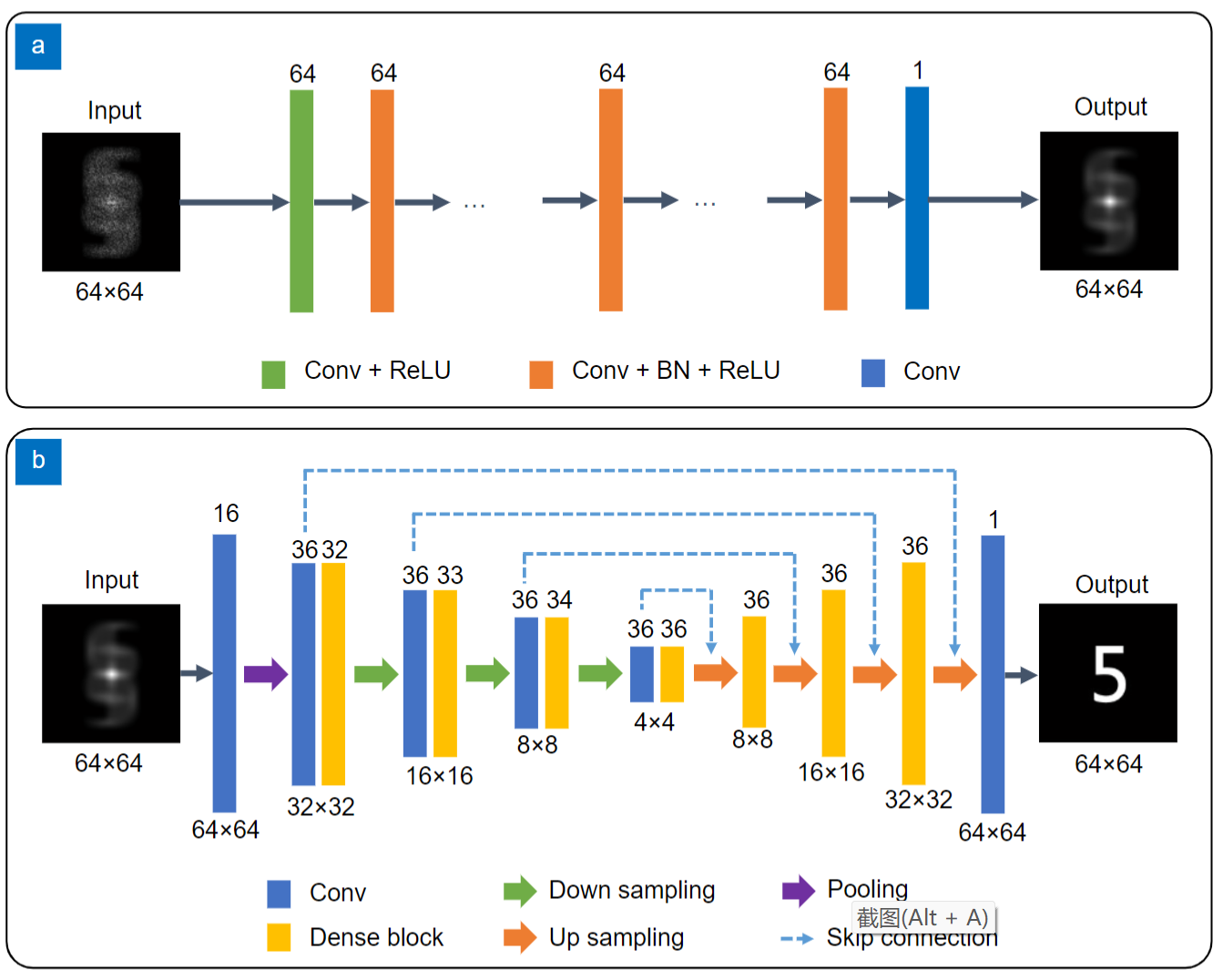
Here, we propose a two-step deep learning strategy for ciphertext-only attack (COA) on the classical double random phase encryption (DRPE). Specifically, we construct a virtual DRPE system to gather the training data. Besides, we divide the inverse problem in COA into two more specific inverse problems and employ two deep neural networks (DNNs) to respectively learn the removal of speckle noise in the autocorrelation domain and the de-correlation operation to retrieve the plaintext image.
With these two trained DNNs at hand, we show that the plaintext can be predicted in real-time from an unknown ciphertext alone. The proposed learning-based COA method dispenses with not only the retrieval of random phase keys but also the invasive data acquisition of plaintext-ciphertext pairs in the DPRE system. Numerical simulations and optical experiments demonstrate the feasibility and effectiveness of the proposed learning-based COA method.
Ultrafast all-optical modulation of wide-bandwidth pulses enabled by silicon-metasurfaces
Kaloyan Georgiev, Khosro Zangeneh Kamali, Anton A. Trifonov, Giulia Crotti, Lyuben Petrov, Stefan Georgiev, Hristo Iliev, Lei Xu, Unai Arregui Leon, Mohsen Rahmani, Giuseppe Della Valle, Ivan Buchvarov, Dragomir Neshev
Opto-Electronic Advances
2026-09-15
Physics-informed neural fields enable blind aberration correction for partially coherent quantitative phase imaging
Shun Zhou, Xingyu Huang, Linpeng Lu, Habib Ullah, Kaiyu Du, Maciej Trusiak, Malgorzata Kujawinska, Yuzhen Zhang, Yao Fan, Qian Chen, Qinrong Zhang, Chao Zuo
Opto-Electronic Science
2026-08-26
Heterogeneously integrated micro-ring with SnS₂ for dual-functional optical modulation and photodetection
Jinyi Du, Lidan Lu, Xu Zhang, Bofei Zhu, Wenbo Bo, Yingjie Xu, Guang Chen, Yanlin He, Guanghui Ren, Xiaoping Lou, Zheng You, Lianqing Zhu
Opto-Electronic Advances
2026-08-25
Hardware-aware lightweight photonic spiking neural network for pattern classification
Shuiying Xiang, Yahui Zhang, Shangxuan Shi, Haowen Zhao, Dianzhuang Zheng, Xingxing Guo, Yanan Han, Ye Tian, Liyue Zhang, Yuechun Shi, Yue Hao
Opto-Electronic Advances
2026-08-25
PhyspeNet: An empirical physics-aware network for adaptive speckle reconstructive spectrometry
Junrui Liang, Min Jiang, Jun Li, Zhongming Huang, Junhong He, Yanting Guo, Yanzhao Ke, Jun Ye, Jiangming Xu, Jinyong Leng, Pu Zhou
Opto-Electronic Advances
2026-08-25
A 36 × 240 Gbps hybrid mode/wavelength division multiplexing transmitter using lithium niobate on insulator
Mingyu Zhu, Weihan Wang, Ruitao Ma, Aoyun Gao, Chun Gao, Zexu Wang, Fei Huang, Zhenyuan Bao, Dajian Liu, Jiaxuan Gan, Zejie Yu, Huan Li, Weike Zhao, Daoxin Dai
Opto-Electronic Advances
2026-08-25