(Peer-Reviewed) Simvastatin Improves Outcomes of Endotoxin-induced Coagulopathy by Regulating Intestinal Microenvironment
Min Xu 徐敏 ¹, Li-li Luo 罗丽丽 ¹, Meng-yi Du 都孟仪 ¹, Lu Tang 唐露 ¹, Jie Zhou ¹, Yu Hu 胡豫 ¹ ² ³, Heng Mei 梅恒 ¹ ² ³
¹ Institute of Hematology, Union Hospital, Tongji Medical College, Huazhong University of Science and Technology, Wuhan, 430022, China
中国 武汉 华中科技大学同济医学院附属协和医院 血液病研究所
² Hubei Clinical and Research Center of Thrombosis and Hemostasis, Wuhan, 430022, China
中国 武汉 湖北省血栓与止血医学临床研究中心
³ Collaborative Innovation Center of Hematology, Huazhong University of Science and Technology, Wuhan, 430022, China
中国 武汉 华中科技大学血液学协同创新中心
Objective
The systemic inflammatory response is regarded as the major cause of endotoxin-induced coagulopathy, which is a strong predictor of mortality in patients with severe sepsis. Simvastatin plays an important role in reducing inflammation. In addition, the gut has long been hypothesized to be the “motor” of critical illness, driving or aggravating sepsis by the increased intestinal permeability and bacterial translocation. Whether simvastatin plays a role in severe endotoxin-induced coagulopathy through the gut is unclear.
Methods
In this study, mice were administered 20 mg/kg simvastatin by gavage for 2 weeks and then intraperitoneally injected with 50 mg/kg endotoxin. Twelve h later, cytokine release, coagulation dysfunction, organ damage, and survival were assessed. Besides, the intestinal barrier, permeability, bacteria abundance, and translocation were evaluated.
Results
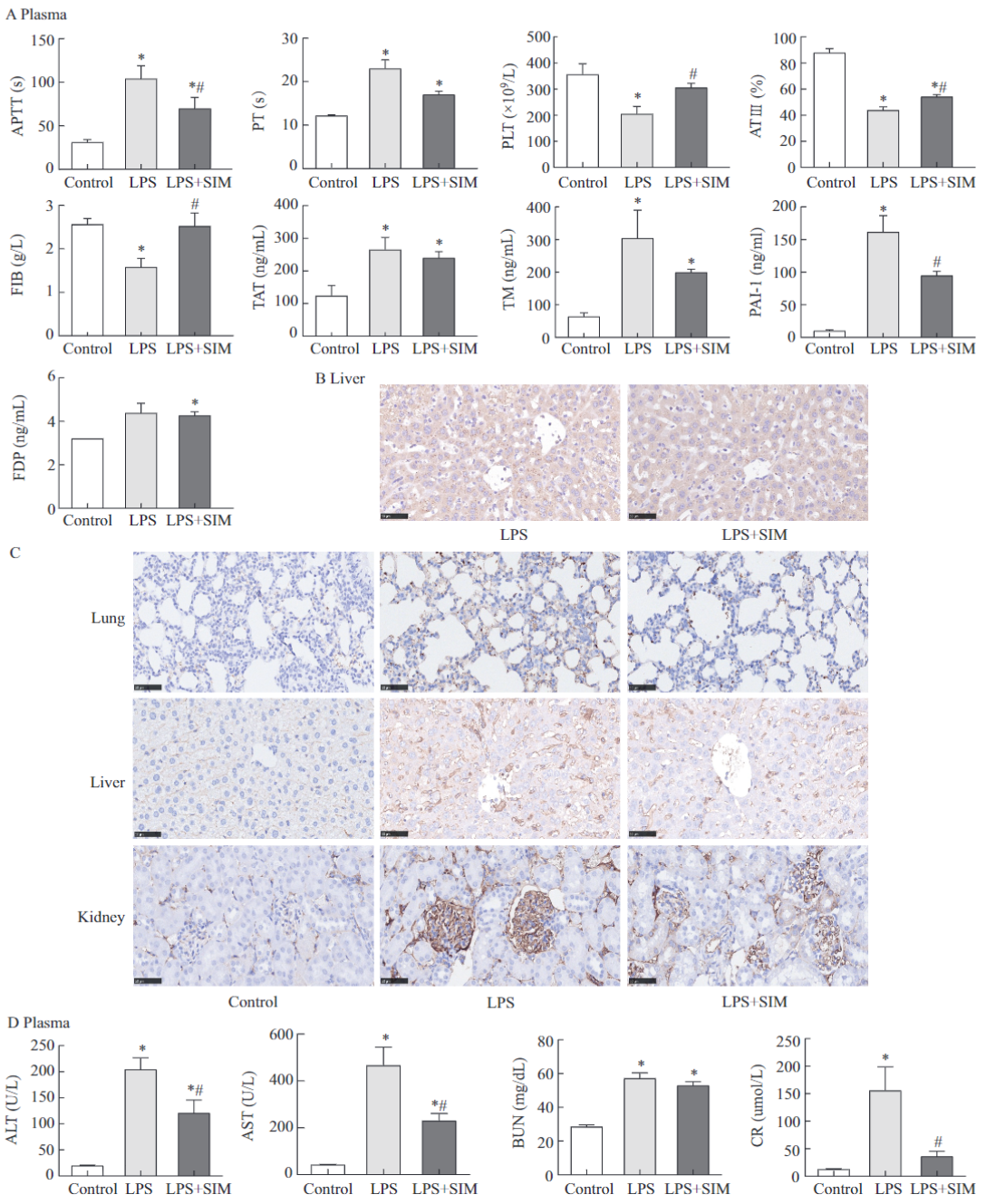
We found that the severity of endotoxin-induced coagulopathy was significantly improved in simvastatin-pretreated mice, who showed attenuated depletion of coagulation factors and platelets, decreased plasminogen activator inhibitor-1 (PAI-1) expression, reduced organ fibrin deposition, and improved survival time. Also, simvastatin reduced epithelial apoptosis and improved intestinal barrier function by upregulating antimicrobial peptides, lysozyme, and mucins. Simvastatin increased Lactobacillales counts, while the lipopolysaccharide group showed increased Desulfovibrio and Mucispirillum, which can produce harmful toxins. Finally, the decreased intestinal permeability in the simvastatin group caused reduced bacterial translocation in the organs and blood, both in terms of quantity and species.
Conclusion
Simvastatin improves the prognosis of severe endotoxemia, and the intestinal microenvironment participates in this process.
Ultrafast all-optical modulation of wide-bandwidth pulses enabled by silicon-metasurfaces
Kaloyan Georgiev, Khosro Zangeneh Kamali, Anton A. Trifonov, Giulia Crotti, Lyuben Petrov, Stefan Georgiev, Hristo Iliev, Lei Xu, Unai Arregui Leon, Mohsen Rahmani, Giuseppe Della Valle, Ivan Buchvarov, Dragomir Neshev
Opto-Electronic Advances
2026-09-15
Physics-informed neural fields enable blind aberration correction for partially coherent quantitative phase imaging
Shun Zhou, Xingyu Huang, Linpeng Lu, Habib Ullah, Kaiyu Du, Maciej Trusiak, Malgorzata Kujawinska, Yuzhen Zhang, Yao Fan, Qian Chen, Qinrong Zhang, Chao Zuo
Opto-Electronic Science
2026-08-26
Heterogeneously integrated micro-ring with SnS₂ for dual-functional optical modulation and photodetection
Jinyi Du, Lidan Lu, Xu Zhang, Bofei Zhu, Wenbo Bo, Yingjie Xu, Guang Chen, Yanlin He, Guanghui Ren, Xiaoping Lou, Zheng You, Lianqing Zhu
Opto-Electronic Advances
2026-08-25
Hardware-aware lightweight photonic spiking neural network for pattern classification
Shuiying Xiang, Yahui Zhang, Shangxuan Shi, Haowen Zhao, Dianzhuang Zheng, Xingxing Guo, Yanan Han, Ye Tian, Liyue Zhang, Yuechun Shi, Yue Hao
Opto-Electronic Advances
2026-08-25
PhyspeNet: An empirical physics-aware network for adaptive speckle reconstructive spectrometry
Junrui Liang, Min Jiang, Jun Li, Zhongming Huang, Junhong He, Yanting Guo, Yanzhao Ke, Jun Ye, Jiangming Xu, Jinyong Leng, Pu Zhou
Opto-Electronic Advances
2026-08-25
A 36 × 240 Gbps hybrid mode/wavelength division multiplexing transmitter using lithium niobate on insulator
Mingyu Zhu, Weihan Wang, Ruitao Ma, Aoyun Gao, Chun Gao, Zexu Wang, Fei Huang, Zhenyuan Bao, Dajian Liu, Jiaxuan Gan, Zejie Yu, Huan Li, Weike Zhao, Daoxin Dai
Opto-Electronic Advances
2026-08-25