(Peer-Reviewed) Parametric study on the flutter sensitivity of a wide-chord hollow fan blade
Xiaojie Zhang ¹, Yanrong Wang 王延荣 ¹ ², Weiyu Chen 陈威宇 ¹, Xianghua Jiang 蒋向华 ¹ ²
¹ School of Energy and Power Engineering, Beihang University, Beijing 100083, China
中国 北京 北京航空航天大学能源与动力工程学院
² Jiangxi Research Institute Beihang University, Nanchang 330096, China
中国 南昌 北京航空航天大学江西研究院
Abstract
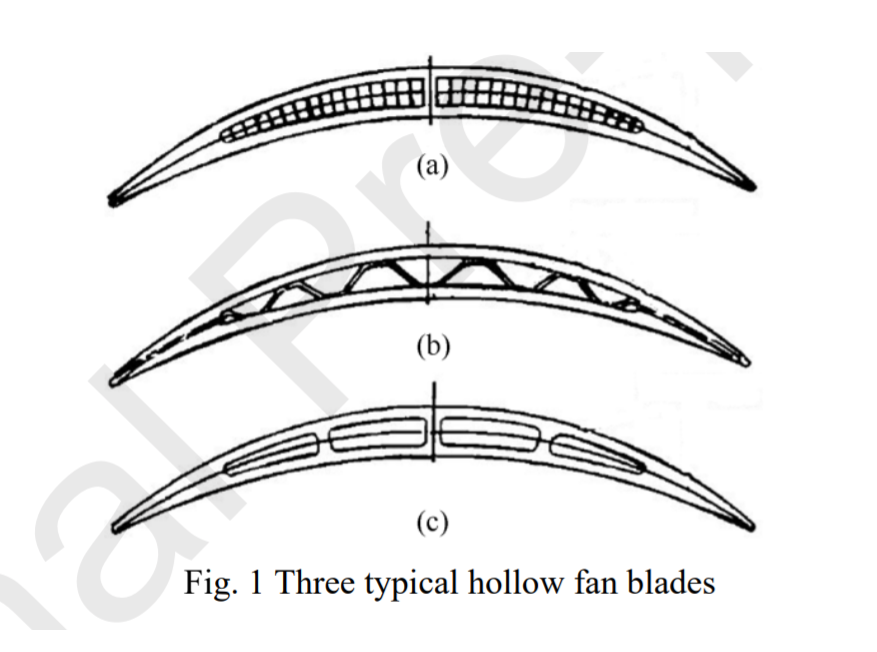
In recent years, the hollow fan blades have been widely used to meet the demand for light weight and good performance of the aero-engine. However, the relationship between the hollow structure and the aeroelastic stability has not been studied yet in the open literature.
In this paper, it has been investigated for an H-shaped hollow fan blade. Before studying the flutter behavior, the methods of parametric modeling and auto-generation of Finite Element Model (FEM) are presented. The influence of the feature parameters on the vibration frequency and mode shape (as the input of flutter calculation) of the first three modes are analyzed by the Orthogonal Experimental Design (OED) method.
The results show that the parameters have a more remarkable impact on the first torsional mode and thus it is concerned in the flutter sensitivity analysis. Compared with the solid blade, the minimum aerodynamic damping of the hollow blade decreases, indicating that the hollow structure makes the aeroelastic stability worse.
For the parameters describing the hollow section, the rib number N has the greatest influence on the minimum aerodynamic damping, followed by the wall thickness W5. For the parameters in the height of hollow segment, the aerodynamic damping increases with the increase of parameters M1 and M2. This means that reducing the height of the hollow segment is helpful to improve the aeroelastic stability.
Compared with the impact of parameters in hollow section, the variation of aerodynamic damping caused by the height of the hollow segment is small.
Ultrafast all-optical modulation of wide-bandwidth pulses enabled by silicon-metasurfaces
Kaloyan Georgiev, Khosro Zangeneh Kamali, Anton A. Trifonov, Giulia Crotti, Lyuben Petrov, Stefan Georgiev, Hristo Iliev, Lei Xu, Unai Arregui Leon, Mohsen Rahmani, Giuseppe Della Valle, Ivan Buchvarov, Dragomir Neshev
Opto-Electronic Advances
2026-09-15
Physics-informed neural fields enable blind aberration correction for partially coherent quantitative phase imaging
Shun Zhou, Xingyu Huang, Linpeng Lu, Habib Ullah, Kaiyu Du, Maciej Trusiak, Malgorzata Kujawinska, Yuzhen Zhang, Yao Fan, Qian Chen, Qinrong Zhang, Chao Zuo
Opto-Electronic Science
2026-08-26
Heterogeneously integrated micro-ring with SnS₂ for dual-functional optical modulation and photodetection
Jinyi Du, Lidan Lu, Xu Zhang, Bofei Zhu, Wenbo Bo, Yingjie Xu, Guang Chen, Yanlin He, Guanghui Ren, Xiaoping Lou, Zheng You, Lianqing Zhu
Opto-Electronic Advances
2026-08-25
Hardware-aware lightweight photonic spiking neural network for pattern classification
Shuiying Xiang, Yahui Zhang, Shangxuan Shi, Haowen Zhao, Dianzhuang Zheng, Xingxing Guo, Yanan Han, Ye Tian, Liyue Zhang, Yuechun Shi, Yue Hao
Opto-Electronic Advances
2026-08-25
PhyspeNet: An empirical physics-aware network for adaptive speckle reconstructive spectrometry
Junrui Liang, Min Jiang, Jun Li, Zhongming Huang, Junhong He, Yanting Guo, Yanzhao Ke, Jun Ye, Jiangming Xu, Jinyong Leng, Pu Zhou
Opto-Electronic Advances
2026-08-25
A 36 × 240 Gbps hybrid mode/wavelength division multiplexing transmitter using lithium niobate on insulator
Mingyu Zhu, Weihan Wang, Ruitao Ma, Aoyun Gao, Chun Gao, Zexu Wang, Fei Huang, Zhenyuan Bao, Dajian Liu, Jiaxuan Gan, Zejie Yu, Huan Li, Weike Zhao, Daoxin Dai
Opto-Electronic Advances
2026-08-25