(Peer-Reviewed) Lensless complex amplitude demodulation based on deep learning in holographic data storage
Jianying Hao 郝建颖 ¹ ³, Xiao Lin 林枭 ¹, Yongkun Lin 林雍坤 ¹, Mingyong Chen 陈明勇 ¹, Ruixian Chen 陈瑞娴 ¹, Guohai Situ 司徒国海 ², Hideyoshi Horimai ³, Xiaodi Tan 谭小地 ¹
¹ College of Photonic and Electronic Engineering, Key Laboratory of Opto-Electronic Science and for Medicine of Ministry of Education, Fujian Provincial Key Laboratory of Photonics Technology, Fujian Provincial Engineering Technology Research Center of Photoelectric Sensing Application, Fujian Normal University, Fuzhou 350117, China
中国 福州 福建师范大学光电与信息工程学院 医学光电科学与技术教育部重点实验室 福建省光子技术重点实验室 福建省光电传感应用工程技术研究中心
² Shanghai Institute of Optics and Fine Mechanics, Chinese Academy of Sciences, Shanghai 201800, China
中国科学院上海光学精密机械研究所
³ HolyMine Corporation, 2032-2-301 Ooka, Numazu, Shizuoka 410-0022, Japan
Opto-Electronic Advances
, 2023-03-25
Abstract
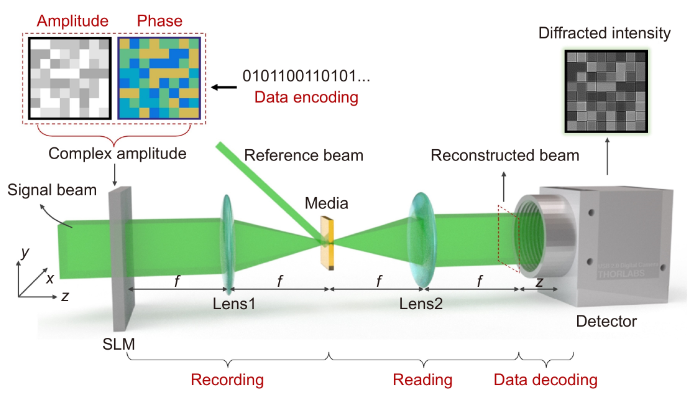
To increase the storage capacity in holographic data storage (HDS), the information to be stored is encoded into a complex amplitude. Fast and accurate retrieval of amplitude and phase from the reconstructed beam is necessary during data readout in HDS. In this study, we proposed a complex amplitude demodulation method based on deep learning from a single-shot diffraction intensity image and verified it by a non-interferometric lensless experiment demodulating four-level amplitude and four-level phase.
By analyzing the correlation between the diffraction intensity features and the amplitude and phase encoding data pages, the inverse problem was decomposed into two backward operators denoted by two convolutional neural networks (CNNs) to demodulate amplitude and phase respectively.
The experimental system is simple, stable, and robust, and it only needs a single diffraction image to realize the direct demodulation of both amplitude and phase. To our investigation, this is the first time in HDS that multilevel complex amplitude demodulation is achieved experimentally from one diffraction intensity image without iterations.
Ultrafast all-optical modulation of wide-bandwidth pulses enabled by silicon-metasurfaces
Kaloyan Georgiev, Khosro Zangeneh Kamali, Anton A. Trifonov, Giulia Crotti, Lyuben Petrov, Stefan Georgiev, Hristo Iliev, Lei Xu, Unai Arregui Leon, Mohsen Rahmani, Giuseppe Della Valle, Ivan Buchvarov, Dragomir Neshev
Opto-Electronic Advances
2026-09-15
Physics-informed neural fields enable blind aberration correction for partially coherent quantitative phase imaging
Shun Zhou, Xingyu Huang, Linpeng Lu, Habib Ullah, Kaiyu Du, Maciej Trusiak, Malgorzata Kujawinska, Yuzhen Zhang, Yao Fan, Qian Chen, Qinrong Zhang, Chao Zuo
Opto-Electronic Science
2026-08-26
Heterogeneously integrated micro-ring with SnS₂ for dual-functional optical modulation and photodetection
Jinyi Du, Lidan Lu, Xu Zhang, Bofei Zhu, Wenbo Bo, Yingjie Xu, Guang Chen, Yanlin He, Guanghui Ren, Xiaoping Lou, Zheng You, Lianqing Zhu
Opto-Electronic Advances
2026-08-25
Hardware-aware lightweight photonic spiking neural network for pattern classification
Shuiying Xiang, Yahui Zhang, Shangxuan Shi, Haowen Zhao, Dianzhuang Zheng, Xingxing Guo, Yanan Han, Ye Tian, Liyue Zhang, Yuechun Shi, Yue Hao
Opto-Electronic Advances
2026-08-25
PhyspeNet: An empirical physics-aware network for adaptive speckle reconstructive spectrometry
Junrui Liang, Min Jiang, Jun Li, Zhongming Huang, Junhong He, Yanting Guo, Yanzhao Ke, Jun Ye, Jiangming Xu, Jinyong Leng, Pu Zhou
Opto-Electronic Advances
2026-08-25
A 36 × 240 Gbps hybrid mode/wavelength division multiplexing transmitter using lithium niobate on insulator
Mingyu Zhu, Weihan Wang, Ruitao Ma, Aoyun Gao, Chun Gao, Zexu Wang, Fei Huang, Zhenyuan Bao, Dajian Liu, Jiaxuan Gan, Zejie Yu, Huan Li, Weike Zhao, Daoxin Dai
Opto-Electronic Advances
2026-08-25