(Peer-Reviewed) Physical Layer Authentication in UAV-enabled Relay Networks Based on Manifold Learning
Shida Xia 夏仕达 ¹, XiaoFeng Tao 陶小峰 ¹, Na Li 李娜 ¹ ², Shiji Wang 王施霁 ¹, Jin Xu 徐瑨 ¹
¹ The National Engineering Lab for Mobile Network Technologies, Beijing University of Posts and Telecommunications, Beijing 100876 China
中国 北京 北京邮电大学 移动互联网安全技术国家工程实验室
² Beijing University of Posts and Telecommunications Research Institute, Shenzhen, 518000, China
中国 深圳 北京邮电大学深圳研究院
Abstract
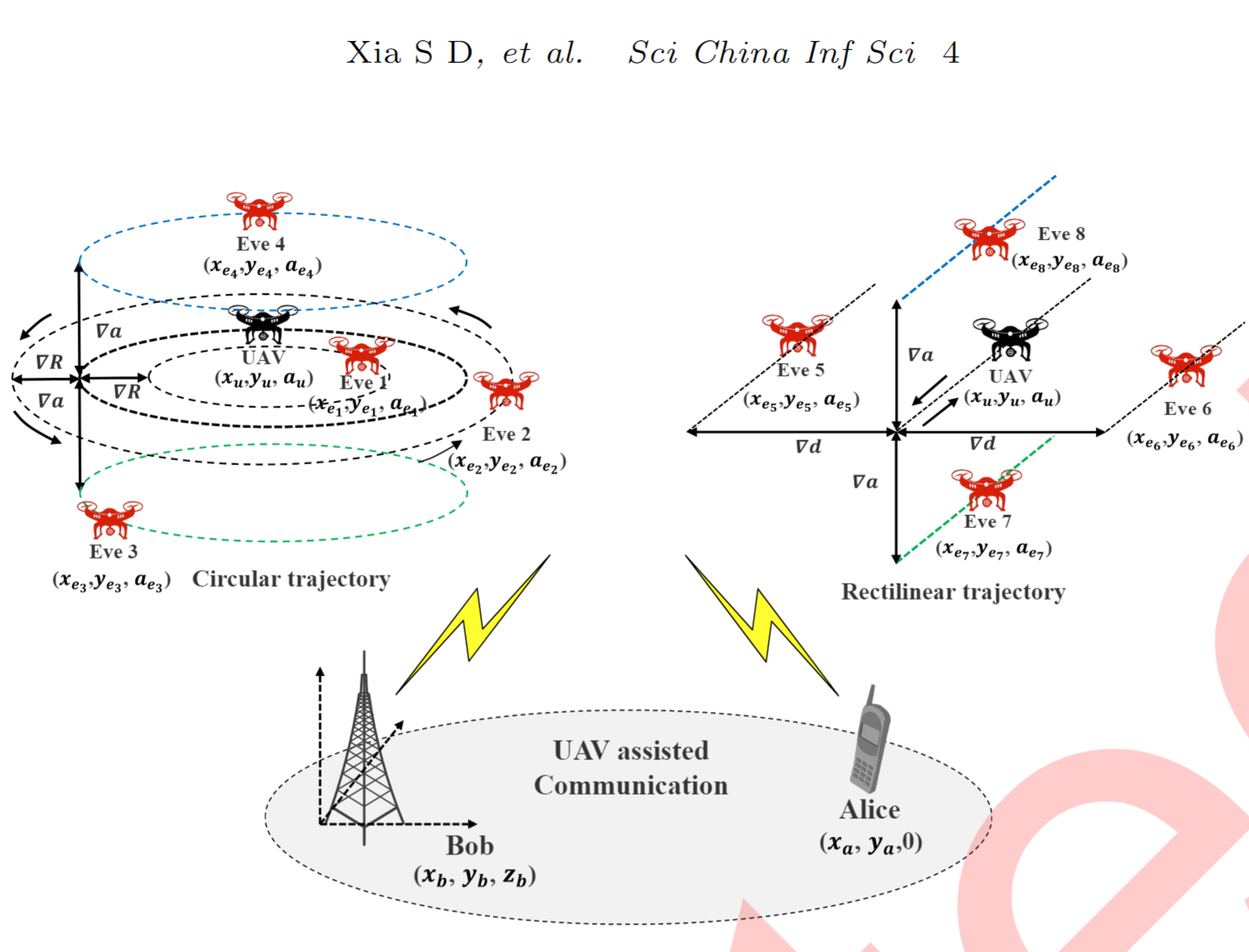
Unmanned aerial vehicle (UAV) relay network is a promising solution in the next-generation wireless networks due to its high capacity and unlimited geography. However, because of the openness of wireless channels and UAV mobility, it is remarkably challenging to guarantee the secure access of UAV relay. In this paper, we investigate the physical layer authentication (PLA) to verify the identity of the UAV relay for preventing unauthorized access to users' information or network service.
Unlike the most existing PLA methods for UAV, the proposed PLA scheme fully considers the time-varying of physical layer attributes caused by UAV mobility, and transforms the authentication problem into recognizing nonlinearly separable physical layer data. Particularly, we propose a manifold learning-based PLA scheme that can authenticate the mobile UAV relay in real-time by establishing the local correlation of physical layer attributes. The Markov chain of physical layer data in the time domain is established to evaluate UAV state transition probability through the proposed diffusion map algorithm. The legitimate UAV and spoofing attackers can always be authenticated by the different motion states.
Performance analysis offered a comprehensive understanding of the proposed scheme. Extensive simulations confirm that the performance of the proposed scheme improves over 18% in resisting the intelligent spoofing UAV compared to the traditional methods.
Ultrafast all-optical modulation of wide-bandwidth pulses enabled by silicon-metasurfaces
Kaloyan Georgiev, Khosro Zangeneh Kamali, Anton A. Trifonov, Giulia Crotti, Lyuben Petrov, Stefan Georgiev, Hristo Iliev, Lei Xu, Unai Arregui Leon, Mohsen Rahmani, Giuseppe Della Valle, Ivan Buchvarov, Dragomir Neshev
Opto-Electronic Advances
2026-09-15
Physics-informed neural fields enable blind aberration correction for partially coherent quantitative phase imaging
Shun Zhou, Xingyu Huang, Linpeng Lu, Habib Ullah, Kaiyu Du, Maciej Trusiak, Malgorzata Kujawinska, Yuzhen Zhang, Yao Fan, Qian Chen, Qinrong Zhang, Chao Zuo
Opto-Electronic Science
2026-08-26
Heterogeneously integrated micro-ring with SnS₂ for dual-functional optical modulation and photodetection
Jinyi Du, Lidan Lu, Xu Zhang, Bofei Zhu, Wenbo Bo, Yingjie Xu, Guang Chen, Yanlin He, Guanghui Ren, Xiaoping Lou, Zheng You, Lianqing Zhu
Opto-Electronic Advances
2026-08-25
Hardware-aware lightweight photonic spiking neural network for pattern classification
Shuiying Xiang, Yahui Zhang, Shangxuan Shi, Haowen Zhao, Dianzhuang Zheng, Xingxing Guo, Yanan Han, Ye Tian, Liyue Zhang, Yuechun Shi, Yue Hao
Opto-Electronic Advances
2026-08-25
PhyspeNet: An empirical physics-aware network for adaptive speckle reconstructive spectrometry
Junrui Liang, Min Jiang, Jun Li, Zhongming Huang, Junhong He, Yanting Guo, Yanzhao Ke, Jun Ye, Jiangming Xu, Jinyong Leng, Pu Zhou
Opto-Electronic Advances
2026-08-25
A 36 × 240 Gbps hybrid mode/wavelength division multiplexing transmitter using lithium niobate on insulator
Mingyu Zhu, Weihan Wang, Ruitao Ma, Aoyun Gao, Chun Gao, Zexu Wang, Fei Huang, Zhenyuan Bao, Dajian Liu, Jiaxuan Gan, Zejie Yu, Huan Li, Weike Zhao, Daoxin Dai
Opto-Electronic Advances
2026-08-25