(Peer-Reviewed) Parent–offspring and inter-offspring responses to conspecific versus heterospecific distress calls in 2 sympatric birds
Yuxin Jiang 蒋宇鑫, Jingru Han 韩静茹, Ziqi Zhang 张子奇, Xiangyang Chen 陈向阳, Canchao Yang 杨灿朝
Ministry of Education Key Laboratory for Ecology of Tropical Islands, College of Life Sciences, Hainan NormalUniversity, Haikou 571158, China
中国 海口 海南师范大学生命科学学院 热带岛屿生态学教育部重点实验室
Abstract
Distress calls, as a type of alarm call, play important roles in expressing bodily condition and conveying information concerning predation threats. In this study, we examined the communication via distress calls in parent–offspring and inter-offspring interactions.
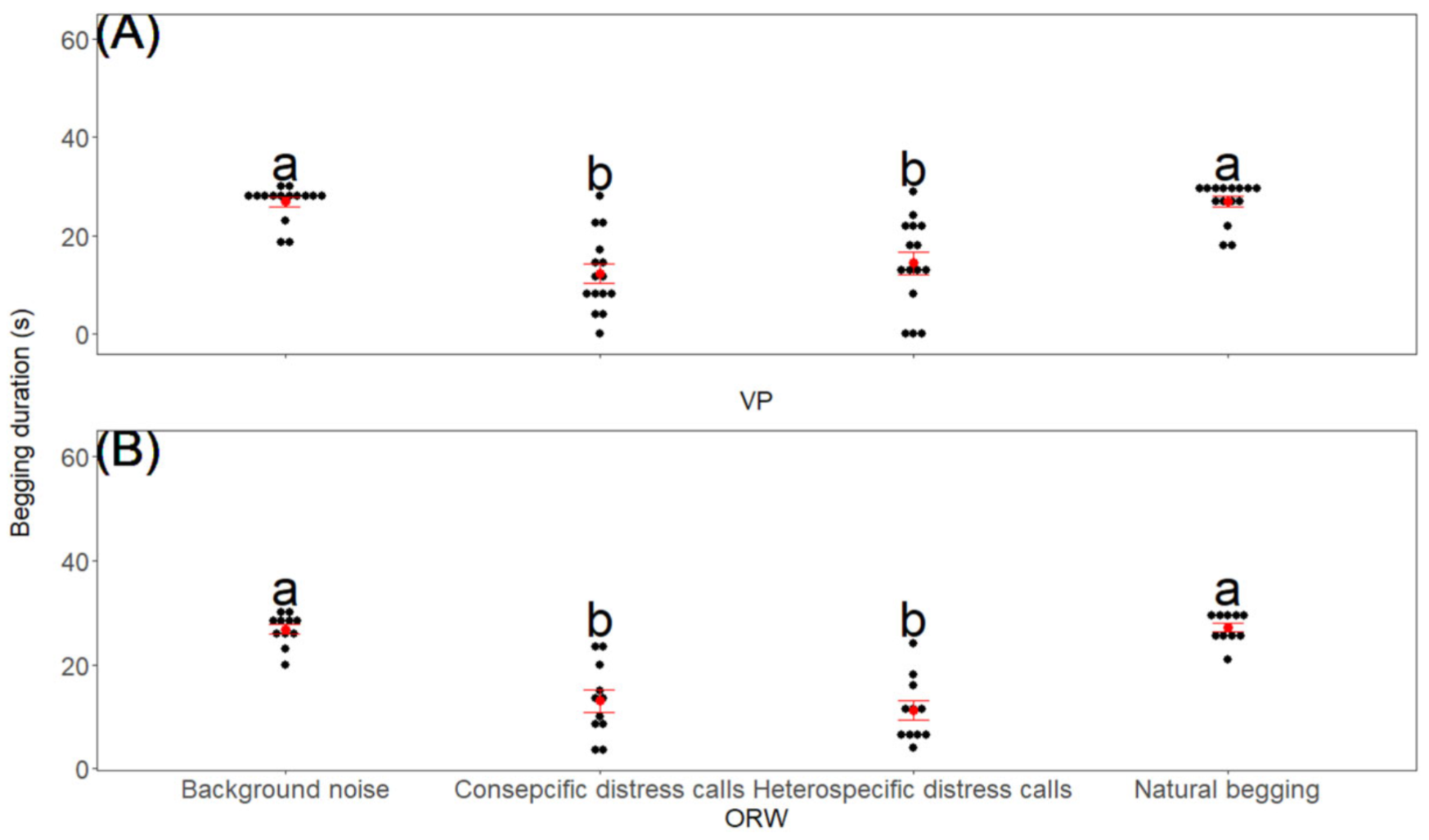
First, we used playback of chick distress calls of 2 sympatric breeders, the vinous-throated parrotbill Sinosuthora webbiana and the oriental reed warbler Acrocephalus orientalis, to the adults/chicks of these 2 species, respectively, and measured the responses of conspecifics or heterospecifics. The playback-to-chicks experiment showed that both species of chicks reduced the number of begging calls and begging duration time as a response to conspecific/heterospecific distress calls compared with natural begging and background noise controls. However, reed warbler chicks also reduced beak opening frequency in the response to conspecific distress calls compared with other playback stimuli.
Second, the results of the playback-to-adults experiment showed that reed warbler adults could eavesdrop on distress calls of conspecific neighbors and sympatric heterospecifics. Furthermore, the nest-leaving behavior of reed warblers did not differ significantly when they heard the distress calls of conspecifics or parrotbills. Finally, reed warbler adults responded to heterospecific distress calls more quickly than to conspecific distress calls, and parrotbill adults presented the same response.
Our results supported the warn-kin hypothesis and show that chick distress calls play an important role in conveying risk and the condition of chicks to enhance individual fitness. In addition, we also found that eavesdropping on distress calls is a congenital behavior that begins in the chick stage.
Ultrafast all-optical modulation of wide-bandwidth pulses enabled by silicon-metasurfaces
Kaloyan Georgiev, Khosro Zangeneh Kamali, Anton A. Trifonov, Giulia Crotti, Lyuben Petrov, Stefan Georgiev, Hristo Iliev, Lei Xu, Unai Arregui Leon, Mohsen Rahmani, Giuseppe Della Valle, Ivan Buchvarov, Dragomir Neshev
Opto-Electronic Advances
2026-09-15
Physics-informed neural fields enable blind aberration correction for partially coherent quantitative phase imaging
Shun Zhou, Xingyu Huang, Linpeng Lu, Habib Ullah, Kaiyu Du, Maciej Trusiak, Malgorzata Kujawinska, Yuzhen Zhang, Yao Fan, Qian Chen, Qinrong Zhang, Chao Zuo
Opto-Electronic Science
2026-08-26
Heterogeneously integrated micro-ring with SnS₂ for dual-functional optical modulation and photodetection
Jinyi Du, Lidan Lu, Xu Zhang, Bofei Zhu, Wenbo Bo, Yingjie Xu, Guang Chen, Yanlin He, Guanghui Ren, Xiaoping Lou, Zheng You, Lianqing Zhu
Opto-Electronic Advances
2026-08-25
Hardware-aware lightweight photonic spiking neural network for pattern classification
Shuiying Xiang, Yahui Zhang, Shangxuan Shi, Haowen Zhao, Dianzhuang Zheng, Xingxing Guo, Yanan Han, Ye Tian, Liyue Zhang, Yuechun Shi, Yue Hao
Opto-Electronic Advances
2026-08-25
PhyspeNet: An empirical physics-aware network for adaptive speckle reconstructive spectrometry
Junrui Liang, Min Jiang, Jun Li, Zhongming Huang, Junhong He, Yanting Guo, Yanzhao Ke, Jun Ye, Jiangming Xu, Jinyong Leng, Pu Zhou
Opto-Electronic Advances
2026-08-25
A 36 × 240 Gbps hybrid mode/wavelength division multiplexing transmitter using lithium niobate on insulator
Mingyu Zhu, Weihan Wang, Ruitao Ma, Aoyun Gao, Chun Gao, Zexu Wang, Fei Huang, Zhenyuan Bao, Dajian Liu, Jiaxuan Gan, Zejie Yu, Huan Li, Weike Zhao, Daoxin Dai
Opto-Electronic Advances
2026-08-25