(Peer-Reviewed) Recent developments of quantum dot based micro-LED based on non-radiative energy transfer mechanism
Xiaotong Fan 范小通 ¹, Tingzhu Wu 吴挺竹 ¹ ², Bin Liu 刘斌 ³, Rong Zhang 张荣 ¹ ³, Hao-Chung Kuo 郭浩中 ⁴, Zhong Chen 陈忠 ¹ ²
¹ School of Electronic Science and Engineering, Fujian Engineering Research Center for Solid-State Lighting, Xiamen University, Xiamen 361005, China
中国 厦门 厦门大学电子科学与技术学院 福建省半导体照明工程技术研究中心
² Fujian Science & Technology Innovation Laboratory for Energy Materials of China, Xiamen 361005, China
中国 福建 中国福建能源材料科学与技术创新实验室
³ Jiangsu Provincial Key Laboratory of Advanced Photonic and Electronic Materials, Nanjing National Laboratory of Microstructures, School of Electronic Science and Engineering, Nanjing University, Nanjing 210093, China
南京大学电子科学与工程学院 江苏省先进光学制造技术重点实验室 南京微结构物理国家重点实验室
⁴ Department of Photonics and Graduate Institute of Electro-Optical Engineering, College of Electrical and Computer Engineering, Chiao Tung University, Hsinchu 30010, China
中国 新竹 台湾交通大学电机学院 光电工程学系 光电研究所
Opto-Electronic Advances
, 2021-04-06
Abstract
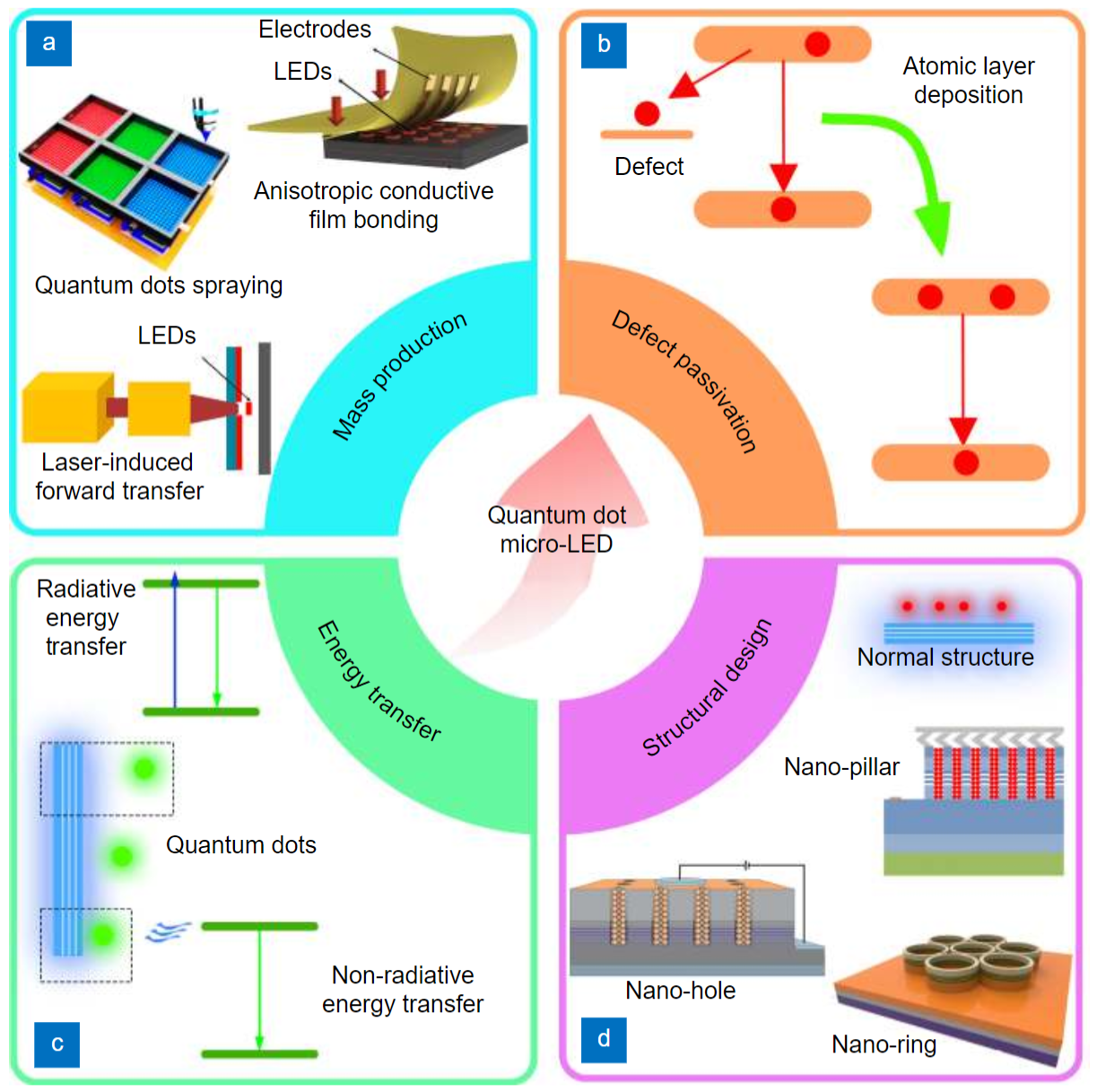
With regard to micro-light-emitting diodes (micro-LEDs), their excellent brightness, low energy consumption, and ultra-high resolution are significant advantages. However, the large size of traditional inorganic phosphors and the number of side defects have restricted the practical applications of small sized micro-LEDs.
Recently, quantum dot (QD) and non-radiative energy transfer (NRET) have been proposed to solve existing problems. QDs possess nanoscale dimensions and high luminous efficiency, and they are suitable for NRET because they are able to nearly contact the micro-LED chip. The NRET between QDs and micro-LED chip further improves the color conversion efficiency (CCE) and effective quantum yield (EQY) of full-color micro-LED devices.
In this review, we discuss the NRET mechanism for QD micro-LED devices, and then nano-pillar LED, nano-hole LED, and nano-ring LED are introduced in detail. These structures are beneficial to the NRET between QD and micro-LED, especially nano-ring LED. Finally, the challenges and future envisions have also been described.
Ultrafast all-optical modulation of wide-bandwidth pulses enabled by silicon-metasurfaces
Kaloyan Georgiev, Khosro Zangeneh Kamali, Anton A. Trifonov, Giulia Crotti, Lyuben Petrov, Stefan Georgiev, Hristo Iliev, Lei Xu, Unai Arregui Leon, Mohsen Rahmani, Giuseppe Della Valle, Ivan Buchvarov, Dragomir Neshev
Opto-Electronic Advances
2026-09-15
Physics-informed neural fields enable blind aberration correction for partially coherent quantitative phase imaging
Shun Zhou, Xingyu Huang, Linpeng Lu, Habib Ullah, Kaiyu Du, Maciej Trusiak, Malgorzata Kujawinska, Yuzhen Zhang, Yao Fan, Qian Chen, Qinrong Zhang, Chao Zuo
Opto-Electronic Science
2026-08-26
Heterogeneously integrated micro-ring with SnS₂ for dual-functional optical modulation and photodetection
Jinyi Du, Lidan Lu, Xu Zhang, Bofei Zhu, Wenbo Bo, Yingjie Xu, Guang Chen, Yanlin He, Guanghui Ren, Xiaoping Lou, Zheng You, Lianqing Zhu
Opto-Electronic Advances
2026-08-25
Hardware-aware lightweight photonic spiking neural network for pattern classification
Shuiying Xiang, Yahui Zhang, Shangxuan Shi, Haowen Zhao, Dianzhuang Zheng, Xingxing Guo, Yanan Han, Ye Tian, Liyue Zhang, Yuechun Shi, Yue Hao
Opto-Electronic Advances
2026-08-25
PhyspeNet: An empirical physics-aware network for adaptive speckle reconstructive spectrometry
Junrui Liang, Min Jiang, Jun Li, Zhongming Huang, Junhong He, Yanting Guo, Yanzhao Ke, Jun Ye, Jiangming Xu, Jinyong Leng, Pu Zhou
Opto-Electronic Advances
2026-08-25
A 36 × 240 Gbps hybrid mode/wavelength division multiplexing transmitter using lithium niobate on insulator
Mingyu Zhu, Weihan Wang, Ruitao Ma, Aoyun Gao, Chun Gao, Zexu Wang, Fei Huang, Zhenyuan Bao, Dajian Liu, Jiaxuan Gan, Zejie Yu, Huan Li, Weike Zhao, Daoxin Dai
Opto-Electronic Advances
2026-08-25