(Peer-Reviewed) Benchmarking deep learning-based models on nanophotonic inverse design problems
Taigao Ma 马太高 ¹, Mustafa Tobah ², Haozhu Wang 王浩竹 ³, L. Jay Guo 郭凌杰 ³
¹ Department of Physics, The University of Michigan, Ann Arbor, Michigan, 48109, USA
² Department of Materials Science and Engineering, The University of Michigan, Ann Arbor, Michigan, 48109, USA
³ Department of Electrical Engineering and Computer Science, The University of Michigan, Ann Arbor, Michigan, 48109, USA
Opto-Electronic Science
, 2022-01-07
Abstract
Photonic inverse design concerns the problem of finding photonic structures with target optical properties. However, traditional methods based on optimization algorithms are time-consuming and computationally expensive. Recently, deep learning-based approaches have been developed to tackle the problem of inverse design efficiently.
Although most of these neural network models have demonstrated high accuracy in different inverse design problems, no previous study has examined the potential effects under given constraints in nanomanufacturing. Additionally, the relative strength of different deep learning-based inverse design approaches has not been fully investigated.
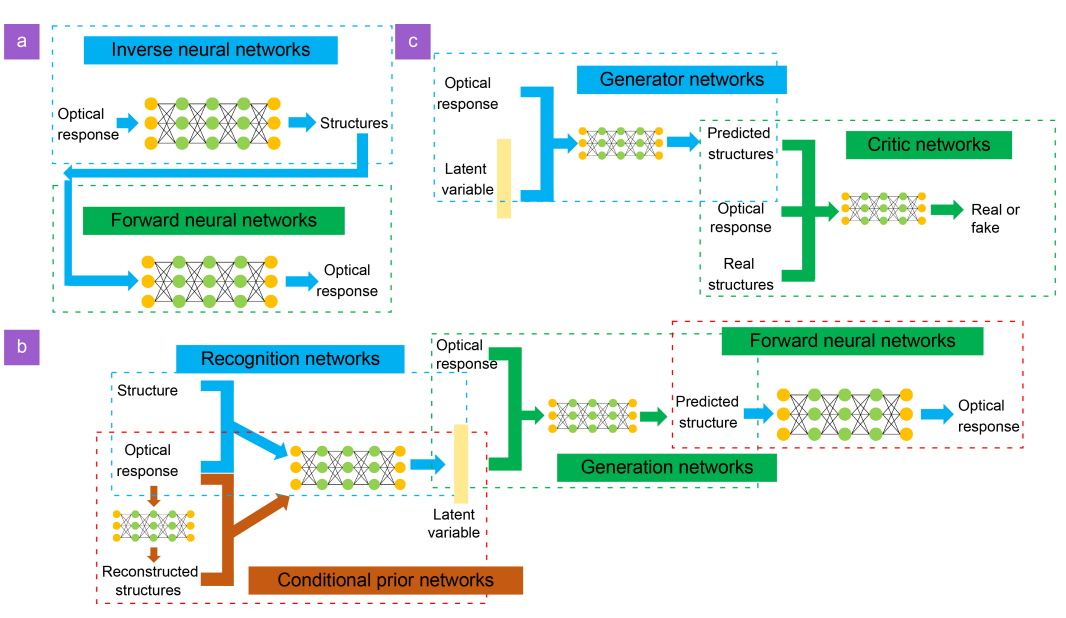
Here, we benchmark three commonly used deep learning models in inverse design: Tandem networks, Variational Auto-Encoders, and Generative Adversarial Networks. We provide detailed comparisons in terms of their accuracy, diversity, and robustness. We find that tandem networks and Variational Auto-Encoders give the best accuracy, while Generative Adversarial Networks lead to the most diverse predictions.
Our findings could serve as a guideline for researchers to select the model that can best suit their design criteria and fabrication considerations. In addition, our code and data are publicly available, which could be used for future inverse design model development and benchmarking.
Ultrafast all-optical modulation of wide-bandwidth pulses enabled by silicon-metasurfaces
Kaloyan Georgiev, Khosro Zangeneh Kamali, Anton A. Trifonov, Giulia Crotti, Lyuben Petrov, Stefan Georgiev, Hristo Iliev, Lei Xu, Unai Arregui Leon, Mohsen Rahmani, Giuseppe Della Valle, Ivan Buchvarov, Dragomir Neshev
Opto-Electronic Advances
2026-09-15
Physics-informed neural fields enable blind aberration correction for partially coherent quantitative phase imaging
Shun Zhou, Xingyu Huang, Linpeng Lu, Habib Ullah, Kaiyu Du, Maciej Trusiak, Malgorzata Kujawinska, Yuzhen Zhang, Yao Fan, Qian Chen, Qinrong Zhang, Chao Zuo
Opto-Electronic Science
2026-08-26
Heterogeneously integrated micro-ring with SnS₂ for dual-functional optical modulation and photodetection
Jinyi Du, Lidan Lu, Xu Zhang, Bofei Zhu, Wenbo Bo, Yingjie Xu, Guang Chen, Yanlin He, Guanghui Ren, Xiaoping Lou, Zheng You, Lianqing Zhu
Opto-Electronic Advances
2026-08-25
Hardware-aware lightweight photonic spiking neural network for pattern classification
Shuiying Xiang, Yahui Zhang, Shangxuan Shi, Haowen Zhao, Dianzhuang Zheng, Xingxing Guo, Yanan Han, Ye Tian, Liyue Zhang, Yuechun Shi, Yue Hao
Opto-Electronic Advances
2026-08-25
PhyspeNet: An empirical physics-aware network for adaptive speckle reconstructive spectrometry
Junrui Liang, Min Jiang, Jun Li, Zhongming Huang, Junhong He, Yanting Guo, Yanzhao Ke, Jun Ye, Jiangming Xu, Jinyong Leng, Pu Zhou
Opto-Electronic Advances
2026-08-25
A 36 × 240 Gbps hybrid mode/wavelength division multiplexing transmitter using lithium niobate on insulator
Mingyu Zhu, Weihan Wang, Ruitao Ma, Aoyun Gao, Chun Gao, Zexu Wang, Fei Huang, Zhenyuan Bao, Dajian Liu, Jiaxuan Gan, Zejie Yu, Huan Li, Weike Zhao, Daoxin Dai
Opto-Electronic Advances
2026-08-25