(Peer-Reviewed) Towards integrated mode-division demultiplexing spectrometer by deep learning
Ze-huan Zheng 郑泽寰 ¹ ², Sheng-ke Zhu 朱圣科 ¹ ⁴, Ying Chen 陈颖 ³, Huanyang Chen 陈焕阳 ⁵, Jin-hui Chen 陈锦辉 ¹ ⁴ ⁶
¹ Shenzhen Research Institute, Xiamen University, Shenzhen 518000, China
中国 深圳 厦门大学深圳研究院
² Xiamen Power Supply Bureau of Fujian Electric Power Company Limited, State Grid, Xiamen 361004, China
中国 厦门 福建省电力有限公司 厦门供电局
³ College of Information Science and Engineering, Fujian Provincial Key Laboratory of Light Propagation and Transformation, Huaqiao University, Xiamen 361021, China
福建省光传输与变换重点实验室 华侨大学信息科学与工程学院
⁴ Institute of Electromagnetics and Acoustics, Xiamen University, Xiamen 361005, China
中国 厦门 厦门大学电磁声学研究院
⁵ College of Physical Science and Technology, Xiamen University, Xiamen 361005, China
中国 厦门 厦门大学物理科学与技术学院
⁶ Innovation Laboratory for Sciences and Technologies of Energy Materials of Fujian Province (IKKEM), Xiamen 361005, China
中国 厦门 中国福建能源材料科学与技术创新实验室(嘉庚创新实验室)
Opto-Electronic Science, 2022-11-01
Abstract
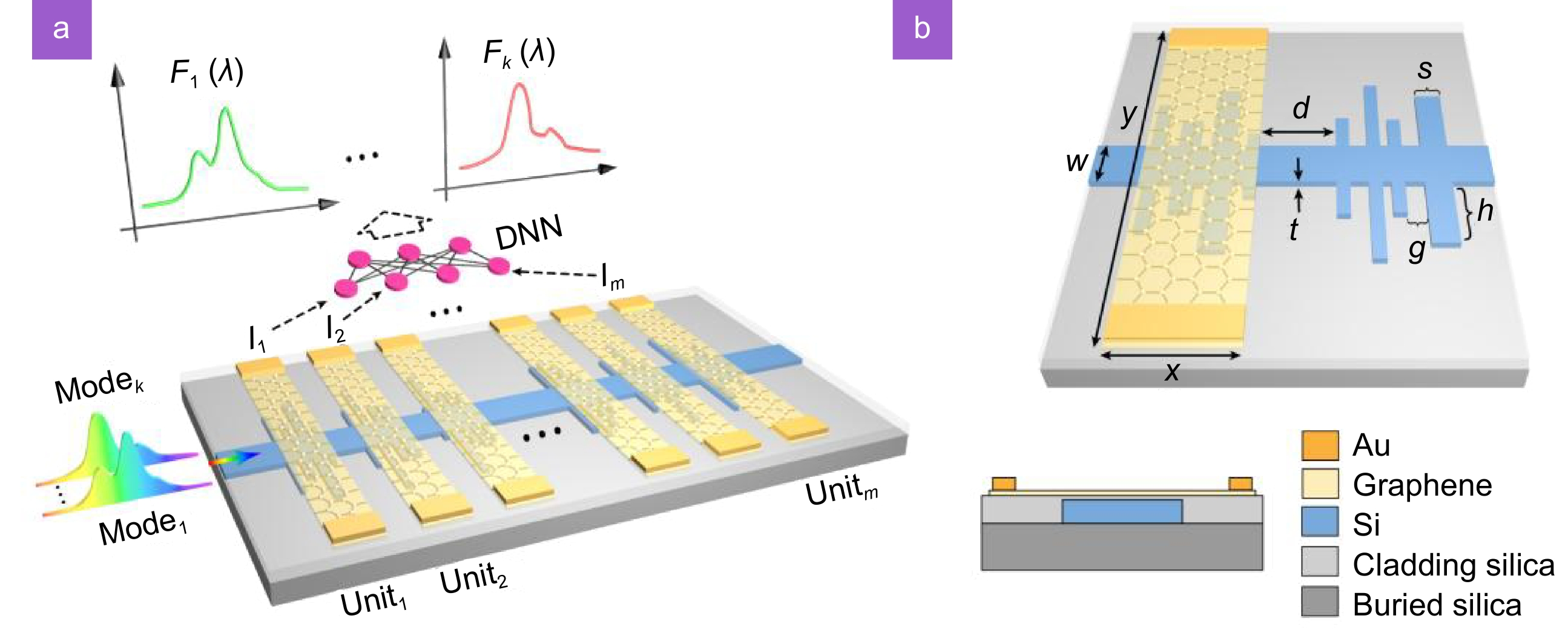
Miniaturized spectrometers have been widely researched in recent years, but few studies are conducted with on-chip multimode schemes for mode-division multiplexing (MDM) systems. Here we propose an ultracompact mode-division demultiplexing spectrometer that includes branched waveguide structures and graphene-based photodetectors, which realizes simultaneously spectral dispersing and light fields detecting.
In the bandwidth of 1500–1600 nm, the designed spectrometer achieves the single-mode spectral resolution of 7 nm for each mode of TE1–TE4 by Tikhonov regularization optimization. Empowered by deep learning algorithms, the 15-nm resolution of parallel reconstruction for TE1–TE4 is achieved by a single-shot measurement. Moreover, by stacking the multimode response in TE1–TE4 to the single spectra, the 3-nm spectral resolution is realized.
This design reveals an effective solution for on-chip MDM spectroscopy, and may find applications in multimode sensing, interconnecting and processing.
Electrically switchable bright-field and interference-synthesized edge-enhanced imaging with a polarization-multiplexed metalens
Xiaotong Li, Junhwa Seong, Yeseul Kim, Kwang-Suk Oh, Shiqi Hu, Le Dai, Harit Keawmuang, Beomha Yang, Minseok Choi, Youngsun Jeon, Cherry Park, Weiyan Li, Tianxu Jia, Han Zhu, Xiaodong Cai, Qi Zheng, Jinhui Shi, Young-Ki Kim, Yuchuan Shao, Trevon Badloe, Junsuk Rho
Opto-Electronic Science
2026-09-20
3D-printed copper water cooling system assisted fabrication of 10.6-μm high-power CO₂ laser resistance reflectors
Hongfei Jiao, Binbin Jiang, Xinshang Niu, Yifan Wang, Dongdong Li, Jun Yu, Xiaochuan Ji, Jingjing Xia, Jinlong Zhang, Xinbin Cheng, Zhanshan Wang
Opto-Electronic Advances
2026-09-15
Ultrafast all-optical modulation of wide-bandwidth pulses enabled by silicon-metasurfaces
Kaloyan Georgiev, Khosro Zangeneh Kamali, Anton A. Trifonov, Giulia Crotti, Lyuben Petrov, Stefan Georgiev, Hristo Iliev, Lei Xu, Unai Arregui Leon, Mohsen Rahmani, Giuseppe Della Valle, Ivan Buchvarov, Dragomir Neshev
Opto-Electronic Advances
2026-09-15
Physics-informed neural fields enable blind aberration correction for partially coherent quantitative phase imaging
Shun Zhou, Xingyu Huang, Linpeng Lu, Habib Ullah, Kaiyu Du, Maciej Trusiak, Malgorzata Kujawinska, Yuzhen Zhang, Yao Fan, Qian Chen, Qinrong Zhang, Chao Zuo
Opto-Electronic Science
2026-08-26