(Peer-Reviewed) Influence of N-doping on dielectric properties of carbon-coated copper nanocomposites in the microwave and terahertz ranges
Feirong Huang 黄斐荣 ¹, Shuting Fan 范姝婷 ², Yuqi Tian 田雨祁 ¹, Xinghao Qu 曲星昊 ¹, Xiyang Li 李夕阳 ¹, Maofan Qin 秦茂繁 ¹, Javid Muhammad ¹, Xuefeng Zhang 张雪峰 ³, Zhidong Zhang 张志东 ⁴, Xinglong Dong 董星龙 ¹
¹ Key Laboratory of Materials Modification by Laser, Ion and Electron Beams (Ministry of Education), School of Materials Science and Engineering, Dalian University of Technology, Dalian, 116024, China
中国 大连 大连理工大学 材料科学与工程学院 三束材料改性教育部重点实验室
² College of Physics and Optoelectronic Engineering, Shenzhen University, Shenzhen, 518060, China
深圳大学 物理与光电工程学院
³ Institute of Advanced Magnetic Materials, College of Materials and Environmental Engineering, Hangzhou Dianzi University, Hangzhou, 110819, China
中国 杭州 杭州电子科技大学 材料与环境工程学院 磁性材料研究院
⁴ Shenyang National Laboratory for Materials Science, Institute of Metal Research, Chinese Academy of Sciences, Shenyang, 110015, China
中国 沈阳 中国科学院金属研究所 沈阳材料科学国家(联合)实验室
Abstract
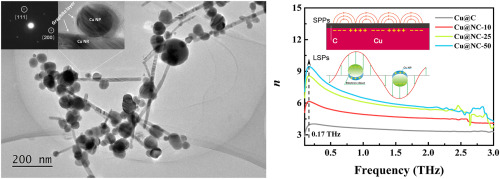
Carbon-coated Cu nanocomposites (Cu@C NCs) consisting of core-shell nanoparticles and nanorods were synthesized by arc discharge plasma under an atmosphere of He and H2 gas, and the N-doping of them was achieved by a post-treatment process using ureal as the precursor. The concentration of N in the N-doped samples varies in the range of 0.62%–2.31 % (in mole), with a transformation from pyrrolic N to graphitic N when increasing the relative content of ureal.
Dielectric properties of the NCs without or with N-doping in the microwave and THz bands were investigated. The N-doped samples achieve the enhanced dielectric loss in both microwave and THz bands. In the microwave band, dielectric loss was dominated by interfacial polarization, dipolar polarization, and conduction loss, while in the THz band, plasma resonance, ionic polarization and conduction loss are responsible for the dielectric loss, with a strong absorption characteristic dominated by conductive effect.
Ultrafast all-optical modulation of wide-bandwidth pulses enabled by silicon-metasurfaces
Kaloyan Georgiev, Khosro Zangeneh Kamali, Anton A. Trifonov, Giulia Crotti, Lyuben Petrov, Stefan Georgiev, Hristo Iliev, Lei Xu, Unai Arregui Leon, Mohsen Rahmani, Giuseppe Della Valle, Ivan Buchvarov, Dragomir Neshev
Opto-Electronic Advances
2026-09-15
Physics-informed neural fields enable blind aberration correction for partially coherent quantitative phase imaging
Shun Zhou, Xingyu Huang, Linpeng Lu, Habib Ullah, Kaiyu Du, Maciej Trusiak, Malgorzata Kujawinska, Yuzhen Zhang, Yao Fan, Qian Chen, Qinrong Zhang, Chao Zuo
Opto-Electronic Science
2026-08-26
Heterogeneously integrated micro-ring with SnS₂ for dual-functional optical modulation and photodetection
Jinyi Du, Lidan Lu, Xu Zhang, Bofei Zhu, Wenbo Bo, Yingjie Xu, Guang Chen, Yanlin He, Guanghui Ren, Xiaoping Lou, Zheng You, Lianqing Zhu
Opto-Electronic Advances
2026-08-25
Hardware-aware lightweight photonic spiking neural network for pattern classification
Shuiying Xiang, Yahui Zhang, Shangxuan Shi, Haowen Zhao, Dianzhuang Zheng, Xingxing Guo, Yanan Han, Ye Tian, Liyue Zhang, Yuechun Shi, Yue Hao
Opto-Electronic Advances
2026-08-25
PhyspeNet: An empirical physics-aware network for adaptive speckle reconstructive spectrometry
Junrui Liang, Min Jiang, Jun Li, Zhongming Huang, Junhong He, Yanting Guo, Yanzhao Ke, Jun Ye, Jiangming Xu, Jinyong Leng, Pu Zhou
Opto-Electronic Advances
2026-08-25
A 36 × 240 Gbps hybrid mode/wavelength division multiplexing transmitter using lithium niobate on insulator
Mingyu Zhu, Weihan Wang, Ruitao Ma, Aoyun Gao, Chun Gao, Zexu Wang, Fei Huang, Zhenyuan Bao, Dajian Liu, Jiaxuan Gan, Zejie Yu, Huan Li, Weike Zhao, Daoxin Dai
Opto-Electronic Advances
2026-08-25