(Peer-Reviewed) Reconfigurable SERS platform based on magnetization-controlled self-assembly of magnetic nanoparticles on NdFeB composite substrate
Na Gao ¹, Liu Wang ¹, Xifeng Li ¹, Mingxuan Wang ¹, Sheng Li ¹, Chenpeng Zhang ², Stefanos Mourdikoudis ³, Guangchao Zheng ⁴, Mingli Wang ¹
¹ State Key Laboratory of Metastable Materials Science and Technology, Key Laboratory for Microstructural Material Physics of Hebei Province, School of Science, Yanshan University, Qinhuangdao 066000, China
中国 秦皇岛 燕山大学理学院 河北省微结构材料物理重点实验室 亚稳材料制备技术与科学国家重点实验室
² Center for Extreme Deformation Research, State Key Laboratory of Metastable Materials Science and Technology, Yanshan University, Qinhuangdao 066000, China
中国 秦皇岛 燕山大学亚稳材料制备技术与科学国家重点实验室极端变形研究中心
³ CINBIO, Universidade de Vigo, Department of Physical Chemistry, Campus Universitario Lagoas Marcosende, Vigo 36310, Spain
⁴ Colloidal Physics Group, School of Physics, Key Laboratory of Material Physics, Ministry of Education, Zhengzhou University, Zhengzhou 450001, China
中国 郑州 郑州大学材料物理教育部重点实验室 物理学院胶体物理课题组
Opto-Electronic Advances, 2026-11-05
Abstract
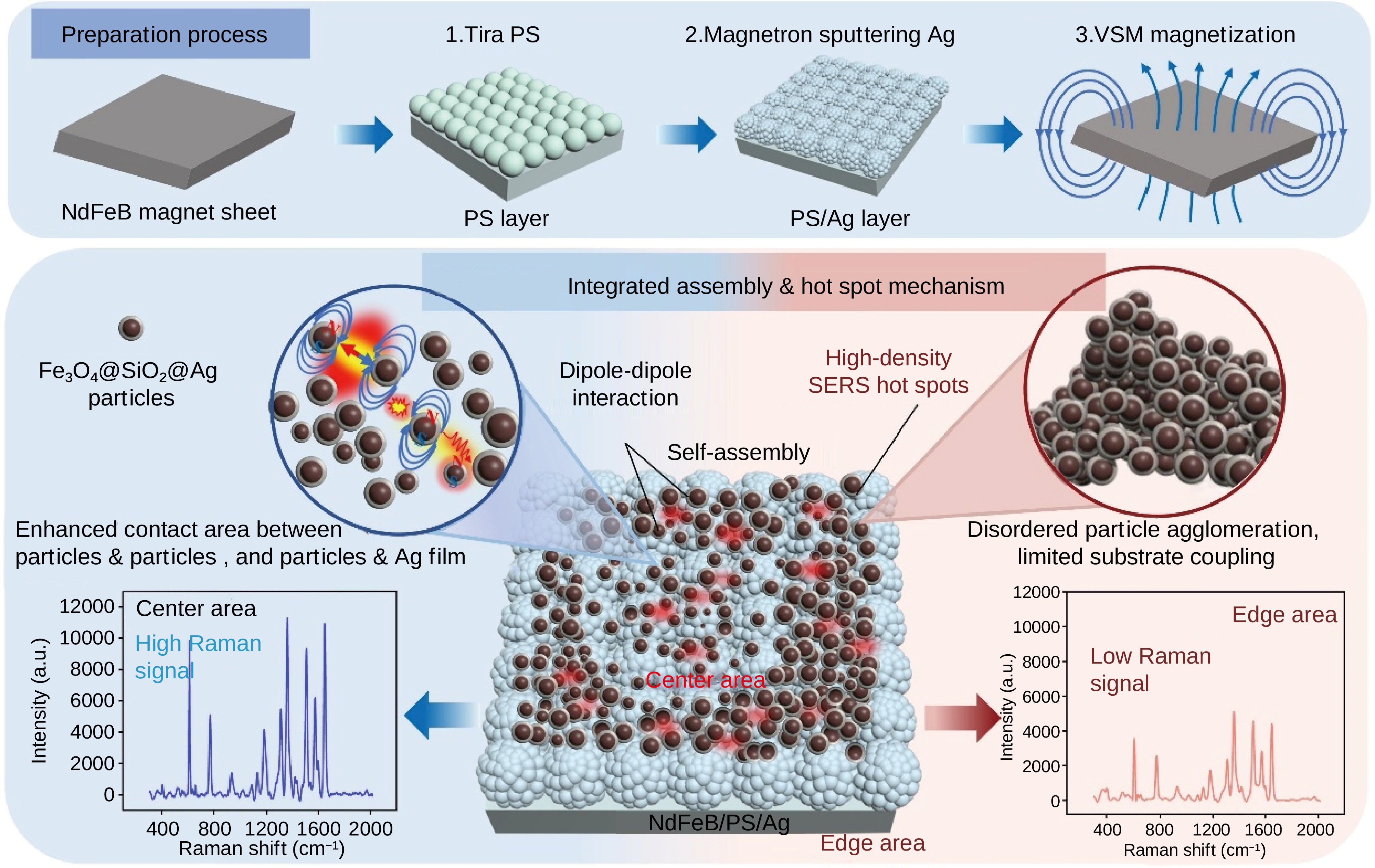
Constructing surface-enhanced Raman scattering (SERS) substrates using magnetic control strategies is a common approach for the development of SERS-efficient tools. However, one persistent challenge lies in how to regulate the spatial coupling between the target analyte carrier and the plasmonic hot spots, in order to maximize the SERS enhancement activity. This study proposes a magnetic-field-controlled composite SERS substrate strategy, through regulating the spatial distribution of the target molecule carriers, to realize its coupling with the plasmon hot spot.
This method allows to elaborate a NdFeB/PS/Ag composite structure as the plasmonic substrate, using Fe₃O₄@SiO₂@Ag (FSA) magnetic nanoparticles as the target molecule. By regulating the magnetic state of NdFeB magnetic sheets and optimizing the magnetization gradient, the spatial distribution state of FSA magnetic nanoparticles can be controlled.
Meanwhile, based on the differences in magnetic field distribution at different positions on the NdFeB substrate, the regional control of SERS signals can be achieved. The finite element analysis method was also used to further verify the experimental results. Thanks to the advantages of differentiated signal distribution brought by magnetic field regulation, this system is expected to be applied to the actual detection of environmental pollutants, harmful substances in food, and biomarkers.
Ultrafast all-optical biomimetic encoder for spiking neural networks
Qijun Bian, Fangchen Hu, Junlian Jia, Aolong Sun, Sizhe Xing, Boyu Dong, An Yan, Ziwei Li, Jianyang Shi, Nan Chi, Junwen Zhang
Opto-Electronic Science
2026-10-20
Neural holography enabled multi-beam steering for multi-task classifier
Lin Wu, Mian Wu, Zhen Li, Ying Qiu, Zichen Liu, Yongquan Zeng, Guozhen Liang, Hanbing Li, Guoxing Zheng, Zhixue He, Xi Xiao, Qi Jie Wang, Jin Tao, Shaohua Yu
Opto-Electronic Technology
2026-09-30
Recent progress on mid-infrared and terahertz dual-comb spectroscopy
Zhuoren Wan, Min Li, Binbin Liu, Yu Xia, Yuan Chen, Xiuxiu Zhang, Dongxu Zhu, Yan Dai, Sinan Tao, Hua Li, Ming Yan, Heping Zeng
Opto-Electronic Technology
2026-09-30