Year
Month
(Peer-Reviewed) Discovery of carbon-based strongest and hardest amorphous material
Shuangshuang Zhang 张爽爽 ¹, Zihe Li 李子鹤 ¹, Kun Luo 罗坤 ¹ ², Julong He 何巨龙 ¹, Yufei Gao 高宇飞 ¹ ², Alexander V. Soldatov ¹ ³ ⁴ ⁵, Vicente Benavides ³ ⁶, Kaiyuan Shi ⁷, Anmin Nie 聂安民 ¹, Bin Zhang ¹, Wentao Hu 胡文涛 ¹, Mengdong Ma 马梦冬 ¹, Yong Liu 刘永 ², Bin Wen 温斌 ¹, Guoying Gao 高国英 ¹, Bing Liu 刘兵 ¹, Yang Zhang ¹ ², Yu Shu 舒予 ¹, Dongli Yu 于栋利 ¹, Xiang-Feng Zhou 周向峰 ¹, Zhisheng Zhao 赵智胜 ¹, Bo Xu 徐波 ¹, Lei Su 苏磊 ⁷, Guoqiang Yang 杨国强 ⁷, Olga P. Chernogorova ⁸, Yongjun Tian 田永君 ¹
¹ Center for High Pressure Science (CHiPS), State Key Laboratory of Metastable Materials Science and Technology, Yanshan University, Qinhuangdao 066004, China; 燕山大学 亚稳材料制备技术与科学国家重点实验室 高压科学研究中心
² Key Laboratory for Microstructural Material Physics of Hebei Province, School of Science, Yanshan University, Qinhuangdao 066004, China; 燕山大学 理学院 河北省微结构材料物理重点实验室
³ Department of Engineering Sciences and Mathematics, Luleå University of Technology, Luleå SE-97187, Sweden;
⁴ Department of Physics, Harvard University, Cambridge, MA 02138, USA;
⁵ Center for High Pressure Science and Technology Advanced Research, Shanghai 201203, China; 上海高压科学与技术先进研究中心
⁶ Department of Materials Science, Saarland University, Saarbrücken D-66123, Germany;
⁷ Key Laboratory of Photochemistry, Institute of Chemistry, University of Chinese Academy of Sciences, Chinese Academy of Sciences, Beijing 100190, China; 中国科学院化学研究所 光化学重点实验室
⁸ Baikov Institute of Metallurgy and Materials Science, Moscow 119334, Russia
National Science Review, 2021-08-05

Abstract

Carbon is one of the most fascinating elements due to its structurally diverse allotropic forms stemming from its bonding varieties (sp, sp², and sp³). Exploring new forms of carbon has always been the eternal theme of scientific research.

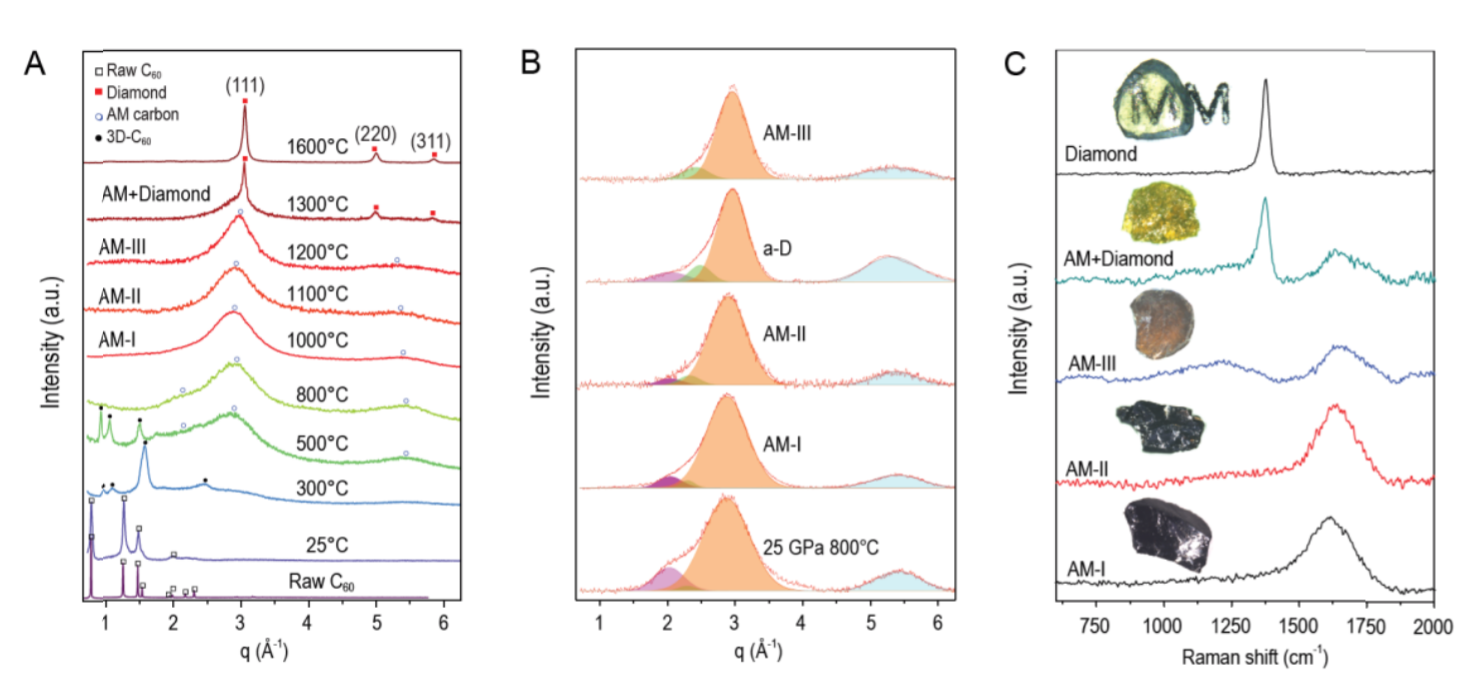
Herein, we report the amorphous (AM) carbon materials with high fraction of sp³ bonding recovered from compression of fullerene C₆₀ under high pressure and high temperature previously unexplored. Analysis of photoluminescence and absorption spectra demonstrates that they are semiconducting with a bandgap range of 1.5–2.2 eV, comparable to that of widely used amorphous silicon.

Comprehensive mechanical tests demonstrate that the synthesized AM-III carbon is the hardest and strongest amorphous material known so far, which can scratch diamond crystal and approach its strength. The produced AM carbon materials combine outstanding mechanical and electronic properties, and may potentially be used in photovoltaic applications that require ultrahigh strength and wear resistance.
Discovery of carbon-based strongest and hardest amorphous material_1
Discovery of carbon-based strongest and hardest amorphous material_2
Discovery of carbon-based strongest and hardest amorphous material_3
  • Integrated photonic synapses, neurons, memristors, and neural networks for photonic neuromorphic computing
  • Shufei Han, Weihong Shen, Min Gu, Qiming Zhang
  • Opto-Electronic Technology
  • 2025-12-25
  • Photoacoustic spectroscopy and light-induced thermoelastic spectroscopy based on inverted-triangular lithium niobate tuning fork
  • Junjie Mu, Guowei Han, Runqiu Wang, Shunda Qiao, Ying He Yufei Ma
  • Opto-Electronic Science
  • 2025-12-25
  • Thin-film lithium niobate-based detector: recent advances and perspectives
  • Xiaoli Sun, Yuechen Jia, Feng Chen
  • Opto-Electronic Science
  • 2025-12-25
  • In-situ and ex-situ twisted bilayer liquid crystal computing platform for reconfigurable image processing
  • Kang Zeng, Yougang Ke, Zhangming Hong, Linzhou Zeng, Xinxing Zhou
  • Opto-Electronic Advances
  • 2025-12-25
  • Highly textured single-crystal-like perovskite films for large-area, high-performance photodiodes
  • Runkai Liu, Feng Li, Rongkun Zheng
  • Opto-Electronic Advances
  • 2025-12-25
  • Robust performance of PTQ10:DTY6 in halogen-free photovoltaics across deposition techniques and configurations for industrial scale-up
  • Atiq Ur Rahman, Tanner M. Melody, Sydney Pfleiger, Acacia Patterson, Andrea Reale, Brian A. Collins
  • Opto-Electronic Advances
  • 2025-12-25
  • Surpassing the diffraction limit in long-range laser engineering via cross-scale vectorial optical field manipulation: perspectives and outlooks
  • Yinghui Guo, Mingbo Pu, Yang Li, Mingfeng Xu, Xiangang Luo
  • Opto-Electronic Advances
  • 2025-12-25
  • Spatiotemporal multiplexed photonic reservoir computing: parallel prediction for the high-dimensional dynamics of complex semiconductor laser network
  • Tong Yang, Li-Yue Zhang, Song-Sui Li, Wei Pan, Xi-Hua Zou, Lian-Shan Yan
  • Opto-Electronic Advances
  • 2025-12-25
  • Filament based ionizing radiation sensing
  • Pengfei Qi, Haiyi Liu, Jiewei Guo, Nan Zhang, Lu Sun, Shishi Tao, Binpeng Shang, Lie Lin Weiwei Liu
  • Opto-Electronic Advances
  • 2025-12-25
  • Separation and identification of mixed signal for distributed acoustic sensor using deep learning
  • Huaxin Gu, Jingming Zhang, Xingwei Chen, Feihong Yu, Deyu Xu, Shuaiqi Liu, Weihao Lin, Xiaobing Shi, Zixing Huang, Xiongji Yang, Qingchang Hu, Liyang Shao
  • Opto-Electronic Advances
  • 2025-11-25
  • Scale-invariant 3D face recognition using computer-generated holograms and the Mellin transform
  • Yongwei Yao, Yaping Zhang, Huanrong He, Xianfeng David Gu, Daping Chu, Ting-Chung Poon
  • Opto-Electronic Advances
  • 2025-11-25
  • Partially coherent optical chip enables physical-layer public-key encryption
  • Bo Wu, Wenkai Zhang, Hailong Zhou, Jianji Dong, Yilun Wang, Xinliang Zhang
  • Opto-Electronic Advances
  • 2025-11-25


  • Crowded catalyst, better catalyst                                Semi-heterogeneous photo-Cu-dual-catalytic cross-coupling reactions using polymeric carbon nitrides
    About
    |
    Contact
    |
    Copyright © PubCard