(Peer-Reviewed) Graphene-empowered dynamic metasurfaces and metadevices
Chao Zeng 曾超 ¹, Hua Lu 陆华 ¹, Dong Mao 毛东 ¹, Yueqing Du 杜岳卿 ¹, He Hua ¹, Wei Zhao 赵卫 ², Jianlin Zhao 赵建林 ¹
¹ MOE Key Laboratory of Material Physics and Chemistry under Extraordinary Conditions, and Shaanxi Key Laboratory of Optical Information Technology, School of Physical Science and Technology, Northwestern Polytechnical University, Xi'an 710129, China
中国 西安 西北工业大学物理科学与技术学院 超常条件材料物理与化学教育部重点实验室 陕西省信息光子技术重点实验室
² State Key Laboratory of Transient Optics and Photonics, Xi’an Institute of Optics and Precision Mechanics, Chinese Academy of Sciences, Xi'an 710119, China
中国 西安 中国科学院西安光学精密机械研究所 瞬态光学与光子技术国家重点实验室
Opto-Electronic Advances, 2022-04-25
Abstract
Metasurfaces, with extremely exotic capabilities to manipulate electromagnetic (EM) waves, have derived a plethora of advanced metadevices with intriguing functionalities. Tremendous endeavors have been mainly devoted to the static metasurfaces and metadevices, where the functionalities cannot be actively tunedin situpost-fabrication.
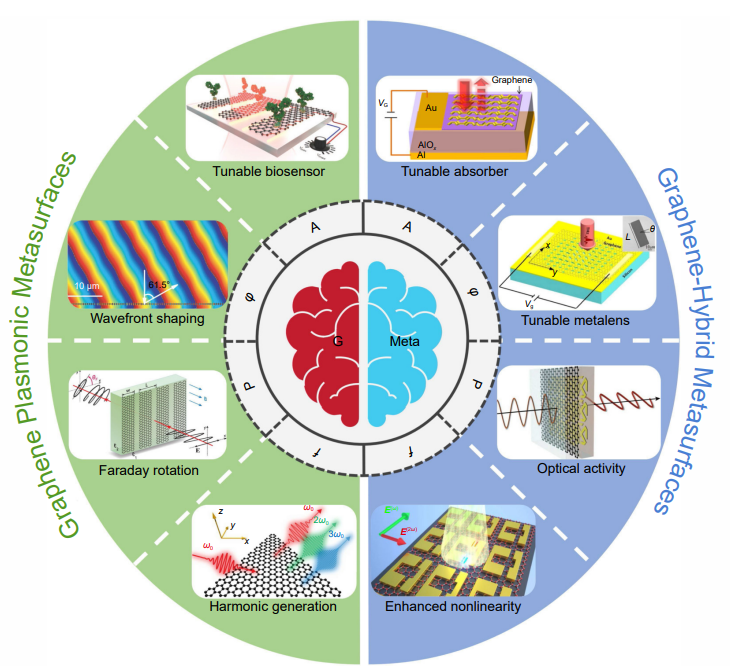
Due to the intrinsic advantage of active tunability by external stimulus, graphene has been successively demonstrated as a favorable candidate to empower metasurfaces with remarkably dynamic tunability, and their recent advances are propelling the EM wave manipulations to a new height: from static to dynamic. Here, we review the recent progress on dynamic metasurfaces and metadevices enabled by graphene with the focus on electrically-controlled dynamic manipulation of the EM waves covering the mid-infrared, terahertz, and microwave regimes.
The fundamentals of graphene, including basic material properties and plasmons, are first discussed. Then, graphene-empowered dynamic metasurfaces and metadevices are divided into two categories, i.e., metasurfaces with building blocks of structured graphene and hybrid metasurfaces integrated with graphene, and their recent advances in dynamic spectrum manipulation, wavefront shaping, polarization control, and frequency conversion in near/far fields and global/local ways are elaborated.
In the end, we summarize the progress, outline the remaining challenges, and prospect the potential future developments.
A 36 × 240 Gbps hybrid mode/wavelength division multiplexing transmitter using lithium niobate on insulator
Mingyu Zhu, Weihan Wang, Ruitao Ma, Aoyun Gao, Chun Gao, Zexu Wang, Fei Huang, Zhenyuan Bao, Dajian Liu, Jiaxuan Gan, Zejie Yu, Huan Li, Weike Zhao, Daoxin Dai
Opto-Electronic Advances
2026-08-25
Light-perception-based interactive control of an underwater digital twin hand
Jinlong Lu, Chao Zhang, Hengchang Nong, Dongying Wang, Hongyu Zhou, Junjie Weng, Yuehua Deng, Yang Yu, Qiang Bian, Jianfa Zhang, Chaofan Zhang, Zhenrong Zhang, Junbo Yang
Opto-Electronic Advances
2026-07-10
Unlocking home-based nocturnal health management: A fiber-optic approach for early detection of cardiorespiratory rhythm disorders
Hanyu Jin, Hao Li, Zhuolin Chen, Liangye Li, Zurui Wang, Kai Zhou, Weijian Hang, Zhipeng Chen, Junfeng Chen, Kai Shen, Jianfeng Wen, Chen Chen, Cunzheng Fan, Zhijun Yan, Feng Wang, Qizhen Sun
Opto-Electronic Advances
2026-07-10
A flexible wireless system for prospective photodynamic therapy applications
Rolan Mansour, Bhavani Yalagala, Vikas Vikas, Nikolas Bruce, Fawziye Tarhini, Georgios N. Arvanitakis, Mohammed Mughal, Jamie Blanche, Ahmad Taha, Jonathan Copper, Muhammad Imran, Karin Williams, Karin Oien, Mahmoud Wagih, Hadi Heidari, Robert Hadfield, David Flynn
Opto-Electronic Advances
2026-07-10
Parallel bright-field and multi-order edge imaging via wide field-of-view trichannel metalens
Xiaotong Li, Yeseul Kim, Youngsun Jeon, Junhwa Seong, Jaekyung Kim, Peng Tang, Shiqi Hu, Harit Keawmuang, Beomha Yang, Dongmin Jeon, Le Dai, Weiyan Li, Xiaodong Cai, Jinhui Shi, Yong-Sang Ryu, Trevon Badloe, Junsuk Rho
Opto-Electronic Advances
2026-07-10