(Peer-Reviewed) Surrogate-guided conditional generative adversarial network for generative design of 3D-printable terahertz holographic metasurfaces
Manxu Lv ¹ ², Zhikai Hu ¹ ², Zhichuan Xie ² ³, Huizhen Feng ⁴ Dongping Zhang ⁴, Manna Gu ⁴, Chee Leong Tan ⁵, Bo Fang ¹, Yongxing Jin ³, Ying Tian ³, Xufeng Jing ² ⁴
¹ College of Metrology & Measurement Engineering, China Jiliang University, Hangzhou 310018, China
中国 杭州 中国计量大学计量测试工程学院
² Centre for THz Research, China Jiliang University, Hangzhou 310018, China
中国 杭州 中国计量大学太赫兹技术与应用研究所
³ Institute of Optoelectronic Technology, China Jiliang University, Hangzhou 310018, China
中国 杭州 中国计量大学光电子技术研究所
⁴ College of Information Engineering, China Jiliang University, Hangzhou 310018, China
中国 杭州 中国计量大学信息工程学院
⁵ Department of Electrical and Computer Engineering, Portland State University, Portland, OR 97201, USA
Opto-Electronic Advances, 2026-11-05
Abstract
Terahertz metasurface holography requires unit cells with prescribed complex transmission responses and sufficient compatibility with practical fabrication processes. For elementary low-bit phase quantization at 0.1 THz, conventional parameter sweeping of simple geometries remains an effective and reliable approach. However, when the design objective is extended from a single phase state to simultaneous consideration of complex transmission matching, transmission amplitude, structural connectivity, and fabrication-related geometric constraints, the design problem becomes a constrained multi-objective inverse-design task.
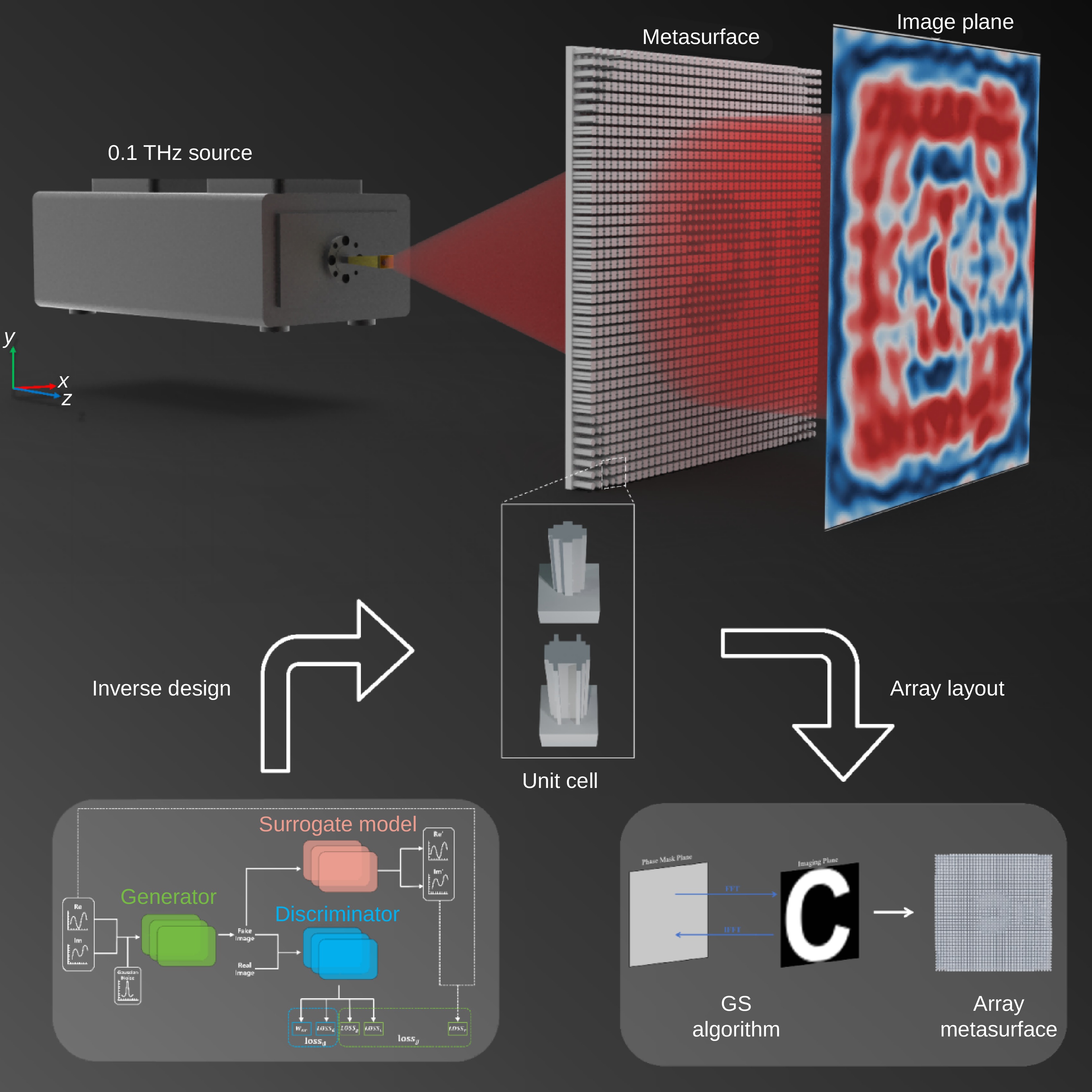
Here, we propose a generative-model-assisted inverse-design framework for 3D-printable terahertz metasurface unit cells. The framework combines a VGG-based surrogate model with a modified WGAN-GP generator. The surrogate model maps binary unit-cell patterns to the real and imaginary parts of the transmission coefficient, while the generator produces candidate structures conditioned on target complex transmission responses. A surrogate-assisted physical-response loss and a content regularization loss are introduced to guide the generated patterns toward both the desired transmission response and the constrained structural distribution. The generated unit cells are then selected according to target phase states and assembled into 1-bit, 2-bit, and 3-bit holographic metasurface arrays using phase distributions obtained by the Gerchberg–Saxton algorithm.
Model evaluation shows improved generation stability compared with tested baseline models, with a mean absolute error of approximately 0.06, an average accuracy above 0.95, and an average coefficient of determination of approximately 0.96 after convergence. Ceramic 3D printing and 0.1 THz holographic experiments further demonstrate that the generated structures can support terahertz holographic imaging, especially for 1-bit and 2-bit designs. The 3-bit experiment shows that higher-bit phase quantization is more sensitive to accumulated design, fabrication, array-level, and experimental uncertainties, highlighting the need for improved design-to-experiment error control in future high-bit designs.
This work provides a fabrication-aware generative inverse-design workflow for terahertz metasurface holography and clarifies both its potential and current fabrication-related limitations.
Ultrafast all-optical biomimetic encoder for spiking neural networks
Qijun Bian, Fangchen Hu, Junlian Jia, Aolong Sun, Sizhe Xing, Boyu Dong, An Yan, Ziwei Li, Jianyang Shi, Nan Chi, Junwen Zhang
Opto-Electronic Science
2026-10-20
Neural holography enabled multi-beam steering for multi-task classifier
Lin Wu, Mian Wu, Zhen Li, Ying Qiu, Zichen Liu, Yongquan Zeng, Guozhen Liang, Hanbing Li, Guoxing Zheng, Zhixue He, Xi Xiao, Qi Jie Wang, Jin Tao, Shaohua Yu
Opto-Electronic Technology
2026-09-30
Recent progress on mid-infrared and terahertz dual-comb spectroscopy
Zhuoren Wan, Min Li, Binbin Liu, Yu Xia, Yuan Chen, Xiuxiu Zhang, Dongxu Zhu, Yan Dai, Sinan Tao, Hua Li, Ming Yan, Heping Zeng
Opto-Electronic Technology
2026-09-30