(Peer-Reviewed) Solvent-free fabrication of broadband WS₂ photodetectors on paper
Wenliang Zhang 张文亮 ¹, Onur Çakıroğlu ¹, Abdullah Al-Enizi ², Ayman Nafady ², Xuetao Gan 甘雪涛 ³, Xiaohua Ma 马晓华 ⁴, Sruthi Kuriakose ¹, Yong Xie 谢涌 ¹ ⁴, Andres Castellanos-Gomez ¹
¹ Materials Science Factory, Instituto de Ciencia de Materiales de Madrid (ICMM-CSIC), Madrid E-28049, Spain
² Department of Chemistry, College of Science, King Saud University, Riyadh 11451, Saudi Arabia
³ Key Laboratory of Light Field Manipulation and Information Acquisition, Ministry of Industry and Information Technology, and Shaanxi Key Laboratory of Optical Information Technology, School of Physical Science and Technology, Northwestern Polytechnical University, Xi'an 710129, China
中国 西安 西北工业大学物理科学与技术学院 光场调控与信息感知工业和信息化部重点实验室 陕西省光信息技术重点实验室
⁴ School of Advanced Materials and Nanotechnology, Xidian University, Xi'an 710071, China
中国 西安 西安电子科技大学 先进材料与纳米科技学院
Opto-Electronic Advances, 2022-12-09
Abstract
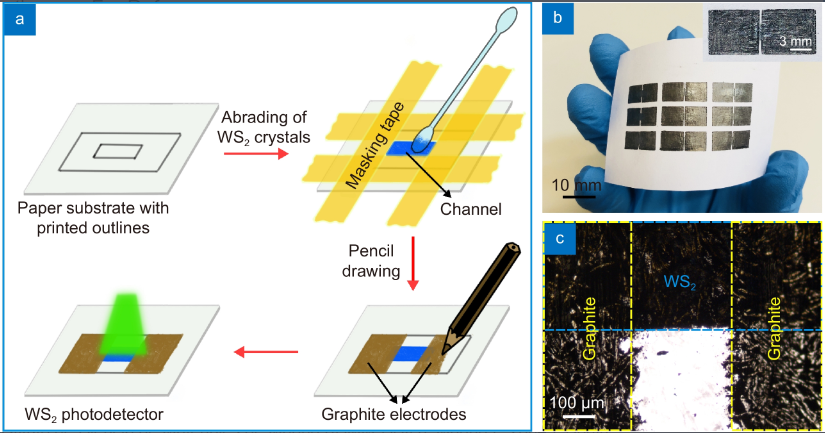
Paper-based devices have attracted extensive attention due to the growing demand for disposable flexible electronics. Herein, we integrate semiconducting devices on cellulose paper substrate through a simple abrasion technique that yields high-performance photodetectors.
A solvent-free WS₂ film deposited on paper favors an effective electron-hole separation and hampers recombination. The as-prepared paper-based WS₂ photodetectors exhibit a sensitive photoresponse over a wide spectral range spanning from ultraviolet (365 nm) to near-infrared (940 nm). Their responsivity value reaches up to ~270 mA W⁻¹ at 35 V under a power density of 35 mW cm⁻². A high performance photodetector was achieved by controlling the environmental exposure as the ambient oxygen molecules were found to decrease the photoresponse and stability of the WS₂ photodetector.
Furthermore, we have built a spectrometer using such a paper-based WS₂ device as the photodetecting component to illustrate its potential application. The present work could promote the development of cost-effective disposable photodetection devices.
Ultrafast all-optical modulation of wide-bandwidth pulses enabled by silicon-metasurfaces
Kaloyan Georgiev, Khosro Zangeneh Kamali, Anton A. Trifonov, Giulia Crotti, Lyuben Petrov, Stefan Georgiev, Hristo Iliev, Lei Xu, Unai Arregui Leon, Mohsen Rahmani, Giuseppe Della Valle, Ivan Buchvarov, Dragomir Neshev
Opto-Electronic Advances
2026-09-15
Physics-informed neural fields enable blind aberration correction for partially coherent quantitative phase imaging
Shun Zhou, Xingyu Huang, Linpeng Lu, Habib Ullah, Kaiyu Du, Maciej Trusiak, Malgorzata Kujawinska, Yuzhen Zhang, Yao Fan, Qian Chen, Qinrong Zhang, Chao Zuo
Opto-Electronic Science
2026-08-26
Heterogeneously integrated micro-ring with SnS₂ for dual-functional optical modulation and photodetection
Jinyi Du, Lidan Lu, Xu Zhang, Bofei Zhu, Wenbo Bo, Yingjie Xu, Guang Chen, Yanlin He, Guanghui Ren, Xiaoping Lou, Zheng You, Lianqing Zhu
Opto-Electronic Advances
2026-08-25
Hardware-aware lightweight photonic spiking neural network for pattern classification
Shuiying Xiang, Yahui Zhang, Shangxuan Shi, Haowen Zhao, Dianzhuang Zheng, Xingxing Guo, Yanan Han, Ye Tian, Liyue Zhang, Yuechun Shi, Yue Hao
Opto-Electronic Advances
2026-08-25
PhyspeNet: An empirical physics-aware network for adaptive speckle reconstructive spectrometry
Junrui Liang, Min Jiang, Jun Li, Zhongming Huang, Junhong He, Yanting Guo, Yanzhao Ke, Jun Ye, Jiangming Xu, Jinyong Leng, Pu Zhou
Opto-Electronic Advances
2026-08-25
A 36 × 240 Gbps hybrid mode/wavelength division multiplexing transmitter using lithium niobate on insulator
Mingyu Zhu, Weihan Wang, Ruitao Ma, Aoyun Gao, Chun Gao, Zexu Wang, Fei Huang, Zhenyuan Bao, Dajian Liu, Jiaxuan Gan, Zejie Yu, Huan Li, Weike Zhao, Daoxin Dai
Opto-Electronic Advances
2026-08-25