(Peer-Reviewed) Pencil-beam scanning catheter for intracoronary optical coherence tomography
Jiqiang Kang 康吉强 ¹, Rui Zhu 朱锐 ² ³ ⁴, Yunxu Sun 孙云旭 ¹, Jianan Li 李嘉男 ³ ⁴, Kenneth K. Y. Wong 黄建业 ⁵ ⁶
¹ School of Electronic and Information Engineering, Harbin Institute of Technology (Shenzhen), Shenzhen 518055, China
中国 深圳 哈尔滨工业大学(深圳)电子与信息工程学院
² International Graduate School at Shenzhen, Tsinghua University, Shenzhen 518055, China
中国 深圳 清华大学深圳国际研究生院
³ Shenzhen Vivolight Medical Device & Technology Co., Ltd., Shenzhen 518055, China
中国 深圳 深圳市中科微光医疗器械技术有限公司
⁴ State Key Laboratory of Transient Optics and Photonics, Xi’an Institute of Optics and Precision Mechanics, Chinese Academy of Sciences, Xi'an 710119, China
中国 西安 中国科学院西安光学精密机械研究所 瞬态光学与光子技术国家重点实验室
⁵ Department of Electrical and Electronic Engineering, The University of Hong Kong, Pokfulam Road, Hong Kong, China
中国 香港 香港大学电机电子工程系
⁶ Advanced Biomedical Instrumentation Centre, Hong Kong Science Park, Shatin, New Territories, Hong Kong, China
中国 香港 香港科学园 先进生物医学仪器中心
Opto-Electronic Advances
, 2022-03-25
Abstract
Current gradient-index (GRIN) lens based proximal-driven intracoronary optical coherence tomography (ICOCT) probes consist of a spacer and a GRIN lens with large gradient constant. This design provides great flexibility to control beam profiles, but the spacer length should be well controlled to obtain desired beam profiles and thus it sets an obstacle in mass catheter fabrication. Besides, although GRIN lens with large gradient constant can provide tight focus spot, it has short depth of focus and fast-expanded beam which leads to poor lateral resolution for deep tissue.
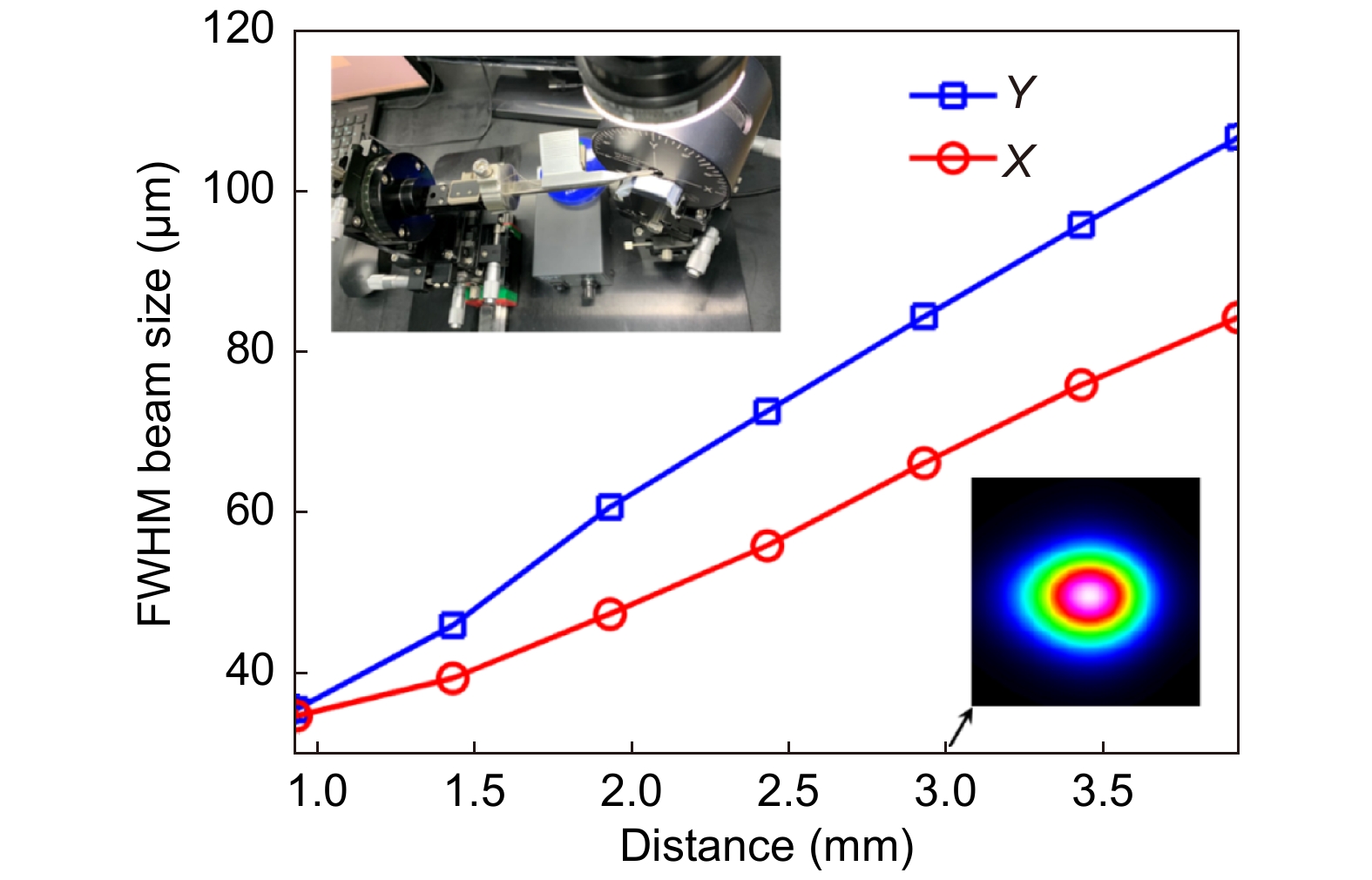
In this paper, a type of spacer-removed probe is demonstrated with a small gradient constant GRIN lens. This design simplifies the fabrication process and is suitable for mass production. The output beam of the catheter is a narrow nearly collimated light beam, referred to as pencil beam here. The full width at half maximum beam size varies from 35.1 µm to 75.3 µm in air over 3-mm range.
Probe design principles are elaborated with probe/catheter fabrication and performance test. The in vivo imaging of the catheter was verified by a clinical ICOCT system. Those results prove that this novel pencil-beam scanning catheter is potentially a good choice for ICOCT systems.
Ultrafast all-optical modulation of wide-bandwidth pulses enabled by silicon-metasurfaces
Kaloyan Georgiev, Khosro Zangeneh Kamali, Anton A. Trifonov, Giulia Crotti, Lyuben Petrov, Stefan Georgiev, Hristo Iliev, Lei Xu, Unai Arregui Leon, Mohsen Rahmani, Giuseppe Della Valle, Ivan Buchvarov, Dragomir Neshev
Opto-Electronic Advances
2026-09-15
Physics-informed neural fields enable blind aberration correction for partially coherent quantitative phase imaging
Shun Zhou, Xingyu Huang, Linpeng Lu, Habib Ullah, Kaiyu Du, Maciej Trusiak, Malgorzata Kujawinska, Yuzhen Zhang, Yao Fan, Qian Chen, Qinrong Zhang, Chao Zuo
Opto-Electronic Science
2026-08-26
Heterogeneously integrated micro-ring with SnS₂ for dual-functional optical modulation and photodetection
Jinyi Du, Lidan Lu, Xu Zhang, Bofei Zhu, Wenbo Bo, Yingjie Xu, Guang Chen, Yanlin He, Guanghui Ren, Xiaoping Lou, Zheng You, Lianqing Zhu
Opto-Electronic Advances
2026-08-25
Hardware-aware lightweight photonic spiking neural network for pattern classification
Shuiying Xiang, Yahui Zhang, Shangxuan Shi, Haowen Zhao, Dianzhuang Zheng, Xingxing Guo, Yanan Han, Ye Tian, Liyue Zhang, Yuechun Shi, Yue Hao
Opto-Electronic Advances
2026-08-25
PhyspeNet: An empirical physics-aware network for adaptive speckle reconstructive spectrometry
Junrui Liang, Min Jiang, Jun Li, Zhongming Huang, Junhong He, Yanting Guo, Yanzhao Ke, Jun Ye, Jiangming Xu, Jinyong Leng, Pu Zhou
Opto-Electronic Advances
2026-08-25
A 36 × 240 Gbps hybrid mode/wavelength division multiplexing transmitter using lithium niobate on insulator
Mingyu Zhu, Weihan Wang, Ruitao Ma, Aoyun Gao, Chun Gao, Zexu Wang, Fei Huang, Zhenyuan Bao, Dajian Liu, Jiaxuan Gan, Zejie Yu, Huan Li, Weike Zhao, Daoxin Dai
Opto-Electronic Advances
2026-08-25