(Peer-Reviewed) Joint 3D facial shape reconstruction and texture completion from a single image
Xiaoxing Zeng 曾小星 ¹ ², Zhelun Wu ¹, Xiaojiang Peng 彭小江 ¹, Yu Qiao 乔宇 ¹
¹ Shenzhen Institute of Advanced Technology, ChineseAcademy of Sciences, Shenzhen, China
中国 深圳 中国科学院深圳先进技术研究院
² University of Chinese Academy of Sciences, Beijing, China
中国 北京 中国科学院大学
Abstract
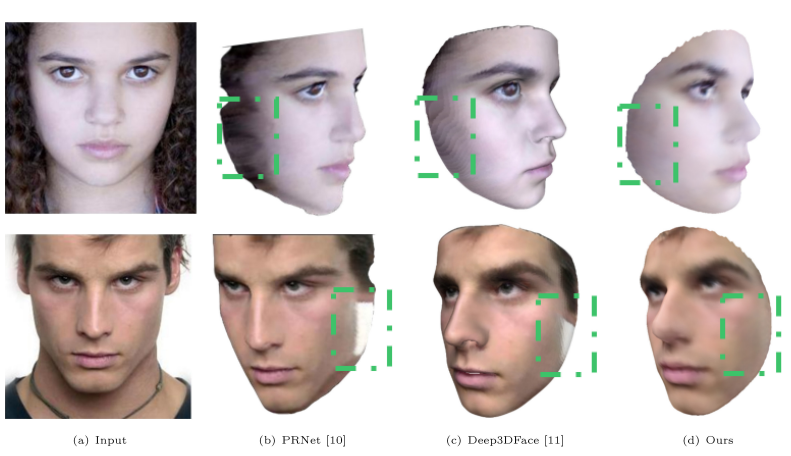
Recent years have witnessed significant progress in image-based 3D face reconstruction using deep convolutional neural networks. However, current reconstruction methods often perform improperly in self-occluded regions and can lead to inaccurate correspondences between a 2D input image and a 3D face template, hindering use in real applications. To address these problems, we propose a deep shape reconstruction and texture completion network, SRTC-Net, which jointly reconstructs 3D facial geometry and completes texture with correspondences from a single input face image.
In SRTC-Net, we leverage the geometric cues from completed 3D texture to reconstruct detailed structures of 3D shapes. The SRTC-Net pipeline has three stages. The first introduces a correspondence network to identify pixel-wise correspondence between the input 2D image and a 3D template model, and transfers the input 2D image to a U-V texture map. Then we complete the invisible and occluded areas in the U-V texture map using an inpainting network. To get the 3D facial geometries, we predict coarse shape (U-V position maps) from the segmented face from the correspondence network using a shape network, and then refine the 3D coarse shape by regressing the U-V displacement map from the completed U-V texture map in a pixel-to-pixel way.
We examine our methods on 3D reconstruction tasks as well as face frontalization and pose invariant face recognition tasks, using both in-the-lab datasets (MICC, MultiPIE) and in-the-wild datasets (CFP). The qualitative and quantitative results demonstrate the effectiveness of our methods on inferring 3D facial geometry and complete texture; they outperform or are comparable to the state-of-the-art.
Ultrafast all-optical modulation of wide-bandwidth pulses enabled by silicon-metasurfaces
Kaloyan Georgiev, Khosro Zangeneh Kamali, Anton A. Trifonov, Giulia Crotti, Lyuben Petrov, Stefan Georgiev, Hristo Iliev, Lei Xu, Unai Arregui Leon, Mohsen Rahmani, Giuseppe Della Valle, Ivan Buchvarov, Dragomir Neshev
Opto-Electronic Advances
2026-09-15
Physics-informed neural fields enable blind aberration correction for partially coherent quantitative phase imaging
Shun Zhou, Xingyu Huang, Linpeng Lu, Habib Ullah, Kaiyu Du, Maciej Trusiak, Malgorzata Kujawinska, Yuzhen Zhang, Yao Fan, Qian Chen, Qinrong Zhang, Chao Zuo
Opto-Electronic Science
2026-08-26
Heterogeneously integrated micro-ring with SnS₂ for dual-functional optical modulation and photodetection
Jinyi Du, Lidan Lu, Xu Zhang, Bofei Zhu, Wenbo Bo, Yingjie Xu, Guang Chen, Yanlin He, Guanghui Ren, Xiaoping Lou, Zheng You, Lianqing Zhu
Opto-Electronic Advances
2026-08-25
Hardware-aware lightweight photonic spiking neural network for pattern classification
Shuiying Xiang, Yahui Zhang, Shangxuan Shi, Haowen Zhao, Dianzhuang Zheng, Xingxing Guo, Yanan Han, Ye Tian, Liyue Zhang, Yuechun Shi, Yue Hao
Opto-Electronic Advances
2026-08-25
PhyspeNet: An empirical physics-aware network for adaptive speckle reconstructive spectrometry
Junrui Liang, Min Jiang, Jun Li, Zhongming Huang, Junhong He, Yanting Guo, Yanzhao Ke, Jun Ye, Jiangming Xu, Jinyong Leng, Pu Zhou
Opto-Electronic Advances
2026-08-25
A 36 × 240 Gbps hybrid mode/wavelength division multiplexing transmitter using lithium niobate on insulator
Mingyu Zhu, Weihan Wang, Ruitao Ma, Aoyun Gao, Chun Gao, Zexu Wang, Fei Huang, Zhenyuan Bao, Dajian Liu, Jiaxuan Gan, Zejie Yu, Huan Li, Weike Zhao, Daoxin Dai
Opto-Electronic Advances
2026-08-25