(Peer-Reviewed) The influences of environmental factors on the air-sea coupling coefficient
Yanmin Zhang 张彦敏 ¹, Yifan Wang ¹, Yunhua Wang 王运华 ¹ ², Yining Bai ¹, Chaofang Zhao 赵朝方 ¹ ²
¹ College of Information Science and Engineering, Ocean University of China, Qingdao 266100, China
中国 青岛 中国海洋大学信息科学与工程学院
² Laboratory for Regional Oceanography and Numerical Modeling, Pilot National Laboratory for Marine Science and Technology (Qingdao), Qingdao 266237, China
中国 青岛 青岛海洋科学与技术试点国家实验室 区域海洋动力学与数值模拟功能实验室
Abstract
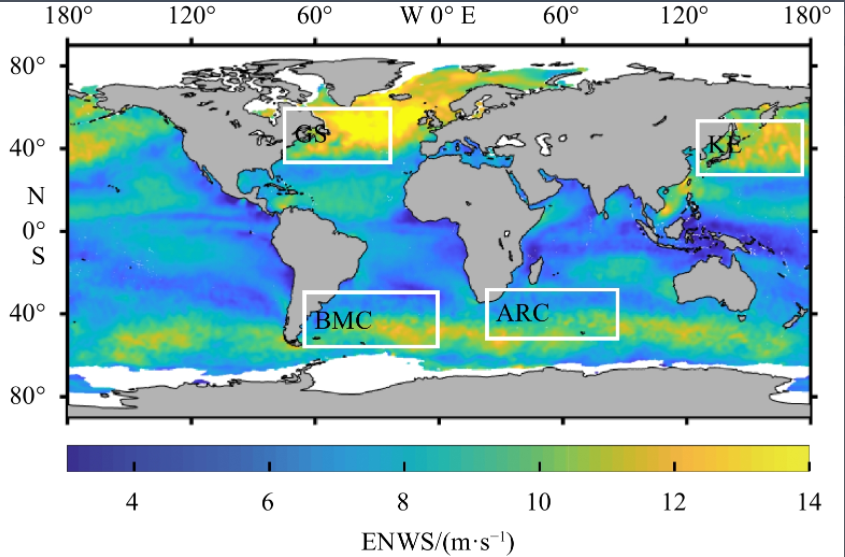
The response relationship between equivalent neutral wind speed anomaly (ENWSA) and sea-air temperature difference anomaly (SATDA) has been analyzed over four typical sea regions, i.e., the Kuroshio Extension, the Gulf Stream, the Brazil-Malvinas Confluence and the Agulhas Return Current. The results show that ENWSA is more sensitive to SATDA than sea surface temperature anomaly (SSTA), which implies that SATDA seems to be a more suitable parameter than SSTA to analyze the mesoscale air-sea interactions.
Here, the slope of the linear relation between ENWSA and SATDA is defined as the air-sea coupling coefficient. It is found that the values of the coupling coefficient over the four typical sea areas have obvious seasonal variations and geographical differences.
In order to reveal the reason of the seasonal variation and geographical difference of the coupling coefficient, the influences of some environmental background factors, such as the spatially averaged sea surface temperature (SST), the spatially averaged air temperature, the spatially averaged sea-air temperature difference and the spatially averaged equivalent neutral wind speed, on the coupling coefficient are discussed in detail.
The results reveal that the background sea-air temperature difference is an important environmental factor which directly affects the magnitude of the coupling coefficients, meanwhile, the seasonal and geographical variations of the coupling coefficient.
Ultrafast all-optical modulation of wide-bandwidth pulses enabled by silicon-metasurfaces
Kaloyan Georgiev, Khosro Zangeneh Kamali, Anton A. Trifonov, Giulia Crotti, Lyuben Petrov, Stefan Georgiev, Hristo Iliev, Lei Xu, Unai Arregui Leon, Mohsen Rahmani, Giuseppe Della Valle, Ivan Buchvarov, Dragomir Neshev
Opto-Electronic Advances
2026-09-15
Physics-informed neural fields enable blind aberration correction for partially coherent quantitative phase imaging
Shun Zhou, Xingyu Huang, Linpeng Lu, Habib Ullah, Kaiyu Du, Maciej Trusiak, Malgorzata Kujawinska, Yuzhen Zhang, Yao Fan, Qian Chen, Qinrong Zhang, Chao Zuo
Opto-Electronic Science
2026-08-26
Heterogeneously integrated micro-ring with SnS₂ for dual-functional optical modulation and photodetection
Jinyi Du, Lidan Lu, Xu Zhang, Bofei Zhu, Wenbo Bo, Yingjie Xu, Guang Chen, Yanlin He, Guanghui Ren, Xiaoping Lou, Zheng You, Lianqing Zhu
Opto-Electronic Advances
2026-08-25
Hardware-aware lightweight photonic spiking neural network for pattern classification
Shuiying Xiang, Yahui Zhang, Shangxuan Shi, Haowen Zhao, Dianzhuang Zheng, Xingxing Guo, Yanan Han, Ye Tian, Liyue Zhang, Yuechun Shi, Yue Hao
Opto-Electronic Advances
2026-08-25
PhyspeNet: An empirical physics-aware network for adaptive speckle reconstructive spectrometry
Junrui Liang, Min Jiang, Jun Li, Zhongming Huang, Junhong He, Yanting Guo, Yanzhao Ke, Jun Ye, Jiangming Xu, Jinyong Leng, Pu Zhou
Opto-Electronic Advances
2026-08-25
A 36 × 240 Gbps hybrid mode/wavelength division multiplexing transmitter using lithium niobate on insulator
Mingyu Zhu, Weihan Wang, Ruitao Ma, Aoyun Gao, Chun Gao, Zexu Wang, Fei Huang, Zhenyuan Bao, Dajian Liu, Jiaxuan Gan, Zejie Yu, Huan Li, Weike Zhao, Daoxin Dai
Opto-Electronic Advances
2026-08-25