(Peer-Reviewed) Seasonal Cumulative Effect of Ural Blocking Episodes on the Frequent Cold events in China during the Early Winter of 2020/21
Yao Yao 姚遥 ¹ ², Wenqi Zhang ¹ ², Dehai Luo 罗德海 ¹ ², Linhao Zhong 钟霖浩 ¹ ², Lin Pei 裴琳 ³
¹ Key Laboratory of Regional Climate-Environment for Temperate East Asia, Institute of Atmospheric Physics, Chinese Academy of Sciences, Beijing, 100029, China
中国 北京 中国科学院大气物理研究所 东亚区域气候-环境重点实验室
² University of Chinese Academy of Sciences, Beijing, 100029, China
中国 北京 中国科学院大学
³ Institute of Urban Meteorology, China Meteorological Administration, Beijing, 100029, China
中国 北京 中国气象局 北京城市气象研究所
Abstract
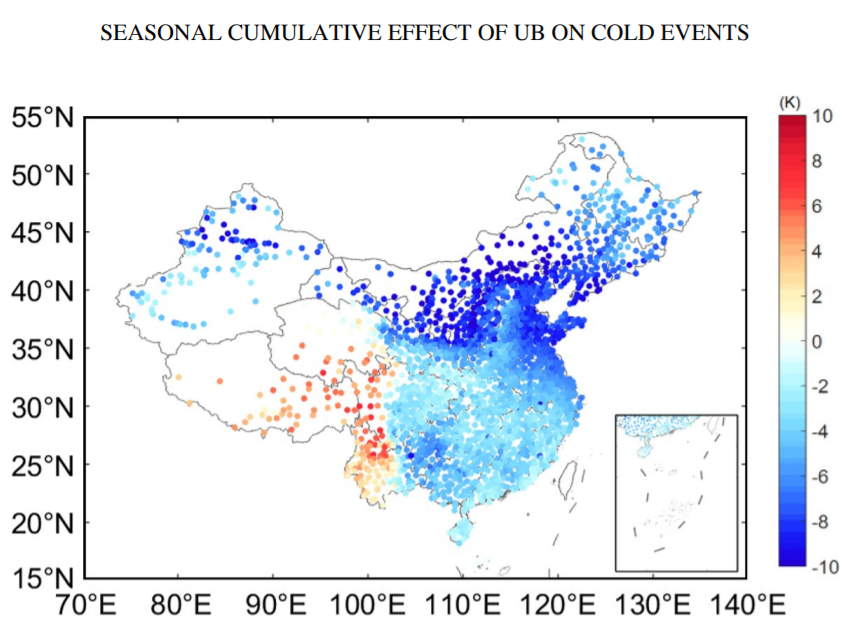
Starting in mid-November, China was hit by several cold events during the early winter of 2020/21. The lowest temperature observed at Beijing station on 7 January reached −19.6°C. In this paper, we show that the outbreak of the record-breaking extreme cold event can be attributed to a huge merging Ural blocking (UB) ridge over the Eurasian region.
The sea-ice cover in the Kara and East Siberia Seas (KESS) in autumn was at its lowest value since 1979, which could have served as a precursor signal. Further analysis shows that several successive UB episodes occurred from 1 September 2020 to 10 January 2021. The persistent UB that occurred in late September/early October 2020 may have made an important contribution to the October historical minimum of sea ice in the KESS region.
Our results also show that, after each UB episode in winter, significant upward propagation of wave activity occurred around 60°E, which resulted in weakening the stratospheric vortex. Meanwhile, each UB episode also caused a significant reduction in sea-ice extent in KESS and a significant weakening of the westerly jet in mid-high-latitude Eurasia.
Results suggest that the Arctic vortex, which is supposed to enhance seasonally, became weaker and more unstable than the climatic mean under the seasonal cumulative effects of UB episodes, KESS warming, and long-lasting negative-phase North Atlantic Oscillation (NAO-). Those seasonal cumulative effects, combined with the impact of La Niña winter, led to the frequent occurrence of extreme cold events.
Ultrafast all-optical modulation of wide-bandwidth pulses enabled by silicon-metasurfaces
Kaloyan Georgiev, Khosro Zangeneh Kamali, Anton A. Trifonov, Giulia Crotti, Lyuben Petrov, Stefan Georgiev, Hristo Iliev, Lei Xu, Unai Arregui Leon, Mohsen Rahmani, Giuseppe Della Valle, Ivan Buchvarov, Dragomir Neshev
Opto-Electronic Advances
2026-09-15
Physics-informed neural fields enable blind aberration correction for partially coherent quantitative phase imaging
Shun Zhou, Xingyu Huang, Linpeng Lu, Habib Ullah, Kaiyu Du, Maciej Trusiak, Malgorzata Kujawinska, Yuzhen Zhang, Yao Fan, Qian Chen, Qinrong Zhang, Chao Zuo
Opto-Electronic Science
2026-08-26
Heterogeneously integrated micro-ring with SnS₂ for dual-functional optical modulation and photodetection
Jinyi Du, Lidan Lu, Xu Zhang, Bofei Zhu, Wenbo Bo, Yingjie Xu, Guang Chen, Yanlin He, Guanghui Ren, Xiaoping Lou, Zheng You, Lianqing Zhu
Opto-Electronic Advances
2026-08-25
Hardware-aware lightweight photonic spiking neural network for pattern classification
Shuiying Xiang, Yahui Zhang, Shangxuan Shi, Haowen Zhao, Dianzhuang Zheng, Xingxing Guo, Yanan Han, Ye Tian, Liyue Zhang, Yuechun Shi, Yue Hao
Opto-Electronic Advances
2026-08-25
PhyspeNet: An empirical physics-aware network for adaptive speckle reconstructive spectrometry
Junrui Liang, Min Jiang, Jun Li, Zhongming Huang, Junhong He, Yanting Guo, Yanzhao Ke, Jun Ye, Jiangming Xu, Jinyong Leng, Pu Zhou
Opto-Electronic Advances
2026-08-25
A 36 × 240 Gbps hybrid mode/wavelength division multiplexing transmitter using lithium niobate on insulator
Mingyu Zhu, Weihan Wang, Ruitao Ma, Aoyun Gao, Chun Gao, Zexu Wang, Fei Huang, Zhenyuan Bao, Dajian Liu, Jiaxuan Gan, Zejie Yu, Huan Li, Weike Zhao, Daoxin Dai
Opto-Electronic Advances
2026-08-25