(Peer-Reviewed) Intrinsically inert hyperbranched interlayer for enhanced stability of organic solar cells
Yawen Li ¹ ², Tengfei Li 李腾飞 ¹, Jiayu Wang 王嘉宇 ³, Xiaowei Zhan 占肖卫 ³, Yuze Lin 林禹泽 ¹ ²
¹ Beijing National Laboratory for Molecular Sciences, CAS Key Laboratory of Organic Solids Institute of Chemistry, Chinese Academy of Sciences (CAS), Beijing 100190, China
中国 北京 中国科学院化学研究所 有机固体重点实验室 北京分子科学国家实验室
² University of Chinese Academy of Sciences, Beijing 100049, China
中国 北京 中国科学院大学
³ School of Materials Science and Engineering, Peking University, Beijing 100871, China
中国 北京 北京大学材料科学与工程学院
Science Bulletin
, 2021-09-21
Abstract
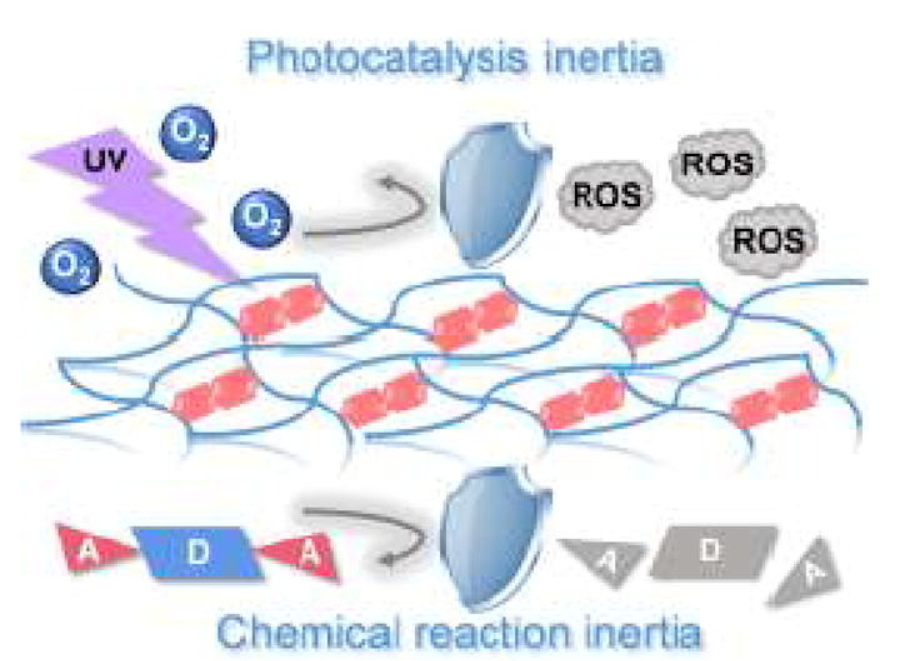
Device stability becomes one of the most crucial issues for the commercialization of organic solar cells (OSCs) after high power conversion efficiencies have been achieved. Besides the intrinsic stability of photoactive materials, the chemical/catalytic reaction between interfacial materials and photoactive materials is another critical factor that destabilizes the device. Herein, we design and synthesize a reaction-inert rylene diimide-embedded hyperbranched polymer named as PDIEIE, which effectively reduces the work function of indium tin oxide electrode from 4.62 to 3.65 eV.
Meanwhile, PDIEIE shows negligible chemical reaction with high-performance photoactive materials and no catalytic effect under strong ultraviolet illumination, resulting in much better photo-stability of OSCs with PDIEIE cathode interlayer (CIL), relative to the traditional CILs, including most-widely used metal oxides and polyethyleneimine derivatives.
Ultrafast all-optical modulation of wide-bandwidth pulses enabled by silicon-metasurfaces
Kaloyan Georgiev, Khosro Zangeneh Kamali, Anton A. Trifonov, Giulia Crotti, Lyuben Petrov, Stefan Georgiev, Hristo Iliev, Lei Xu, Unai Arregui Leon, Mohsen Rahmani, Giuseppe Della Valle, Ivan Buchvarov, Dragomir Neshev
Opto-Electronic Advances
2026-09-15
Physics-informed neural fields enable blind aberration correction for partially coherent quantitative phase imaging
Shun Zhou, Xingyu Huang, Linpeng Lu, Habib Ullah, Kaiyu Du, Maciej Trusiak, Malgorzata Kujawinska, Yuzhen Zhang, Yao Fan, Qian Chen, Qinrong Zhang, Chao Zuo
Opto-Electronic Science
2026-08-26
Heterogeneously integrated micro-ring with SnS₂ for dual-functional optical modulation and photodetection
Jinyi Du, Lidan Lu, Xu Zhang, Bofei Zhu, Wenbo Bo, Yingjie Xu, Guang Chen, Yanlin He, Guanghui Ren, Xiaoping Lou, Zheng You, Lianqing Zhu
Opto-Electronic Advances
2026-08-25
Hardware-aware lightweight photonic spiking neural network for pattern classification
Shuiying Xiang, Yahui Zhang, Shangxuan Shi, Haowen Zhao, Dianzhuang Zheng, Xingxing Guo, Yanan Han, Ye Tian, Liyue Zhang, Yuechun Shi, Yue Hao
Opto-Electronic Advances
2026-08-25
PhyspeNet: An empirical physics-aware network for adaptive speckle reconstructive spectrometry
Junrui Liang, Min Jiang, Jun Li, Zhongming Huang, Junhong He, Yanting Guo, Yanzhao Ke, Jun Ye, Jiangming Xu, Jinyong Leng, Pu Zhou
Opto-Electronic Advances
2026-08-25
A 36 × 240 Gbps hybrid mode/wavelength division multiplexing transmitter using lithium niobate on insulator
Mingyu Zhu, Weihan Wang, Ruitao Ma, Aoyun Gao, Chun Gao, Zexu Wang, Fei Huang, Zhenyuan Bao, Dajian Liu, Jiaxuan Gan, Zejie Yu, Huan Li, Weike Zhao, Daoxin Dai
Opto-Electronic Advances
2026-08-25