(Peer-Reviewed) Cell-free chemoenzymatic starch synthesis from carbon dioxide
Tao Cai 蔡韬 ¹ ², Hongbing Sun 孙红兵 ¹ ², Jing Qiao 乔婧 ¹ ², Leilei Zhu 朱蕾蕾 ² ³, Fan Zhang ¹ ², Jie Zhang 张洁 ² ³, Zijing Tang ² ³, Xinlei Wei 魏欣蕾 ² ³, Jiangang Yang 杨建刚 ² ³, Qianqian Yuan 袁倩倩 ² ⁴, Wangyin Wang 王旺银 ⁵, Xue Yang 杨雪 ² ⁴, Huanyu Chu ² ⁴, Qian Wang ² ⁴, Chun You 游淳 ² ³, Hongwu Ma 马红武 ² ⁴, Yuanxia Sun 孙媛霞 ² ³, Yin Li 李寅 ¹ ², Can Li 李灿 ⁵, Huifeng Jiang 江会锋 ² ⁴, Qinhong Wang 王钦宏 ¹ ² ⁴, Yanhe Ma 马延和 ¹ ² ³
¹ Department of Strategic and Integrative Research, Tianjin Institute of Industrial Biotechnology, Chinese Academy of Sciences, Tianjin 300308, China
中国 天津 中国科学院天津工业生物技术研究所 战略与综合研究部
² National Center of Technology Innovation for Synthetic Biology, Tianjin 300308, China
中国 天津 国家合成生物技术创新中心
³ National Engineering Laboratory for Industrial Enzymes, Tianjin Institute of Industrial Biotechnology, Chinese Academy of Sciences, Tianjin 300308, China
中国 天津 中国科学院天津工业生物技术研究所 工业酶国家工程实验室
⁴ CAS Key Laboratory of Systems Microbial Biotechnology, Tianjin Institute of Industrial Biotechnology, Chinese Academy of Sciences, Tianjin 300308, China
中国 天津 中国科学院天津工业生物技术研究所 中国科学院系统微生物工程重点实验室
⁵ State Key Laboratory of Catalysis, Dalian Institute of Chemical Physics, Chinese Academy of Sciences, Dalian 116023, China
中国 大连 中国科学院大连化学物理研究所 催化基础国家重点实验室
Science
, 2021-09-24
Abstract
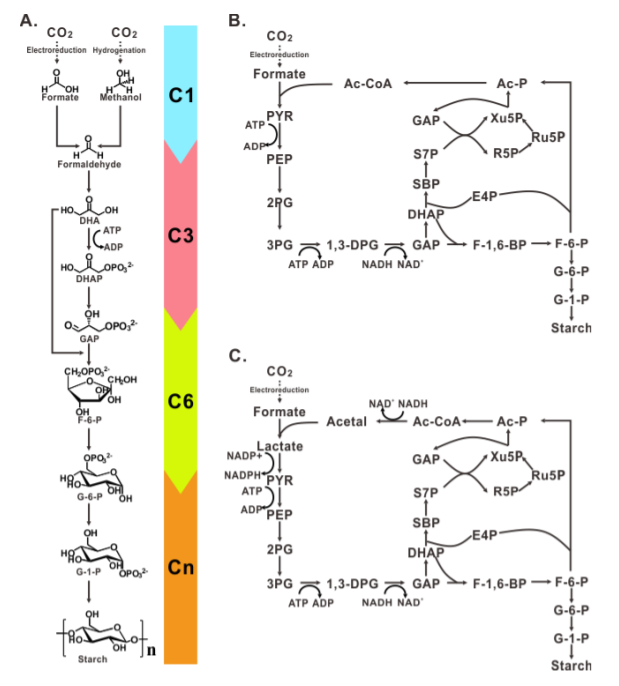
Starches, a storage form of carbohydrates, are a major source of calories in the human diet and a primary feedstock for bioindustry. We report a chemical-biochemical hybrid pathway for starch synthesis from carbon dioxide (CO₂) and hydrogen in a cell-free system. The artificial starch anabolic pathway (ASAP), consisting of 11 core reactions, was drafted by computational pathway design, established through modular assembly and substitution, and optimized by protein engineering of three bottleneck-associated enzymes.
In a chemoenzymatic system with spatial and temporal segregation, ASAP, driven by hydrogen, converts CO₂ to starch at a rate of 22 nanomoles of CO₂ per minute per milligram of total catalyst, an ~8.5-fold higher rate than starch synthesis in maize. This approach opens the way toward future chemo-biohybrid starch synthesis from CO₂.
Ultrafast all-optical modulation of wide-bandwidth pulses enabled by silicon-metasurfaces
Kaloyan Georgiev, Khosro Zangeneh Kamali, Anton A. Trifonov, Giulia Crotti, Lyuben Petrov, Stefan Georgiev, Hristo Iliev, Lei Xu, Unai Arregui Leon, Mohsen Rahmani, Giuseppe Della Valle, Ivan Buchvarov, Dragomir Neshev
Opto-Electronic Advances
2026-09-15
Physics-informed neural fields enable blind aberration correction for partially coherent quantitative phase imaging
Shun Zhou, Xingyu Huang, Linpeng Lu, Habib Ullah, Kaiyu Du, Maciej Trusiak, Malgorzata Kujawinska, Yuzhen Zhang, Yao Fan, Qian Chen, Qinrong Zhang, Chao Zuo
Opto-Electronic Science
2026-08-26
Heterogeneously integrated micro-ring with SnS₂ for dual-functional optical modulation and photodetection
Jinyi Du, Lidan Lu, Xu Zhang, Bofei Zhu, Wenbo Bo, Yingjie Xu, Guang Chen, Yanlin He, Guanghui Ren, Xiaoping Lou, Zheng You, Lianqing Zhu
Opto-Electronic Advances
2026-08-25
Hardware-aware lightweight photonic spiking neural network for pattern classification
Shuiying Xiang, Yahui Zhang, Shangxuan Shi, Haowen Zhao, Dianzhuang Zheng, Xingxing Guo, Yanan Han, Ye Tian, Liyue Zhang, Yuechun Shi, Yue Hao
Opto-Electronic Advances
2026-08-25
PhyspeNet: An empirical physics-aware network for adaptive speckle reconstructive spectrometry
Junrui Liang, Min Jiang, Jun Li, Zhongming Huang, Junhong He, Yanting Guo, Yanzhao Ke, Jun Ye, Jiangming Xu, Jinyong Leng, Pu Zhou
Opto-Electronic Advances
2026-08-25
A 36 × 240 Gbps hybrid mode/wavelength division multiplexing transmitter using lithium niobate on insulator
Mingyu Zhu, Weihan Wang, Ruitao Ma, Aoyun Gao, Chun Gao, Zexu Wang, Fei Huang, Zhenyuan Bao, Dajian Liu, Jiaxuan Gan, Zejie Yu, Huan Li, Weike Zhao, Daoxin Dai
Opto-Electronic Advances
2026-08-25