(Peer-Reviewed) 100 Hertz frame-rate switching three-dimensional orbital angular momentum multiplexing holography via cross convolution
Weijia Meng 孟维佳 ¹ ², Yilin Hua 华怡林 ¹ ², Ke Cheng 成科 ¹ ², Baoli Li 李保莉 ¹ ², Tingting Liu 刘婷婷 ¹ ², Qinyu Chen 陈沁雨 ¹ ², Haitao Luan 栾海涛 ¹ ², Min Gu 顾敏 ¹ ², Xinyuan Fang 方心远 ¹ ²
¹ Institute of Photonic Chips, University of Shanghai for Science and Technology, Shanghai 200093, China
中国 上海 上海理工大学光子芯片研究院
² Centre for Artificial-Intelligence Nanophotonics, School of Optical-Electrical and Computer Engineering, University of Shanghai for Science and Technology, Shanghai 200093, China
中国 上海 上海理工大学光电信息与计算机工程学院 人工智能纳米光子学中心
Opto-Electronic Science
, 2022-09-07
Abstract
The orbital angular momentum (OAM) of light has been implemented as an information carrier in OAM holography. Holographic information can be multiplexed in theoretical unbounded OAM channels, promoting the applications of optically addressable dynamic display and high-security optical encryption.
However, the frame-rate of the dynamic extraction of the information reconstruction process in OAM holography is physically determined by the switching speed of the incident OAM states, which is currently below 30 Hz limited by refreshing rate of the phase-modulation spatial light modulator (SLM).
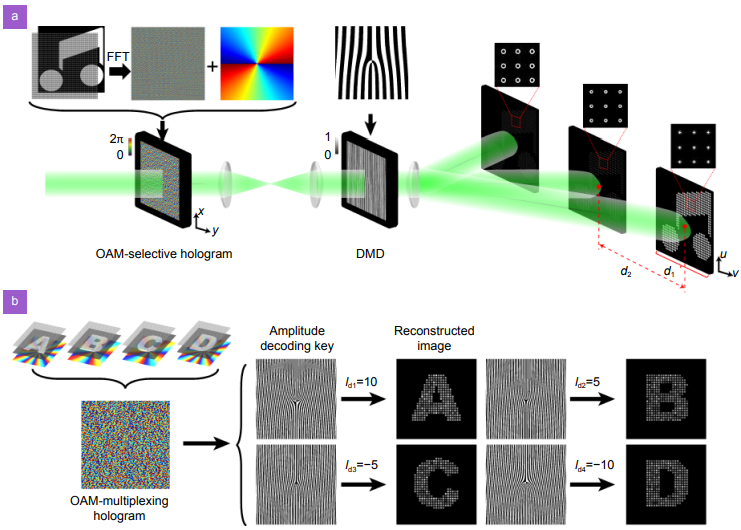
Here, based on a cross convolution with the spatial frequency of the OAM-multiplexing hologram, the spatial frequencies of an elaborately-designed amplitude distribution, namely amplitude decoding key, has been adopted for the extraction of three-dimensional holographic information encoded in a specific OAM information channel.
We experimentally demonstrated a dynamic extraction frame rate of 100 Hz from an OAM multiplexing hologram with 10 information channels indicated by individual OAM values from –50 to 50. The new concept of cross convolution theorem can even provide the potential of parallel reproduction and distribution of information encoded in many OAM channels at various positions which boosts the capacity of information processing far beyond the traditional decoding methods.
Thus, our results provide a holographic paradigm for high-speed 3D information processing, paving an unprecedented way to achieve the high-capacity short-range optical communication system.
Ultrafast all-optical modulation of wide-bandwidth pulses enabled by silicon-metasurfaces
Kaloyan Georgiev, Khosro Zangeneh Kamali, Anton A. Trifonov, Giulia Crotti, Lyuben Petrov, Stefan Georgiev, Hristo Iliev, Lei Xu, Unai Arregui Leon, Mohsen Rahmani, Giuseppe Della Valle, Ivan Buchvarov, Dragomir Neshev
Opto-Electronic Advances
2026-09-15
Physics-informed neural fields enable blind aberration correction for partially coherent quantitative phase imaging
Shun Zhou, Xingyu Huang, Linpeng Lu, Habib Ullah, Kaiyu Du, Maciej Trusiak, Malgorzata Kujawinska, Yuzhen Zhang, Yao Fan, Qian Chen, Qinrong Zhang, Chao Zuo
Opto-Electronic Science
2026-08-26
Heterogeneously integrated micro-ring with SnS₂ for dual-functional optical modulation and photodetection
Jinyi Du, Lidan Lu, Xu Zhang, Bofei Zhu, Wenbo Bo, Yingjie Xu, Guang Chen, Yanlin He, Guanghui Ren, Xiaoping Lou, Zheng You, Lianqing Zhu
Opto-Electronic Advances
2026-08-25
Hardware-aware lightweight photonic spiking neural network for pattern classification
Shuiying Xiang, Yahui Zhang, Shangxuan Shi, Haowen Zhao, Dianzhuang Zheng, Xingxing Guo, Yanan Han, Ye Tian, Liyue Zhang, Yuechun Shi, Yue Hao
Opto-Electronic Advances
2026-08-25
PhyspeNet: An empirical physics-aware network for adaptive speckle reconstructive spectrometry
Junrui Liang, Min Jiang, Jun Li, Zhongming Huang, Junhong He, Yanting Guo, Yanzhao Ke, Jun Ye, Jiangming Xu, Jinyong Leng, Pu Zhou
Opto-Electronic Advances
2026-08-25
A 36 × 240 Gbps hybrid mode/wavelength division multiplexing transmitter using lithium niobate on insulator
Mingyu Zhu, Weihan Wang, Ruitao Ma, Aoyun Gao, Chun Gao, Zexu Wang, Fei Huang, Zhenyuan Bao, Dajian Liu, Jiaxuan Gan, Zejie Yu, Huan Li, Weike Zhao, Daoxin Dai
Opto-Electronic Advances
2026-08-25