(Peer-Reviewed) Direct detection with an optimal transfer function: toward the electrical spectral efficiency of coherent homodyne detection
Xingfeng Li 李星峰 ¹, Jingchi Li 李靖驰 ¹, Xiong Ni 倪雄 ¹, Hudi Liu 刘虎迪 ¹, Qunbi Zhuge 诸葛群碧 ¹, Haoshuo Chen 陈昊硕 ², William Shieh 谢伟 ³, Yikai Su 苏翼凯 ¹
¹ State Key Lab of Advanced Optical Communication Systems and Networks, Department of Electronic Engineering, Shanghai Jiao Tong University, Shanghai 200240, China
中国 上海 上海交通大学电子工程系 区域光纤通信网与新型光通信系统国家重点实验室
² Nokia Bell Labs, 600 Mountain Ave, Murray Hill, NJ 07974, USA
³ School of Engineering, Westlake University, Hangzhou 310030, China
中国 杭州 西湖大学工学院
Opto-Electronic Science
, 2024-12-24
Abstract
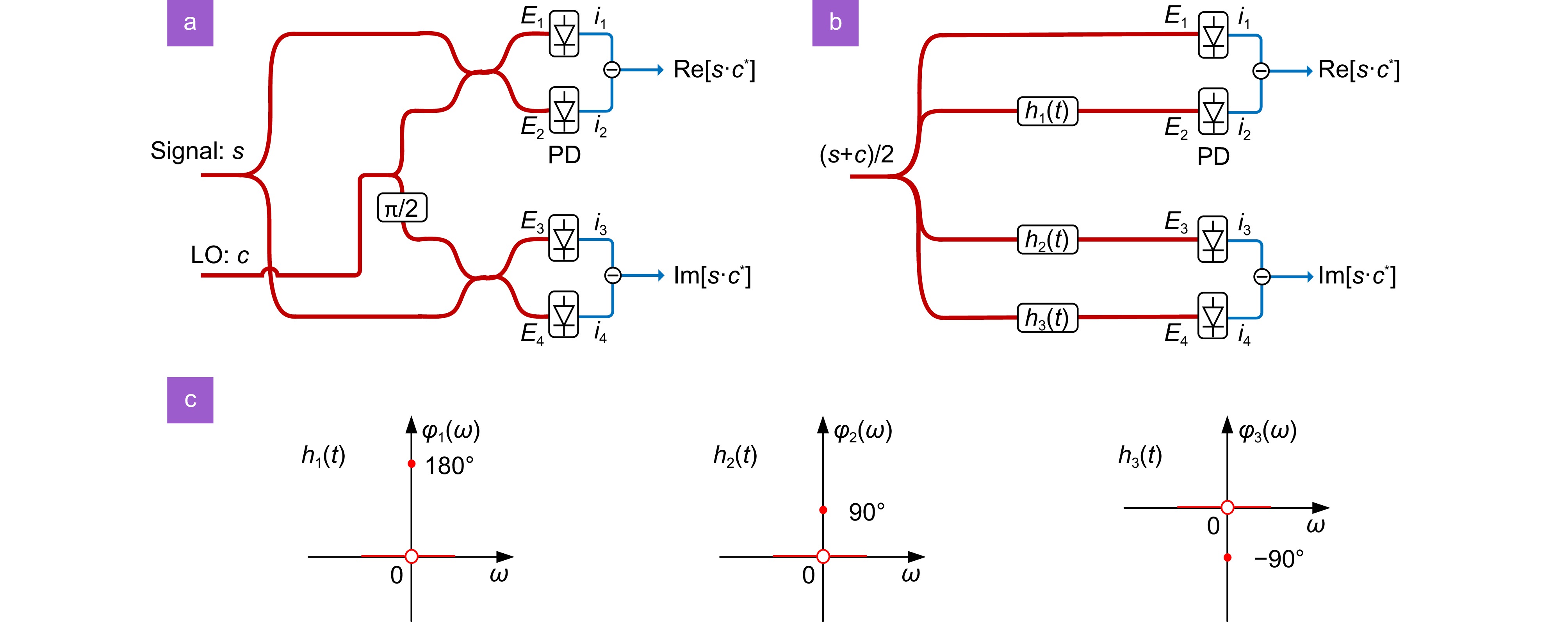
Complex-valued double-sideband direct detection (DD) can reconstruct the optical field and achieve a high electrical spectral efficiency (ESE) comparable to that of a coherent homodyne receiver, and DD does not require a costly local oscillator laser. However, a fundamental question remains if there is an optimal DD receiver structure with the simplest design to approach the performance of the coherent homodyne detection.
This study derives the optimal DD receiver structure with an optimal transfer function to recover a quadrature amplitude modulation (QAM) signal with a near-zero guard band at the central frequency of the signal. We derive the theoretical ESE limit for various detection schemes by invoking Shannon’s formula. Our proposed scheme is closest to coherent homodyne detection in terms of the theoretical ESE limit.
By leveraging a WaveShaper to construct the optimal transfer function, we conduct a proof-of-concept experiment to transmit a net 228.85-Gb/s 64-QAM signal over an 80-km single-mode fiber with a net ESE of 8.76 b/s/Hz. To the best of our knowledge, this study reports the highest net ESE per polarization per wavelength for DD transmission beyond 40-km single-mode fiber. For a comprehensive metric, denoted as 2ᴱˢᴱ×Reach, we achieve the highest 2ᴱˢᴱ×Reach per polarization per wavelength for DD transmission.
Ultrafast all-optical modulation of wide-bandwidth pulses enabled by silicon-metasurfaces
Kaloyan Georgiev, Khosro Zangeneh Kamali, Anton A. Trifonov, Giulia Crotti, Lyuben Petrov, Stefan Georgiev, Hristo Iliev, Lei Xu, Unai Arregui Leon, Mohsen Rahmani, Giuseppe Della Valle, Ivan Buchvarov, Dragomir Neshev
Opto-Electronic Advances
2026-09-15
Physics-informed neural fields enable blind aberration correction for partially coherent quantitative phase imaging
Shun Zhou, Xingyu Huang, Linpeng Lu, Habib Ullah, Kaiyu Du, Maciej Trusiak, Malgorzata Kujawinska, Yuzhen Zhang, Yao Fan, Qian Chen, Qinrong Zhang, Chao Zuo
Opto-Electronic Science
2026-08-26
Heterogeneously integrated micro-ring with SnS₂ for dual-functional optical modulation and photodetection
Jinyi Du, Lidan Lu, Xu Zhang, Bofei Zhu, Wenbo Bo, Yingjie Xu, Guang Chen, Yanlin He, Guanghui Ren, Xiaoping Lou, Zheng You, Lianqing Zhu
Opto-Electronic Advances
2026-08-25
Hardware-aware lightweight photonic spiking neural network for pattern classification
Shuiying Xiang, Yahui Zhang, Shangxuan Shi, Haowen Zhao, Dianzhuang Zheng, Xingxing Guo, Yanan Han, Ye Tian, Liyue Zhang, Yuechun Shi, Yue Hao
Opto-Electronic Advances
2026-08-25
PhyspeNet: An empirical physics-aware network for adaptive speckle reconstructive spectrometry
Junrui Liang, Min Jiang, Jun Li, Zhongming Huang, Junhong He, Yanting Guo, Yanzhao Ke, Jun Ye, Jiangming Xu, Jinyong Leng, Pu Zhou
Opto-Electronic Advances
2026-08-25
A 36 × 240 Gbps hybrid mode/wavelength division multiplexing transmitter using lithium niobate on insulator
Mingyu Zhu, Weihan Wang, Ruitao Ma, Aoyun Gao, Chun Gao, Zexu Wang, Fei Huang, Zhenyuan Bao, Dajian Liu, Jiaxuan Gan, Zejie Yu, Huan Li, Weike Zhao, Daoxin Dai
Opto-Electronic Advances
2026-08-25