(Peer-Reviewed) Learning-based joint UAV trajectory and power allocation optimization for secure IoT networks
Dan Deng 邓单 ¹, Xingwang Li 李兴旺 ², Varun Menon ³, Md Jalil Piran ⁴, Hui Chen 陈慧 ², Mian Ahmad Jan ⁵
¹ School of Information Engineering, Guangzhou Panyu Polytechnic, Guangzhou, 410630, China
中国 广州 广州番禺职业技术学院信息工程学院
² School of Physics and Electronic Information Engineering, Henan Polytechnic University, Jiaozuo, 454150, China
中国 焦作 河南理工大学 信息科学与工程学院
³ Department of Computer Science and Engineering, SCMS School of Engineering and Technology, India
⁴ Department of Computer Science and Engineering, Sejong University, South Korea
⁵ Department of Computer Science, Abdul Wali Khan University Mardan, Pakistan
Abstract
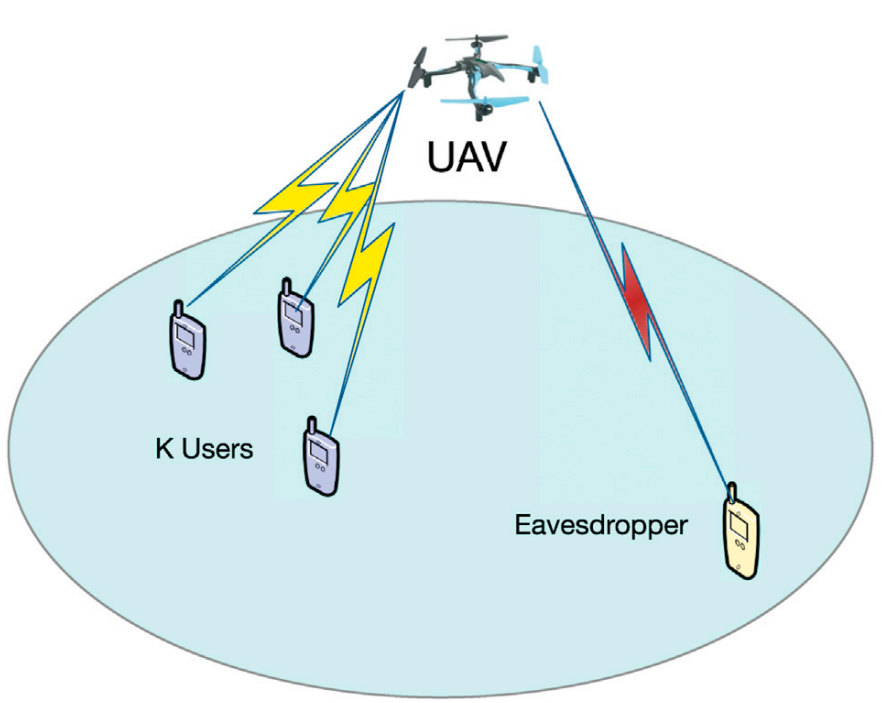
Non-Orthogonal Multiplex Access (NOMA) can be deployed in Unmanned Aerial Vehicle (UAV) networks to improve spectrum efficiency. Due to the broadcasting feature of NOMA-UAV networks, it is essential to focus on the security of the wireless system. This paper focuses on maximizing the secrecy sum rate under the constraint of the achievable rate of the legitimate channels. To tackle the non-convexity optimization problem, a reinforcement learning-based alternative optimization algorithm is proposed.
Firstly, with the help of successive convex approximations, the optimal power allocation scheme with a given UAV trajectory is obtained by using convex optimization tools. Afterwards, through plenty of explorations of the wireless environment, the Q-learning networks approach the optimal location transition strategy of the UAV, even without the wireless channel state information.
Ultrafast all-optical modulation of wide-bandwidth pulses enabled by silicon-metasurfaces
Kaloyan Georgiev, Khosro Zangeneh Kamali, Anton A. Trifonov, Giulia Crotti, Lyuben Petrov, Stefan Georgiev, Hristo Iliev, Lei Xu, Unai Arregui Leon, Mohsen Rahmani, Giuseppe Della Valle, Ivan Buchvarov, Dragomir Neshev
Opto-Electronic Advances
2026-09-15
Physics-informed neural fields enable blind aberration correction for partially coherent quantitative phase imaging
Shun Zhou, Xingyu Huang, Linpeng Lu, Habib Ullah, Kaiyu Du, Maciej Trusiak, Malgorzata Kujawinska, Yuzhen Zhang, Yao Fan, Qian Chen, Qinrong Zhang, Chao Zuo
Opto-Electronic Science
2026-08-26
Heterogeneously integrated micro-ring with SnS₂ for dual-functional optical modulation and photodetection
Jinyi Du, Lidan Lu, Xu Zhang, Bofei Zhu, Wenbo Bo, Yingjie Xu, Guang Chen, Yanlin He, Guanghui Ren, Xiaoping Lou, Zheng You, Lianqing Zhu
Opto-Electronic Advances
2026-08-25
Hardware-aware lightweight photonic spiking neural network for pattern classification
Shuiying Xiang, Yahui Zhang, Shangxuan Shi, Haowen Zhao, Dianzhuang Zheng, Xingxing Guo, Yanan Han, Ye Tian, Liyue Zhang, Yuechun Shi, Yue Hao
Opto-Electronic Advances
2026-08-25
PhyspeNet: An empirical physics-aware network for adaptive speckle reconstructive spectrometry
Junrui Liang, Min Jiang, Jun Li, Zhongming Huang, Junhong He, Yanting Guo, Yanzhao Ke, Jun Ye, Jiangming Xu, Jinyong Leng, Pu Zhou
Opto-Electronic Advances
2026-08-25
A 36 × 240 Gbps hybrid mode/wavelength division multiplexing transmitter using lithium niobate on insulator
Mingyu Zhu, Weihan Wang, Ruitao Ma, Aoyun Gao, Chun Gao, Zexu Wang, Fei Huang, Zhenyuan Bao, Dajian Liu, Jiaxuan Gan, Zejie Yu, Huan Li, Weike Zhao, Daoxin Dai
Opto-Electronic Advances
2026-08-25