(Peer-Reviewed) Rayleigh-driven ethanol cluster tracking based on non-contact deep optical molecular diagnosis
Geon Mo Kim ¹, Yun Ji Hwang ¹, Chengyi Li ¹, Teajong Hwang ¹, In-Sung Hwang ², James Hone ³, Seong Chan Jun ¹
¹ School of Mechanical Engineering, Yonsei University, 50, Yonsei-ro, Seodaemun-gu, Seoul 03722, Republic of Korea
² Sentech GMI Co. Ltd, Seoul 07548, Republic of Korea
³ Department of Mechanical Engineering, Columbia University, 500 West 120th Street, Mudd 220, New York 10027, USA
Opto-Electronic Advances
, 2026-06-08
Abstract
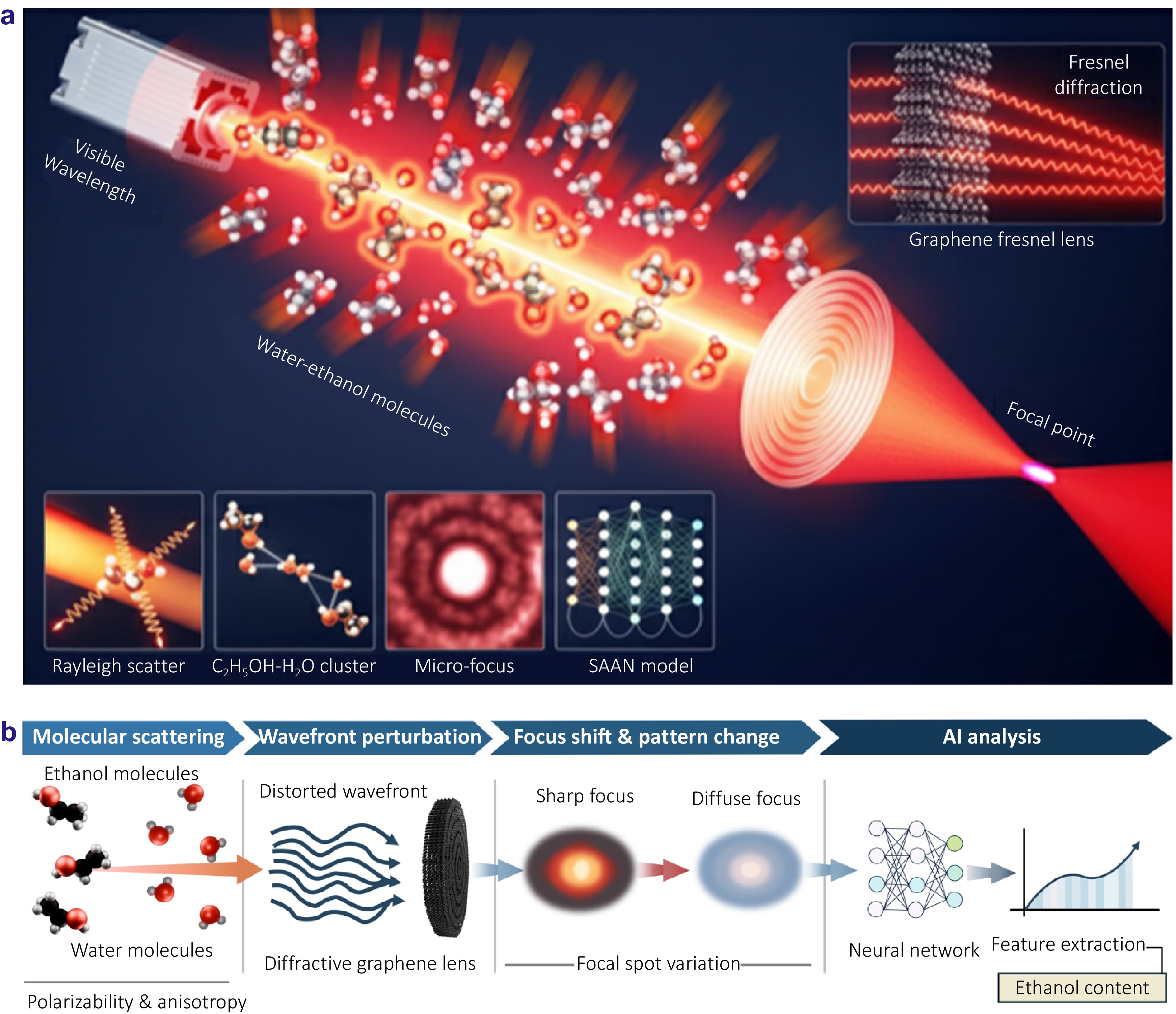
Investigating the composition ratio of ethanol–water molecular clusters in air, which are responsible for anisotropic behavior, is a significant challenge, primarily owing to the difficulty of detecting Rayleigh scattering, an inherently weak signal highly susceptible to external interference. This study overcame these limitations by integrating laser diffraction focusing with artificial neural networks.
We demonstrate a fully non-contact sensing system that circumvents the direct measurement of difficult-to-distinguish Rayleigh scattering signals. Our approach infers ethanol content by utilizing a self-fabricated multi-layered graphene Fresnel lens. An analysis of gaseous ethanol content in the 0.01%–0.1% range revealed that while a wavelength of 405 nm exhibited high sensitivity with up to a 7% intensity change corresponding to ethanol content, a wavelength of 638 nm provided superior stability for deep-learning analysis as its intensity parameter remained fixed. Ultimately, by combining the 638 nm laser with our self-developed self-aware assembly network model, we successfully inferred ethanol content with an R2 of 0.884, even under varied power conditions.
This study creates a new path for recognizing weak Rayleigh scattering signals that were previously difficult to measure and may facilitate the development of rapid and durable sensing systems, such as for the non-invasive diagnosis of gas molecules.
Ultrafast all-optical modulation of wide-bandwidth pulses enabled by silicon-metasurfaces
Kaloyan Georgiev, Khosro Zangeneh Kamali, Anton A. Trifonov, Giulia Crotti, Lyuben Petrov, Stefan Georgiev, Hristo Iliev, Lei Xu, Unai Arregui Leon, Mohsen Rahmani, Giuseppe Della Valle, Ivan Buchvarov, Dragomir Neshev
Opto-Electronic Advances
2026-09-15
Physics-informed neural fields enable blind aberration correction for partially coherent quantitative phase imaging
Shun Zhou, Xingyu Huang, Linpeng Lu, Habib Ullah, Kaiyu Du, Maciej Trusiak, Malgorzata Kujawinska, Yuzhen Zhang, Yao Fan, Qian Chen, Qinrong Zhang, Chao Zuo
Opto-Electronic Science
2026-08-26
Heterogeneously integrated micro-ring with SnS₂ for dual-functional optical modulation and photodetection
Jinyi Du, Lidan Lu, Xu Zhang, Bofei Zhu, Wenbo Bo, Yingjie Xu, Guang Chen, Yanlin He, Guanghui Ren, Xiaoping Lou, Zheng You, Lianqing Zhu
Opto-Electronic Advances
2026-08-25
Hardware-aware lightweight photonic spiking neural network for pattern classification
Shuiying Xiang, Yahui Zhang, Shangxuan Shi, Haowen Zhao, Dianzhuang Zheng, Xingxing Guo, Yanan Han, Ye Tian, Liyue Zhang, Yuechun Shi, Yue Hao
Opto-Electronic Advances
2026-08-25
PhyspeNet: An empirical physics-aware network for adaptive speckle reconstructive spectrometry
Junrui Liang, Min Jiang, Jun Li, Zhongming Huang, Junhong He, Yanting Guo, Yanzhao Ke, Jun Ye, Jiangming Xu, Jinyong Leng, Pu Zhou
Opto-Electronic Advances
2026-08-25
A 36 × 240 Gbps hybrid mode/wavelength division multiplexing transmitter using lithium niobate on insulator
Mingyu Zhu, Weihan Wang, Ruitao Ma, Aoyun Gao, Chun Gao, Zexu Wang, Fei Huang, Zhenyuan Bao, Dajian Liu, Jiaxuan Gan, Zejie Yu, Huan Li, Weike Zhao, Daoxin Dai
Opto-Electronic Advances
2026-08-25