(Peer-Reviewed) Vacancy oscillating mode in amorphous binary oxide film by terahertz time domain spectroscopy
Huan Liu 刘欢 ¹ ², Haiyun Huang 黄海云 ³, Heng Yu 于恒 ⁴, Zhi Gong 龚直 ⁶, Fei Yu 于飞 ², Zheng Zhang 张正 ², Zhiyong Tan 谭智勇 ⁵, Juncheng Cao 曹俊诚 ⁵, Haiyun Liu 刘海云 ³, Kan-Hao Xue 薛堪豪 ⁴, Xiangshui Miao 缪向水 ⁴, Yan Liu 刘艳 ¹ ², Yue Hao 郝跃 ², Genquan Han 韩根全 ¹ ², Qihua Xiong 熊启华 ³
¹ Hangzhou Institute of Technology, Xidian University, Hangzhou 311231, China
中国 杭州 西安电子科技大学杭州研究院
² Faculty of Integrated Circuits, Xidian University, Xi'an 710071, China
中国 西安 西安电子科技大学集成电路学部
³ Beijing Academy of Quantum Information Sciences, Beijing 100193, China
中国 北京 北京量子信息科学研究院
⁴ School of Integrated Circuits, Huazhong University of Science and Technology, Wuhan 430074, China
中国 武汉 华中科技大学集成电路学院
⁵ State Key Laboratory of Materials for Integrated Circuits, Shanghai Institute of Microsystem and Information Technology, Chinese Academy of Sciences, 865 Changning Road, Shanghai 200050, China
中国 上海 中国科学院上海微系统与信息技术研究所 集成电路材料全国重点实验室
⁶ Electrical Engineering College, Zhejiang University, Hangzhou 310027, China
中国 杭州 浙江大学电气工程学院
Opto-Electronic Advances
, 2026-06-08
Abstract
Unveiling the vacancy oscillation mode in amorphous binary oxides films at nanoscale and its impact on ionic conductivity and conductivity spectra is vital to explore the tightly intertwined connection between reversible oxygen migration and stabilizing and controlling the ferroelectric behavior, to complement traditional ferroelectric doped-HfO₂ materials.
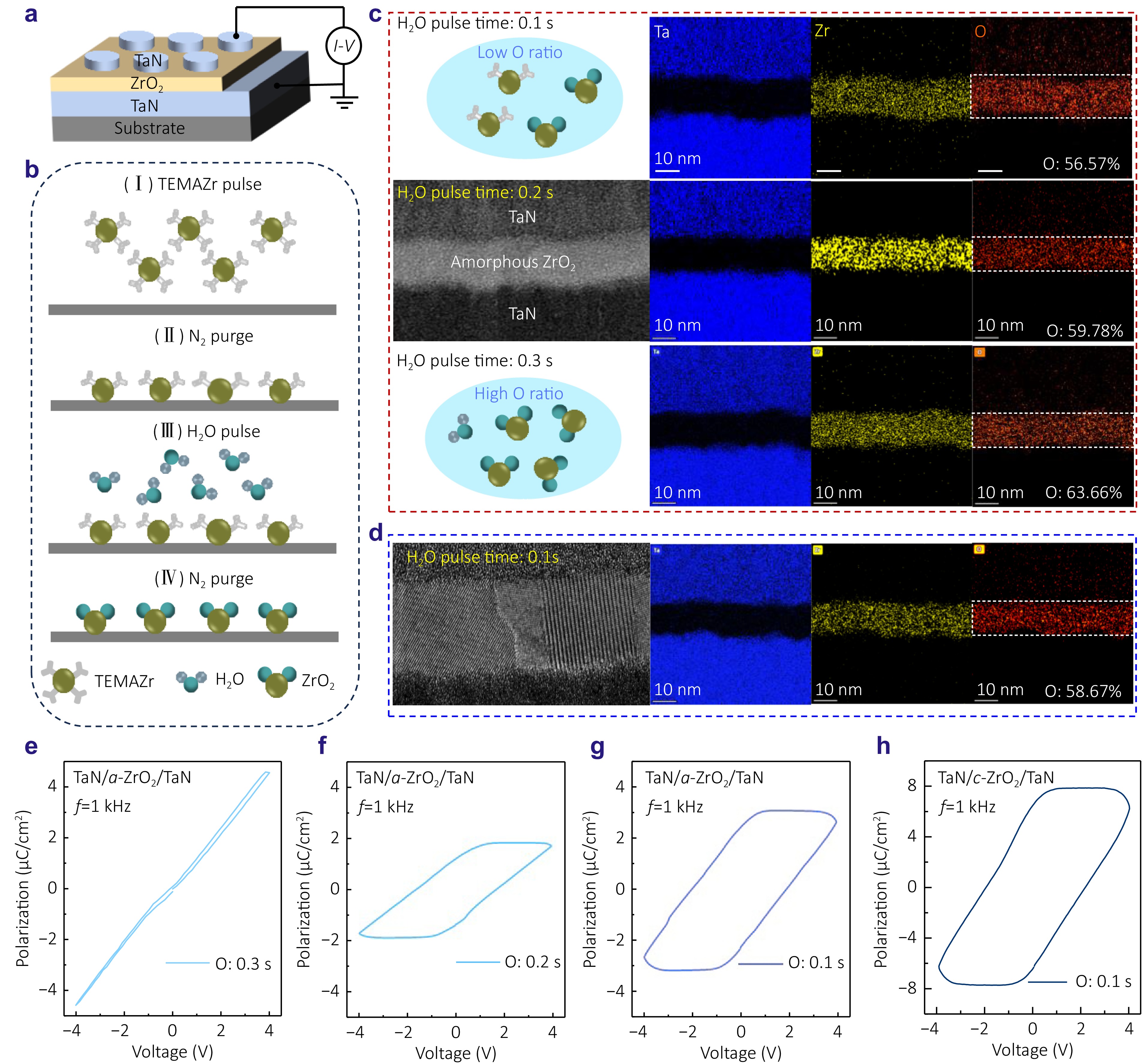
Using terahertz time-domain spectroscopy (THz-TDS), infrared reflection spectra, and density functional theory (DFT) calculations, we investigate the optical absorption and reflection spectra of crystalline and amorphous ZrO₂ thin film by varying oxygen vacancy concentrations. Experimental results show that oxygen vacancy migration rather than intrinsic paraelectric nature in films significantly affect the conductivity and polarization behavior of ZrO₂ thin film. Notably, except for the phonon modes induce distinct absorption peaks around 11 THz, additional absorption peaks are observed in the 1–2 THz range, which are caused by localized states originated from the oxygen vacancies, supported by DFT calculations.
Temperature-dependent ion migration behavior further confirms the role of vacancy oscillation modes in ionic conductivity. DFT calculations additionally reveal how oxygen vacancies alter infrared absorption and optical modes, leading to a redshift in existing absorption peaks or the introduction of new peaks. Our findings unambiguously clarify the oxygen voltammetry characteristics in amorphous ferroelectric binary oxides films.
Furthermore, the strategic deployment of amorphous binary oxides films enables the use of low-temperature atomic layer deposition (ALD) growing process, effectively alleviating routing congestion of ferroelectric oxides and offering additional design flexibility for future memory devices with ultra-low effective oxide thickness (EOT) and low thermal budget, and providing alternative technological routes that are poised to propel the development of next-generation more compact ferroelectric devices for advanced process nodes.
Ultrafast all-optical modulation of wide-bandwidth pulses enabled by silicon-metasurfaces
Kaloyan Georgiev, Khosro Zangeneh Kamali, Anton A. Trifonov, Giulia Crotti, Lyuben Petrov, Stefan Georgiev, Hristo Iliev, Lei Xu, Unai Arregui Leon, Mohsen Rahmani, Giuseppe Della Valle, Ivan Buchvarov, Dragomir Neshev
Opto-Electronic Advances
2026-09-15
Physics-informed neural fields enable blind aberration correction for partially coherent quantitative phase imaging
Shun Zhou, Xingyu Huang, Linpeng Lu, Habib Ullah, Kaiyu Du, Maciej Trusiak, Malgorzata Kujawinska, Yuzhen Zhang, Yao Fan, Qian Chen, Qinrong Zhang, Chao Zuo
Opto-Electronic Science
2026-08-26
Heterogeneously integrated micro-ring with SnS₂ for dual-functional optical modulation and photodetection
Jinyi Du, Lidan Lu, Xu Zhang, Bofei Zhu, Wenbo Bo, Yingjie Xu, Guang Chen, Yanlin He, Guanghui Ren, Xiaoping Lou, Zheng You, Lianqing Zhu
Opto-Electronic Advances
2026-08-25
Hardware-aware lightweight photonic spiking neural network for pattern classification
Shuiying Xiang, Yahui Zhang, Shangxuan Shi, Haowen Zhao, Dianzhuang Zheng, Xingxing Guo, Yanan Han, Ye Tian, Liyue Zhang, Yuechun Shi, Yue Hao
Opto-Electronic Advances
2026-08-25
PhyspeNet: An empirical physics-aware network for adaptive speckle reconstructive spectrometry
Junrui Liang, Min Jiang, Jun Li, Zhongming Huang, Junhong He, Yanting Guo, Yanzhao Ke, Jun Ye, Jiangming Xu, Jinyong Leng, Pu Zhou
Opto-Electronic Advances
2026-08-25
A 36 × 240 Gbps hybrid mode/wavelength division multiplexing transmitter using lithium niobate on insulator
Mingyu Zhu, Weihan Wang, Ruitao Ma, Aoyun Gao, Chun Gao, Zexu Wang, Fei Huang, Zhenyuan Bao, Dajian Liu, Jiaxuan Gan, Zejie Yu, Huan Li, Weike Zhao, Daoxin Dai
Opto-Electronic Advances
2026-08-25