(Peer-Reviewed) Involvement of glucose transporter 4 in ovarian development and reproductive maturation of Harmonia axyridis (Coleoptera: Coccinellidae)
Yan Li ¹ ², Sha-Sha Wang 王沙沙 ², Su Wang 王甦 ³, Shi-Gui Wang 王世贵 ², Bin Tang 唐斌 ², Fang Liu 刘芳 ¹
¹ College of Horticulture and Plant Protection, Yangzhou University, Yangzhou, Jiangsu, 225009, China
中国 扬州 扬州大学园艺与植物保护学院
² College of Life and EnvironmentalSciences, Hangzhou Normal University, Hangzhou, Zhejiang, 310036, China
中国 浙江 杭州 杭州师范大学生命与环境科学学院
³ Institute of Plant and Environment Protection, Beijing Academy of Agricultural and Forestry Sciences, Beijing, 100097, China
中国 北京 北京市农林科学院 植物保护环境保护研究所
Abstract
Glucose is vital to embryogenesis, as are glucose transporters. Glucose transporter 4 (Glut4) is one of the glucose transporters, which is involved in rapid uptake of glucose by various cells and promotes glucose homeostasis. Although energy metabolism in insect reproduction is well known, the molecular mechanism of Glut4 in insect reproduction is poorly understood. We suspect that Glut4 is involved in maintaining glucose concentrations in the ovaries and affecting vitellogenesis, which is critical for subsequent oocyte maturation and insect fertility.
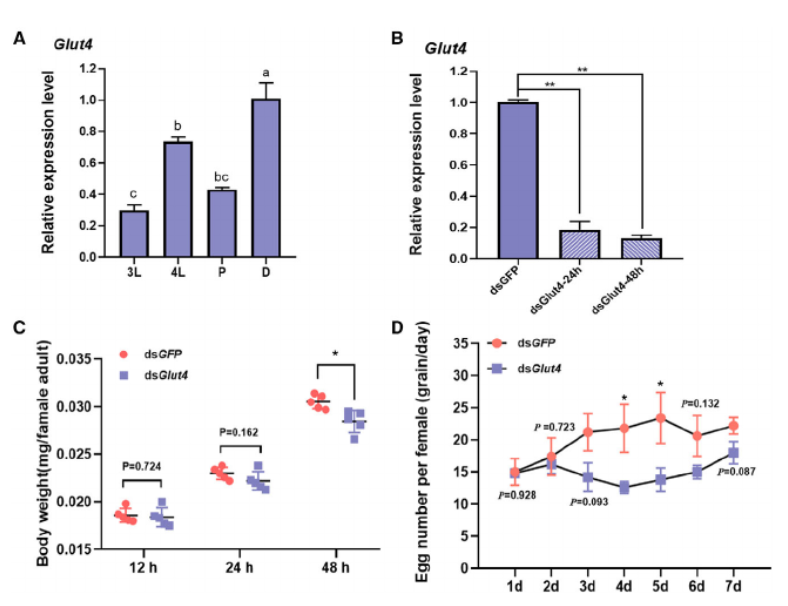
Harmonia axyridis (Pallas) is a model organism for genetic research and a natural enemy of insect pests. We studied the influence of the Glut4 gene on the reproduction and development of H. axyridis using RNA interference technology. Reverse transcription quantitative polymerase chain reaction analysis revealed that HaGlut4 was most highly expressed in adults. Knockdown of the HaGlut4 gene reduced the transcript levels of HaGlut4, and the weight and number of eggs produced significantly decreased.
In addition, the transcript levels of vitellogenin receptor and vitellogenin in the fat bodies and the ovaries of H. axyridis decreased after the interference of Glut4, and decreased the triglyceride, fatty acid, total amino acid and adenosine triphosphate content of H. axyridis. This resulted in severe blockage of ovary development and reduction of yolk formation; there was no development of ovarioles in the developing oocytes. These changes indicate that a lack of HaGlut4 can impair ovarian development and oocyte maturation and result in decreased fecundity.
Ultrafast all-optical modulation of wide-bandwidth pulses enabled by silicon-metasurfaces
Kaloyan Georgiev, Khosro Zangeneh Kamali, Anton A. Trifonov, Giulia Crotti, Lyuben Petrov, Stefan Georgiev, Hristo Iliev, Lei Xu, Unai Arregui Leon, Mohsen Rahmani, Giuseppe Della Valle, Ivan Buchvarov, Dragomir Neshev
Opto-Electronic Advances
2026-09-15
Physics-informed neural fields enable blind aberration correction for partially coherent quantitative phase imaging
Shun Zhou, Xingyu Huang, Linpeng Lu, Habib Ullah, Kaiyu Du, Maciej Trusiak, Malgorzata Kujawinska, Yuzhen Zhang, Yao Fan, Qian Chen, Qinrong Zhang, Chao Zuo
Opto-Electronic Science
2026-08-26
Heterogeneously integrated micro-ring with SnS₂ for dual-functional optical modulation and photodetection
Jinyi Du, Lidan Lu, Xu Zhang, Bofei Zhu, Wenbo Bo, Yingjie Xu, Guang Chen, Yanlin He, Guanghui Ren, Xiaoping Lou, Zheng You, Lianqing Zhu
Opto-Electronic Advances
2026-08-25
Hardware-aware lightweight photonic spiking neural network for pattern classification
Shuiying Xiang, Yahui Zhang, Shangxuan Shi, Haowen Zhao, Dianzhuang Zheng, Xingxing Guo, Yanan Han, Ye Tian, Liyue Zhang, Yuechun Shi, Yue Hao
Opto-Electronic Advances
2026-08-25
PhyspeNet: An empirical physics-aware network for adaptive speckle reconstructive spectrometry
Junrui Liang, Min Jiang, Jun Li, Zhongming Huang, Junhong He, Yanting Guo, Yanzhao Ke, Jun Ye, Jiangming Xu, Jinyong Leng, Pu Zhou
Opto-Electronic Advances
2026-08-25
A 36 × 240 Gbps hybrid mode/wavelength division multiplexing transmitter using lithium niobate on insulator
Mingyu Zhu, Weihan Wang, Ruitao Ma, Aoyun Gao, Chun Gao, Zexu Wang, Fei Huang, Zhenyuan Bao, Dajian Liu, Jiaxuan Gan, Zejie Yu, Huan Li, Weike Zhao, Daoxin Dai
Opto-Electronic Advances
2026-08-25