(Peer-Reviewed) Numerical simulation of nanosecond laser ablation and plasma characteristics considering a real gas equation of state
Qiang LIU 刘强 ¹, Qi MIN 敏琦 ¹ ², Maogen SU 苏茂根 ¹ ², Xingbang LIU 刘兴邦 ¹, Shiquan CAO 曹世权 ¹ ², Duixiong SUN 孙对兄 ¹ ², Chenzhong DONG 董晨钟 ¹ ², Yanbiao FU 符彦飙 ¹ ²
¹ Key Laboratory of Atomic and Molecular Physics and Functional Material of Gansu Province, College of Physics and Electronic Engineering, Northwest Normal University, Lanzhou 730070, People’s Republic of China
中国 兰州 西北师范大学物理与电子工程学院 甘肃省原子分子物理与功能材料重点实验室
² Joint Laboratory of Atomic and Molecular Physics, Northwest Normal University and Institute of Modern Physics of Chinese Academy of Sciences, Lanzhou 730070, People's Republic of China
中国 兰州 西北师范大学 中国科学院近代物理研究所 极端环境原子分子物理联合实验室
Abstract
Based on the governing equations which include the heat conduction equation in the target and the fluid equations of the vapor plasma, a two-dimensional axisymmetric model for ns-laser ablation considering the Knudsen layer and plasma shielding effect is developed. The equations of state of the plasma are described by a real gas approximation, which divides the internal energy into the thermal energy of atoms, ions and electrons, ionization energy and the excitation energy of atoms and ions.
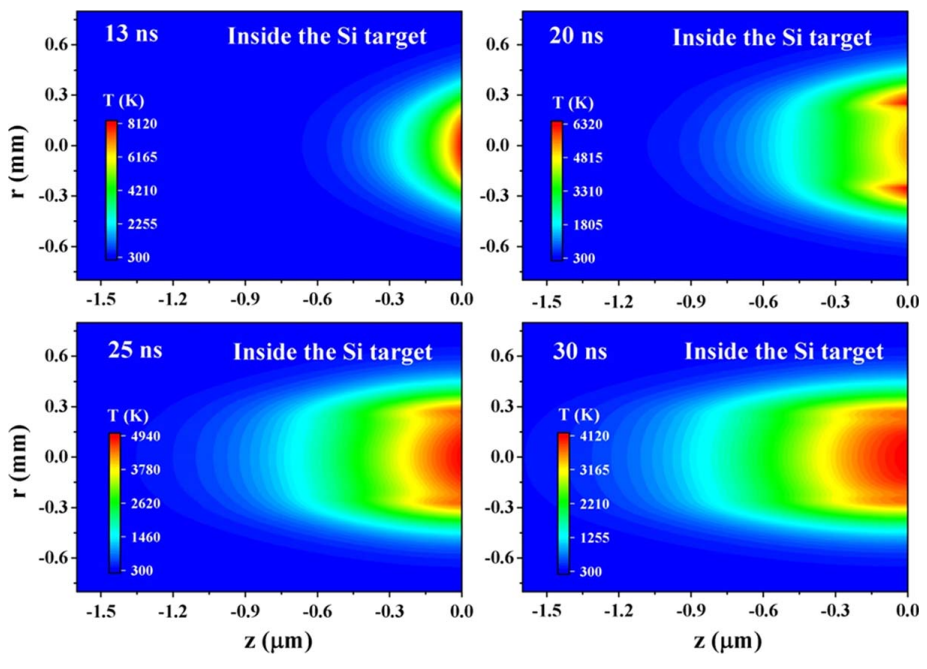
The dynamic evolution of the silicon target and plasma during laser ablation is studied by using this model, and the distributions of the temperature, plasma density, Mach number related to the evaporation/condensation of the target surface, laser transmissivity as well as internal energy of the plasma are given.
It is found that the evolution of the target surface during laser ablation can be divided into three stages: (1) the target surface temperature increases continuously; (2) the sonic and subsonic evaporation; and (3) the subsonic condensation. The result of the internal energy distribution indicates that the ionization and excitation energy plays an important role in the internal energy of the plasma during laser ablation. This model is suitable for the case that the temperature of the target surface is lower than the critical temperature.
Ultrafast all-optical modulation of wide-bandwidth pulses enabled by silicon-metasurfaces
Kaloyan Georgiev, Khosro Zangeneh Kamali, Anton A. Trifonov, Giulia Crotti, Lyuben Petrov, Stefan Georgiev, Hristo Iliev, Lei Xu, Unai Arregui Leon, Mohsen Rahmani, Giuseppe Della Valle, Ivan Buchvarov, Dragomir Neshev
Opto-Electronic Advances
2026-09-15
Physics-informed neural fields enable blind aberration correction for partially coherent quantitative phase imaging
Shun Zhou, Xingyu Huang, Linpeng Lu, Habib Ullah, Kaiyu Du, Maciej Trusiak, Malgorzata Kujawinska, Yuzhen Zhang, Yao Fan, Qian Chen, Qinrong Zhang, Chao Zuo
Opto-Electronic Science
2026-08-26
Heterogeneously integrated micro-ring with SnS₂ for dual-functional optical modulation and photodetection
Jinyi Du, Lidan Lu, Xu Zhang, Bofei Zhu, Wenbo Bo, Yingjie Xu, Guang Chen, Yanlin He, Guanghui Ren, Xiaoping Lou, Zheng You, Lianqing Zhu
Opto-Electronic Advances
2026-08-25
Hardware-aware lightweight photonic spiking neural network for pattern classification
Shuiying Xiang, Yahui Zhang, Shangxuan Shi, Haowen Zhao, Dianzhuang Zheng, Xingxing Guo, Yanan Han, Ye Tian, Liyue Zhang, Yuechun Shi, Yue Hao
Opto-Electronic Advances
2026-08-25
PhyspeNet: An empirical physics-aware network for adaptive speckle reconstructive spectrometry
Junrui Liang, Min Jiang, Jun Li, Zhongming Huang, Junhong He, Yanting Guo, Yanzhao Ke, Jun Ye, Jiangming Xu, Jinyong Leng, Pu Zhou
Opto-Electronic Advances
2026-08-25
A 36 × 240 Gbps hybrid mode/wavelength division multiplexing transmitter using lithium niobate on insulator
Mingyu Zhu, Weihan Wang, Ruitao Ma, Aoyun Gao, Chun Gao, Zexu Wang, Fei Huang, Zhenyuan Bao, Dajian Liu, Jiaxuan Gan, Zejie Yu, Huan Li, Weike Zhao, Daoxin Dai
Opto-Electronic Advances
2026-08-25