(Peer-Reviewed) {332}<113>Twinning transfer behavior and its effect on the twin shape in a beta-type Ti-23.1Nb-2.0Zr-1.0O alloy
Yi Yang 杨义 ¹, Bohua Zhang ¹, Zhichao Meng 孟志超 ², Lei Qu ³, Hao Wang 王皞 ¹, Sheng Cao ⁴, Jianan Hu 胡嘉南 ¹, Hao Chen ¹, Songquan Wu 吴松全 ¹, Dehai Ping ⁵, Geping Li 李阁平 ², Lai-Chang Zhang 张来昌 ⁶, Rui Yang 杨锐 ², Aijun Huang 黄爱军 ⁷
¹ School of Materials Science and Engineering, University of Shanghai for Science and Technology, Shanghai 200093, China
中国 上海 上海理工大学材料科学与工程学院
² Institute of Metal Research, Chinese Academy of Sciences, Shenyang 110016, China
中国 沈阳 中国科学院金属研究所
³ Northwest Institute for Non-ferrous Metal Research, Xi'an 710016, China
中国 西安 西北有色金属研究院
⁴ School of Materials, University of Manchester, Oxford Road, Manchester M139PL, United Kingdom
⁵ National Institute for Materials Science, Sengen 1-2-1, Tsukuba 305-0047, Japan
⁶ School of Engineering, Edith Cowan University, 270 Joondalup Drive, Joondalup, Perth, WA6027, Australia
⁷ Department of Materials Science and Engineering, Monash University, Clayton, VIC 3800, Australia
Abstract
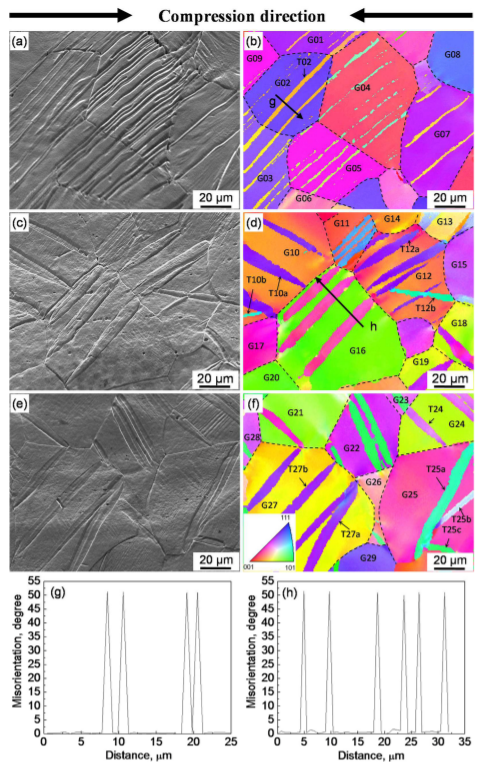
The interaction between twins and grain boundaries (GB) has an important influence on the deformation and fracture behavior of materials. In the present work, {332}<113> twinning transfer (TT) behavior and its effect on the twin shape in a deformed β-type Ti-23.1Nb-2.0Zr-1.0O Ti alloy were investigated experimentally and with molecular dynamics simulation.
The crystallographic alignment factor of the two twinning systems in the neighboring grains and the misorientation angle of the grain pairs were found to influence the occurrence of TT. This further determines the twin shape: twins present a ruler shape when TT occurs but are in a lenticular shape otherwise. Such different twin shapes are attributed to the local stress states related to TT occurring or not. Both ruler-shaped paired twinning and lenticular twinning would provide effective mechanisms to release or reduce the stress concentration in front of the twin tips in different grain pairs.
Ultrafast all-optical modulation of wide-bandwidth pulses enabled by silicon-metasurfaces
Kaloyan Georgiev, Khosro Zangeneh Kamali, Anton A. Trifonov, Giulia Crotti, Lyuben Petrov, Stefan Georgiev, Hristo Iliev, Lei Xu, Unai Arregui Leon, Mohsen Rahmani, Giuseppe Della Valle, Ivan Buchvarov, Dragomir Neshev
Opto-Electronic Advances
2026-09-15
Physics-informed neural fields enable blind aberration correction for partially coherent quantitative phase imaging
Shun Zhou, Xingyu Huang, Linpeng Lu, Habib Ullah, Kaiyu Du, Maciej Trusiak, Malgorzata Kujawinska, Yuzhen Zhang, Yao Fan, Qian Chen, Qinrong Zhang, Chao Zuo
Opto-Electronic Science
2026-08-26
Heterogeneously integrated micro-ring with SnS₂ for dual-functional optical modulation and photodetection
Jinyi Du, Lidan Lu, Xu Zhang, Bofei Zhu, Wenbo Bo, Yingjie Xu, Guang Chen, Yanlin He, Guanghui Ren, Xiaoping Lou, Zheng You, Lianqing Zhu
Opto-Electronic Advances
2026-08-25
Hardware-aware lightweight photonic spiking neural network for pattern classification
Shuiying Xiang, Yahui Zhang, Shangxuan Shi, Haowen Zhao, Dianzhuang Zheng, Xingxing Guo, Yanan Han, Ye Tian, Liyue Zhang, Yuechun Shi, Yue Hao
Opto-Electronic Advances
2026-08-25
PhyspeNet: An empirical physics-aware network for adaptive speckle reconstructive spectrometry
Junrui Liang, Min Jiang, Jun Li, Zhongming Huang, Junhong He, Yanting Guo, Yanzhao Ke, Jun Ye, Jiangming Xu, Jinyong Leng, Pu Zhou
Opto-Electronic Advances
2026-08-25
A 36 × 240 Gbps hybrid mode/wavelength division multiplexing transmitter using lithium niobate on insulator
Mingyu Zhu, Weihan Wang, Ruitao Ma, Aoyun Gao, Chun Gao, Zexu Wang, Fei Huang, Zhenyuan Bao, Dajian Liu, Jiaxuan Gan, Zejie Yu, Huan Li, Weike Zhao, Daoxin Dai
Opto-Electronic Advances
2026-08-25