(Peer-Reviewed) Mapping non-laminar proton acceleration in laser-driven target normal sheath field
Qin Chengyu 秦承宇 ¹ ², Zhang Hui 张辉 ¹ ³, Ji Liangliang 吉亮亮 ¹ ³, Li Shun 李顺 ¹, Zhai Shuhua ⁴, Li Angxiao 李昂骁 ¹ ⁵, Qian Jiayi 钱佳毅 ¹, Gui Jiayan 归佳彦 ¹, Wu Fenxiang 吴分翔 ¹, Zhang Zongxin 张宗昕 ¹, Xu Yi 许毅 ¹ ³, Liang Xiaoyan 梁晓燕 ¹ ³, Leng Yuxin 冷雨欣 ¹ ³, Shen Baifei 沈百飞 ¹ ⁴, Li Ruxin 李儒新 ¹ ³ ⁵
¹ State Key Laboratory of High Field Laser Physics, Shanghai Institute of Optics and Fine Mechanics, Chinese Academy of Sciences, Shanghai 201800, China
中国 上海 中国科学院上海光学精密机械研究所 强场激光物理国家重点实验室
² Center of Materials Science and Optoelectronics Engineering, University of Chinese Academy of Sciences, Beijing 100049, China
中国 北京 中国科学院大学 材料科学与光电技术学院
³ CAS Center for Excellence in Ultra-intense Laser Science, Shanghai 201800, China
中国 上海 中国科学院 超强激光科学卓越创新中心
⁴ Department of Physics, Shanghai Normal University, Shanghai 200234, China
中国 上海 上海师范大学物理系
⁵ ShanghaiTech University, Shanghai 201210, China
中国 上海 上海科技大学
Abstract
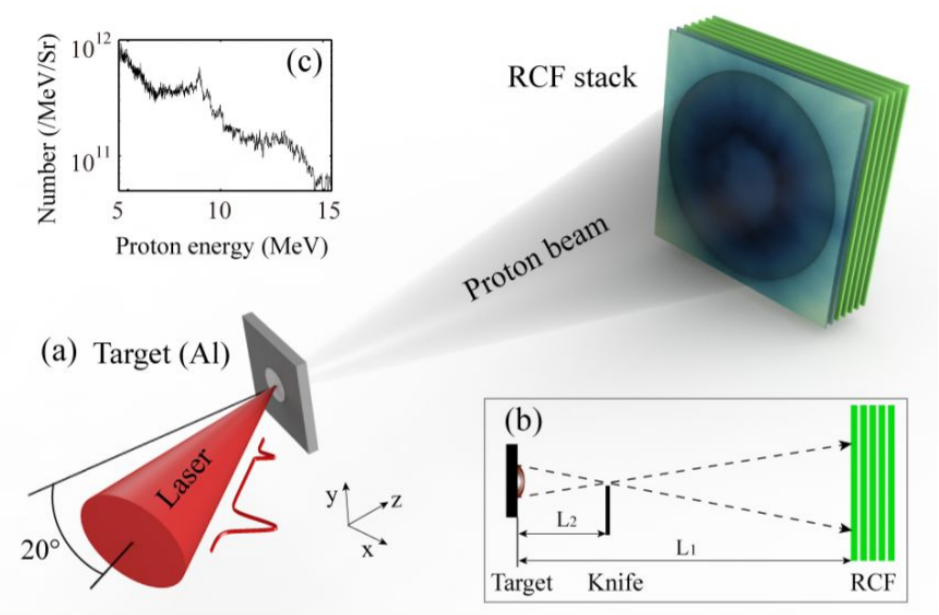
We report on experimental observation of non-laminar proton acceleration modulated by strong magnetic field in laser irradiating micron-meter Aluminum targets. The results illustrate coexistence of ring-like and filamentation structures. We implement the knife edge method into the radiochromic film detector to map the accelerated beams, measuring source size of 30 ~ 110 μm for proton of > 5MeV. The diagnosis reveals that the ring-like profile originates from low energy protons far off the axis while the filamentation is from the near-axis high energy protons, exhibiting non-laminar features.
Particle-in-cell simulations reproduced the experimental results, showing that the short-term magnetic turbulence via Weibel instability and the long-term quasi-static annular magnetic field by the streaming electric current account for the measured beam profile. Our work provides direct mapping of laser-driven proton sources in the space-energy domain and reveals the non-laminar beam evolution at featured time scales.
Ultrafast all-optical modulation of wide-bandwidth pulses enabled by silicon-metasurfaces
Kaloyan Georgiev, Khosro Zangeneh Kamali, Anton A. Trifonov, Giulia Crotti, Lyuben Petrov, Stefan Georgiev, Hristo Iliev, Lei Xu, Unai Arregui Leon, Mohsen Rahmani, Giuseppe Della Valle, Ivan Buchvarov, Dragomir Neshev
Opto-Electronic Advances
2026-09-15
Physics-informed neural fields enable blind aberration correction for partially coherent quantitative phase imaging
Shun Zhou, Xingyu Huang, Linpeng Lu, Habib Ullah, Kaiyu Du, Maciej Trusiak, Malgorzata Kujawinska, Yuzhen Zhang, Yao Fan, Qian Chen, Qinrong Zhang, Chao Zuo
Opto-Electronic Science
2026-08-26
Heterogeneously integrated micro-ring with SnS₂ for dual-functional optical modulation and photodetection
Jinyi Du, Lidan Lu, Xu Zhang, Bofei Zhu, Wenbo Bo, Yingjie Xu, Guang Chen, Yanlin He, Guanghui Ren, Xiaoping Lou, Zheng You, Lianqing Zhu
Opto-Electronic Advances
2026-08-25
Hardware-aware lightweight photonic spiking neural network for pattern classification
Shuiying Xiang, Yahui Zhang, Shangxuan Shi, Haowen Zhao, Dianzhuang Zheng, Xingxing Guo, Yanan Han, Ye Tian, Liyue Zhang, Yuechun Shi, Yue Hao
Opto-Electronic Advances
2026-08-25
PhyspeNet: An empirical physics-aware network for adaptive speckle reconstructive spectrometry
Junrui Liang, Min Jiang, Jun Li, Zhongming Huang, Junhong He, Yanting Guo, Yanzhao Ke, Jun Ye, Jiangming Xu, Jinyong Leng, Pu Zhou
Opto-Electronic Advances
2026-08-25
A 36 × 240 Gbps hybrid mode/wavelength division multiplexing transmitter using lithium niobate on insulator
Mingyu Zhu, Weihan Wang, Ruitao Ma, Aoyun Gao, Chun Gao, Zexu Wang, Fei Huang, Zhenyuan Bao, Dajian Liu, Jiaxuan Gan, Zejie Yu, Huan Li, Weike Zhao, Daoxin Dai
Opto-Electronic Advances
2026-08-25