(Peer-Reviewed) Calcium hydride reduced high-quality Nd–Fe–B powder from Nd–Fe–B sintered magnet sludge
Haibo Xu 徐海波 ¹, Qingmei Lu 路清梅 ¹ ², Liying Cong ¹, Haowen Tian ¹, Weiqiang Liu 刘卫强 ¹ ², Youhao Liu 刘友好 ² ³, Yunqiao Wang ⁴, Jingwu Chen 陈静武 ² ³, Xiaofei Yi 衣晓飞 ² ³, Ming Yue 岳明 ¹ ²
¹ Key Lab of Advanced Functional Materials, Ministry of Education, Faculty of Materials and Manufacturing, Beijing University of Technology, Beijing, 100124, China
中国 北京 北京工业大学 材料科学与工程学院 新型功能材料教育部重点实验室
² State Key Laboratory of Rare Earth Permanent Magnetic Materials, Hefei 231500, China
中国 合肥 稀土永磁材料国家重点实验室
³ Earth–Panda Advanced Magnetic Materials Co., Ltd., Hefei 231500, China
中国 合肥 安徽大地熊新材料股份有限公司
⁴ Beijing Zhong Ke San Huan Research, Beijing 102200, China
中国 北京 中科三环研究院
Abstract
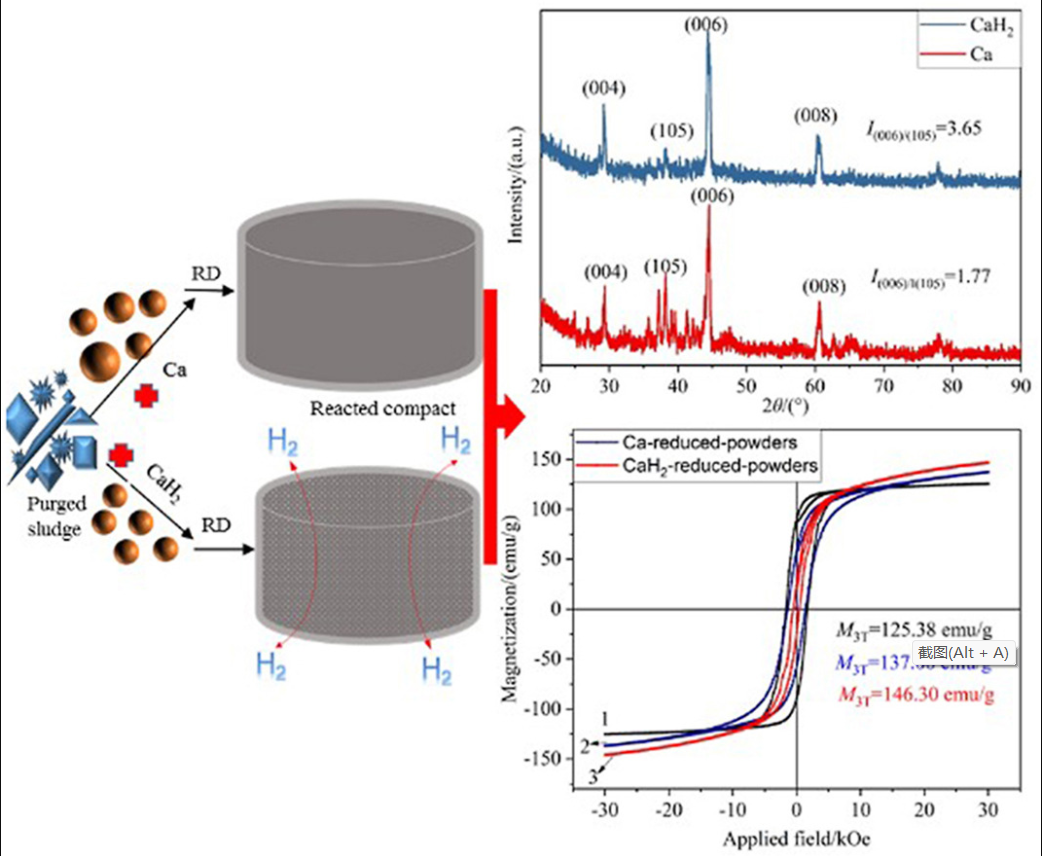
The structural and magnetic properties were studied for recycling Nd–Fe–B powders from Nd–Fe–B sintered magnets sludge via reduction diffusion (RD) with calcium hydride (CaH2) particles. For comparison, traditional reducing agent calcium granules were applied to prepare recycled Nd–Fe–B powders. Finer particle size and better size distribution as well as lower impurity content are achieved by using CaH2 instead of Ca. In detail, the average particle size of the recycled Nd–Fe–B powder is reduced from 4.66 to 3.43 μm, and the bimodal distribution disappears. Moreover, the residual calcium content and oxygen content are reduced to about 0.080 wt% and 0.32 wt%.
As a consequence, the room-temperature magnetization of the CaH2-recycled Nd–Fe–B powder is increased to 146.30 emu/g, 6.8% and 33%, respectively, higher than that of Ca-reduced powder and the initial sludge. Further analysis indicates that CaH2 is able to reduce the sludge at lower temperature to fabricate well-dispersed, uniform recycled powder with high magnetization arising from a combination factors of its low melting point, low thermodynamic behavior, and the release of hydrogen during the reaction.
Ultrafast all-optical modulation of wide-bandwidth pulses enabled by silicon-metasurfaces
Kaloyan Georgiev, Khosro Zangeneh Kamali, Anton A. Trifonov, Giulia Crotti, Lyuben Petrov, Stefan Georgiev, Hristo Iliev, Lei Xu, Unai Arregui Leon, Mohsen Rahmani, Giuseppe Della Valle, Ivan Buchvarov, Dragomir Neshev
Opto-Electronic Advances
2026-09-15
Physics-informed neural fields enable blind aberration correction for partially coherent quantitative phase imaging
Shun Zhou, Xingyu Huang, Linpeng Lu, Habib Ullah, Kaiyu Du, Maciej Trusiak, Malgorzata Kujawinska, Yuzhen Zhang, Yao Fan, Qian Chen, Qinrong Zhang, Chao Zuo
Opto-Electronic Science
2026-08-26
Heterogeneously integrated micro-ring with SnS₂ for dual-functional optical modulation and photodetection
Jinyi Du, Lidan Lu, Xu Zhang, Bofei Zhu, Wenbo Bo, Yingjie Xu, Guang Chen, Yanlin He, Guanghui Ren, Xiaoping Lou, Zheng You, Lianqing Zhu
Opto-Electronic Advances
2026-08-25
Hardware-aware lightweight photonic spiking neural network for pattern classification
Shuiying Xiang, Yahui Zhang, Shangxuan Shi, Haowen Zhao, Dianzhuang Zheng, Xingxing Guo, Yanan Han, Ye Tian, Liyue Zhang, Yuechun Shi, Yue Hao
Opto-Electronic Advances
2026-08-25
PhyspeNet: An empirical physics-aware network for adaptive speckle reconstructive spectrometry
Junrui Liang, Min Jiang, Jun Li, Zhongming Huang, Junhong He, Yanting Guo, Yanzhao Ke, Jun Ye, Jiangming Xu, Jinyong Leng, Pu Zhou
Opto-Electronic Advances
2026-08-25
A 36 × 240 Gbps hybrid mode/wavelength division multiplexing transmitter using lithium niobate on insulator
Mingyu Zhu, Weihan Wang, Ruitao Ma, Aoyun Gao, Chun Gao, Zexu Wang, Fei Huang, Zhenyuan Bao, Dajian Liu, Jiaxuan Gan, Zejie Yu, Huan Li, Weike Zhao, Daoxin Dai
Opto-Electronic Advances
2026-08-25