(Peer-Reviewed) Bismuth-based materials for rechargeable aqueous batteries and water desalination
Xiao-Jing Dai 戴晓婧 ¹, Xin-Xin Niu 牛昕欣 ¹, Wang-Qin Fu 傅王秦 ¹, Dong Zheng 郑冬 ¹, Wen-Xian Liu 刘文贤 ¹, Wen-Hui Shi 施文慧 ², Jian-Wei Nai ¹, Fang-Fang Wu 毋芳芳 ¹, Xie-Hong Cao 曹澥宏 ¹
¹ School of Materials Science and Engineering, Zhejiang University of Technology, Hangzhou, 310014, China
中国 杭州 浙江工业大学材料科学与工程学院
² Center for Membrane Separation and Water Science & Technology, College of Chemical Engineering, Zhejiang University of Technology, Hangzhou, 310014, China
中国 杭州 浙江工业大学膜分离与水科学技术中心
Abstract
Aqueous batteries and seawater desalination have received considerable attention in recent years due to their merits as high safety, environmental friendliness and cost-effectiveness. However, the scarcity of highly match electrode materials hinders their development. The exploration of high performance and low cost electrode materials is crucial for their potential applications. Bismuth (Bi), with high energy density and low redox potential, shows perspective in the field of aqueous batteries and seawater desalination, and significant progress has been achieved in the past decades.
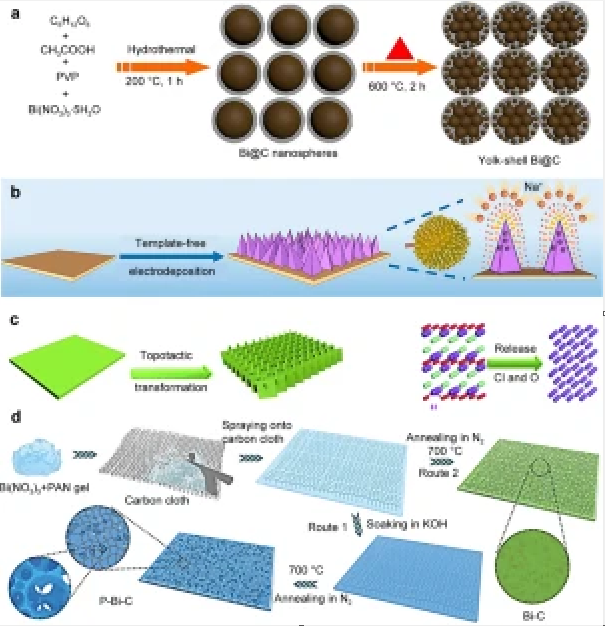
In this review, the unique properties and synthetic methods of Bi-based electrodes, as well as their applications are comprehensively summarized and discussed. The commonly used preparation methods of Bi-based electrodes, including hydrothermal method, electrodeposition method, etc., are introduced. Then, the applications of the Bi-based composites in aqueous batteries, such as Ni//Bi batteries and water desalination, are summarized. Finally, the challenges and future research direction of Bi-based materials are proposed.
Ultrafast all-optical modulation of wide-bandwidth pulses enabled by silicon-metasurfaces
Kaloyan Georgiev, Khosro Zangeneh Kamali, Anton A. Trifonov, Giulia Crotti, Lyuben Petrov, Stefan Georgiev, Hristo Iliev, Lei Xu, Unai Arregui Leon, Mohsen Rahmani, Giuseppe Della Valle, Ivan Buchvarov, Dragomir Neshev
Opto-Electronic Advances
2026-09-15
Physics-informed neural fields enable blind aberration correction for partially coherent quantitative phase imaging
Shun Zhou, Xingyu Huang, Linpeng Lu, Habib Ullah, Kaiyu Du, Maciej Trusiak, Malgorzata Kujawinska, Yuzhen Zhang, Yao Fan, Qian Chen, Qinrong Zhang, Chao Zuo
Opto-Electronic Science
2026-08-26
Heterogeneously integrated micro-ring with SnS₂ for dual-functional optical modulation and photodetection
Jinyi Du, Lidan Lu, Xu Zhang, Bofei Zhu, Wenbo Bo, Yingjie Xu, Guang Chen, Yanlin He, Guanghui Ren, Xiaoping Lou, Zheng You, Lianqing Zhu
Opto-Electronic Advances
2026-08-25
Hardware-aware lightweight photonic spiking neural network for pattern classification
Shuiying Xiang, Yahui Zhang, Shangxuan Shi, Haowen Zhao, Dianzhuang Zheng, Xingxing Guo, Yanan Han, Ye Tian, Liyue Zhang, Yuechun Shi, Yue Hao
Opto-Electronic Advances
2026-08-25
PhyspeNet: An empirical physics-aware network for adaptive speckle reconstructive spectrometry
Junrui Liang, Min Jiang, Jun Li, Zhongming Huang, Junhong He, Yanting Guo, Yanzhao Ke, Jun Ye, Jiangming Xu, Jinyong Leng, Pu Zhou
Opto-Electronic Advances
2026-08-25
A 36 × 240 Gbps hybrid mode/wavelength division multiplexing transmitter using lithium niobate on insulator
Mingyu Zhu, Weihan Wang, Ruitao Ma, Aoyun Gao, Chun Gao, Zexu Wang, Fei Huang, Zhenyuan Bao, Dajian Liu, Jiaxuan Gan, Zejie Yu, Huan Li, Weike Zhao, Daoxin Dai
Opto-Electronic Advances
2026-08-25