(Peer-Reviewed) Application and Prospect of Platelet Multi-Omics Technology in Study of Blood Stasis Syndrome
Ying Li 张颖, Ming-qian Sun 孙明谦, Lei Li 李磊, Ye-hao Zhang 张业昊, Lan Miao 苗兰, Jian-xun Liu 刘建勋
Beijing Key Laboratory of Pharmacology of Chinese Materia Region, Xiyuan Hospital, China Academy of Chinese Medical Sciences, National Clinical Research Center for Chinese Medicine Cardiology, Beijing, 100091, China
中国 北京 中国中医科学院西苑医院 中药药理北京市重点实验室 国家中医心血管病临床医学研究中心
Abstract
The abnormality of platelet function plays an important role in the pathogenesis and evolution of blood stasis syndrome (BSS). The explanation of its mechanism is a key scientific issue in the study of cardiovascular and cerebrovascular diseases and treatment. System biology technology provides a good technical platform for further development of platelet multi-omics, which is conducive to the scientific interpretation of the biological mechanism of BSS.
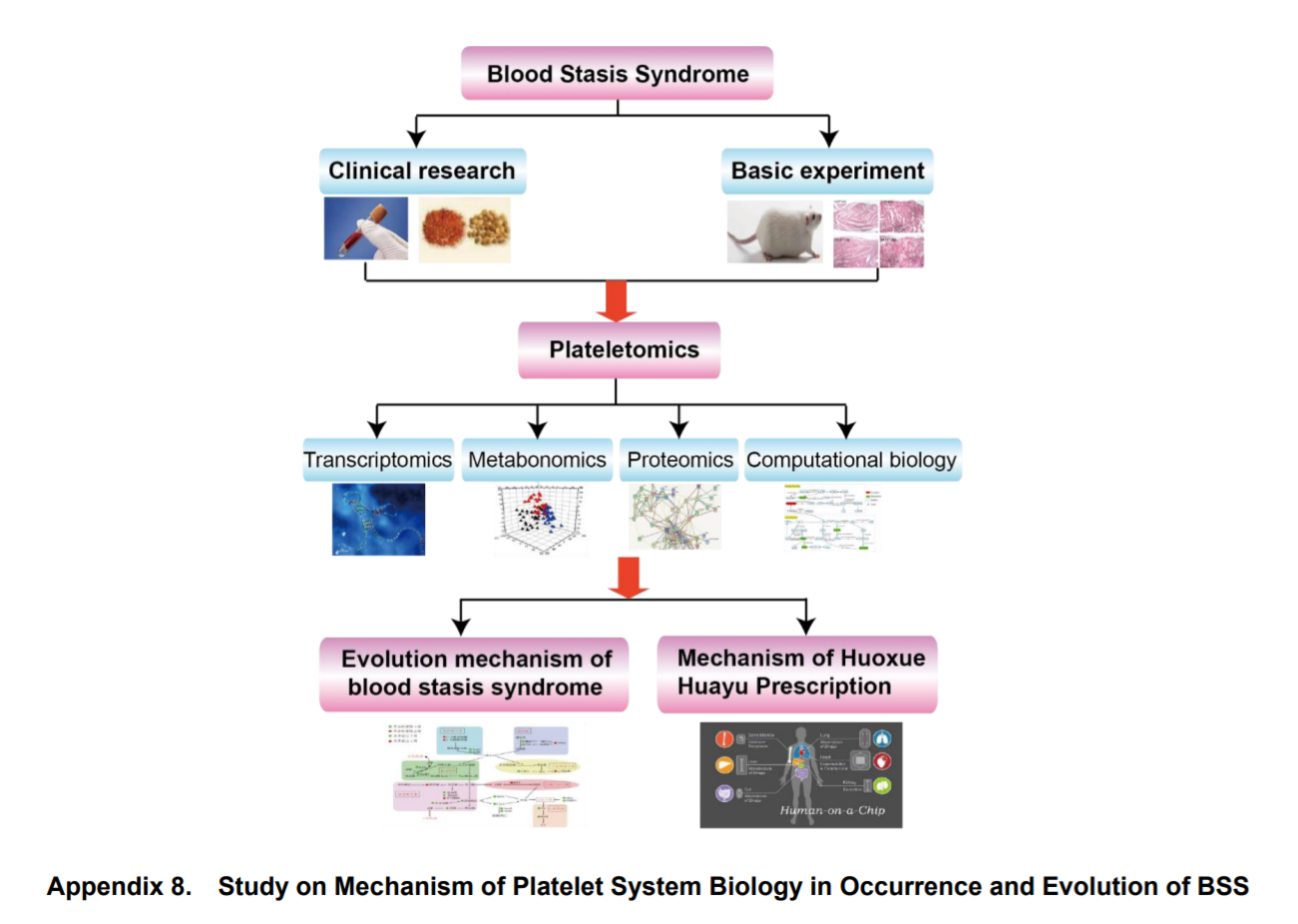
The article summarized the pathogenesis of platelets in BSS, the mechanism of action of blood activating and stasis resolving drugs, and the application of genomics, proteomics, and metabonomics in platelet research, and put forward the concept of “plateletomics in BSS”. Through the combination and cross-validation of multi-omics technology, it mainly focuses on the clinical and basic research of cardiovascular and cerebrovascular diseases; through the interactive verification of multi-omics technology and system biology, it mainly focuses on the platelet function and secretion system.
The article systematically explains the molecular biological mechanism of platelet activation, aggregation, release, and other stages in the formation and development of BSS, and provides a new research idea and method for clarifying the pathogenesis of BSS and the mechanism of action of blood activating and stasis resolving drugs.
Ultrafast all-optical modulation of wide-bandwidth pulses enabled by silicon-metasurfaces
Kaloyan Georgiev, Khosro Zangeneh Kamali, Anton A. Trifonov, Giulia Crotti, Lyuben Petrov, Stefan Georgiev, Hristo Iliev, Lei Xu, Unai Arregui Leon, Mohsen Rahmani, Giuseppe Della Valle, Ivan Buchvarov, Dragomir Neshev
Opto-Electronic Advances
2026-09-15
Physics-informed neural fields enable blind aberration correction for partially coherent quantitative phase imaging
Shun Zhou, Xingyu Huang, Linpeng Lu, Habib Ullah, Kaiyu Du, Maciej Trusiak, Malgorzata Kujawinska, Yuzhen Zhang, Yao Fan, Qian Chen, Qinrong Zhang, Chao Zuo
Opto-Electronic Science
2026-08-26
Heterogeneously integrated micro-ring with SnS₂ for dual-functional optical modulation and photodetection
Jinyi Du, Lidan Lu, Xu Zhang, Bofei Zhu, Wenbo Bo, Yingjie Xu, Guang Chen, Yanlin He, Guanghui Ren, Xiaoping Lou, Zheng You, Lianqing Zhu
Opto-Electronic Advances
2026-08-25
Hardware-aware lightweight photonic spiking neural network for pattern classification
Shuiying Xiang, Yahui Zhang, Shangxuan Shi, Haowen Zhao, Dianzhuang Zheng, Xingxing Guo, Yanan Han, Ye Tian, Liyue Zhang, Yuechun Shi, Yue Hao
Opto-Electronic Advances
2026-08-25
PhyspeNet: An empirical physics-aware network for adaptive speckle reconstructive spectrometry
Junrui Liang, Min Jiang, Jun Li, Zhongming Huang, Junhong He, Yanting Guo, Yanzhao Ke, Jun Ye, Jiangming Xu, Jinyong Leng, Pu Zhou
Opto-Electronic Advances
2026-08-25
A 36 × 240 Gbps hybrid mode/wavelength division multiplexing transmitter using lithium niobate on insulator
Mingyu Zhu, Weihan Wang, Ruitao Ma, Aoyun Gao, Chun Gao, Zexu Wang, Fei Huang, Zhenyuan Bao, Dajian Liu, Jiaxuan Gan, Zejie Yu, Huan Li, Weike Zhao, Daoxin Dai
Opto-Electronic Advances
2026-08-25