(Peer-Reviewed) Artificial intelligence CT helps evaluate the severity of COVID-19 patients: A retrospective study
Yi Han ¹, Su-cheng Mu ¹, Hai-dong Zhang ², Wei Wei ¹, Xing-yue Wu ¹, Chao-yuan Jin ¹, Guo-rong Gu 顾国嵘 ¹, Bao-jun Xie 谢宝君 ², Chao-yang Tong 童朝阳 ¹
¹ Department of Emergency Medicine, Zhongshan Hospital Fudan University, Shanghai 200032, China
中国 上海 复旦大学附属中山医院急诊科
² Department of Radiology, Renmin Hospital of Wuhan University, Wuhan 430060, China
中国 武汉 武汉大学人民医院放射科
Background
Computed tomography (CT) is a noninvasive imaging approach to assist the early diagnosis of pneumonia. However, coronavirus disease 2019 (COVID-19) shares similar imaging features with other types of pneumonia, which makes differential diagnosis problematic. Artificial intelligence (AI) has been proven successful in the medical imaging field, which has helped disease identification. However, whether AI can be used to identify the severity of COVID-19 is still underdetermined.
Methods
Data were extracted from 140 patients with confirmed COVID-19. The severity of COVID-19 patients (severe vs. non-severe) was defined at admission, according to American Thoracic Society (ATS) guidelines for community-acquired pneumonia (CAP). The AI-CT rating system constructed by Hangzhou YITU Healthcare Technology Co., Ltd. was used as the analysis tool to analyze chest CT images.
Results
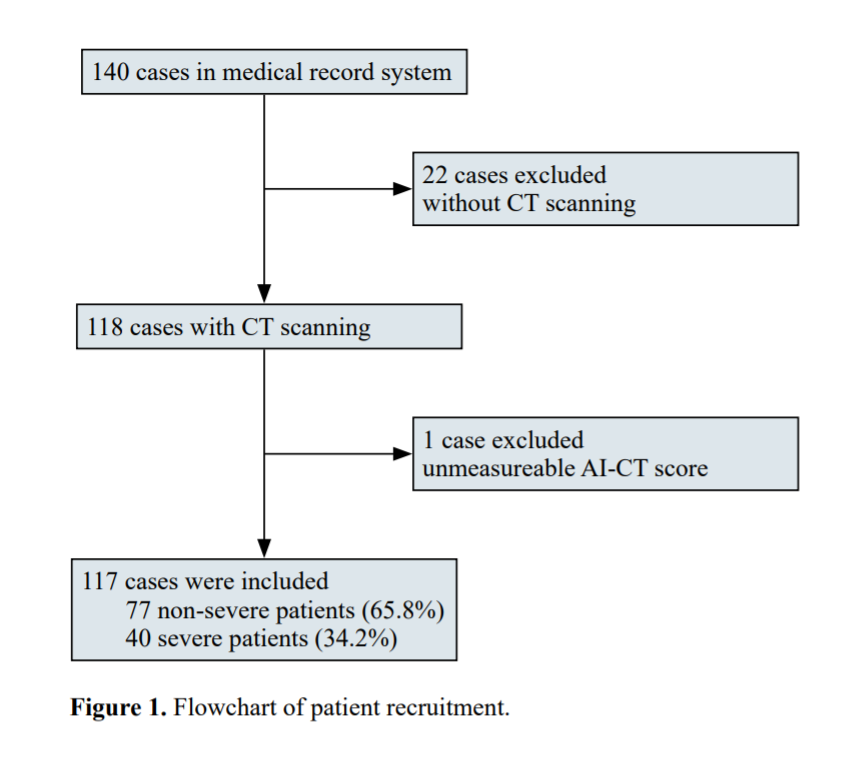
A total of 117 diagnosed cases were enrolled, with 40 severe cases and 77 non-severe cases. Severe patients had more dyspnea symptoms on admission (12 vs. 3), higher acute physiology and chronic health evaluation (APACHE) II (9 vs. 4) and sequential organ failure assessment (SOFA) (3 vs. 1) scores, as well as higher CT semiquantitative rating scores (4 vs. 1) and AI-CT rating scores than non-severe patients (P<0.001). The AI-CT score was more predictive of the severity of COVID-19 (AUC=0.929), and ground-glass opacity (GGO) was more predictive of further intubation and mechanical ventilation (AUC=0.836). Furthermore, the CT semiquantitative score was linearly associated with the AI-CT rating system (Adj R2=75.5%, P<0.001).
Conclusion
AI technology could be used to evaluate disease severity in COVID-19 patients. Although it could not be considered an independent factor, there was no doubt that GGOs displayed more predictive value for further mechanical ventilation.
Ultrafast all-optical modulation of wide-bandwidth pulses enabled by silicon-metasurfaces
Kaloyan Georgiev, Khosro Zangeneh Kamali, Anton A. Trifonov, Giulia Crotti, Lyuben Petrov, Stefan Georgiev, Hristo Iliev, Lei Xu, Unai Arregui Leon, Mohsen Rahmani, Giuseppe Della Valle, Ivan Buchvarov, Dragomir Neshev
Opto-Electronic Advances
2026-09-15
Physics-informed neural fields enable blind aberration correction for partially coherent quantitative phase imaging
Shun Zhou, Xingyu Huang, Linpeng Lu, Habib Ullah, Kaiyu Du, Maciej Trusiak, Malgorzata Kujawinska, Yuzhen Zhang, Yao Fan, Qian Chen, Qinrong Zhang, Chao Zuo
Opto-Electronic Science
2026-08-26
Heterogeneously integrated micro-ring with SnS₂ for dual-functional optical modulation and photodetection
Jinyi Du, Lidan Lu, Xu Zhang, Bofei Zhu, Wenbo Bo, Yingjie Xu, Guang Chen, Yanlin He, Guanghui Ren, Xiaoping Lou, Zheng You, Lianqing Zhu
Opto-Electronic Advances
2026-08-25
Hardware-aware lightweight photonic spiking neural network for pattern classification
Shuiying Xiang, Yahui Zhang, Shangxuan Shi, Haowen Zhao, Dianzhuang Zheng, Xingxing Guo, Yanan Han, Ye Tian, Liyue Zhang, Yuechun Shi, Yue Hao
Opto-Electronic Advances
2026-08-25
PhyspeNet: An empirical physics-aware network for adaptive speckle reconstructive spectrometry
Junrui Liang, Min Jiang, Jun Li, Zhongming Huang, Junhong He, Yanting Guo, Yanzhao Ke, Jun Ye, Jiangming Xu, Jinyong Leng, Pu Zhou
Opto-Electronic Advances
2026-08-25
A 36 × 240 Gbps hybrid mode/wavelength division multiplexing transmitter using lithium niobate on insulator
Mingyu Zhu, Weihan Wang, Ruitao Ma, Aoyun Gao, Chun Gao, Zexu Wang, Fei Huang, Zhenyuan Bao, Dajian Liu, Jiaxuan Gan, Zejie Yu, Huan Li, Weike Zhao, Daoxin Dai
Opto-Electronic Advances
2026-08-25