(Peer-Reviewed) Non-volatile dynamically switchable color display via chalcogenide stepwise cavity resonators
Kuan Liu ¹, Zhenyuan Lin ³, Bing Han ¹, Minghui Hong ², Tun Cao ¹
¹ School of Optoelectronic Engineering and Instrumentation Science, Dalian University of Technology, Dalian 116024, China
中国 大连 大连理工大学光电工程与仪器科学学院
² Pen-Tung Sah Institute of Micro-Nano Science and Technology, Xiamen University, Xiamen 361102, China
中国 厦门 厦门大学萨本栋微米纳米科学技术研究院
³ Institute of Laser Engineering, Faculty of Materials and Manufacturing, Beijing University of Technology, Beijing, 100124, China
中国 北京 北京理工大学激光工程学院 材料加工工程系
Opto-Electronic Advances
, 2023-08-30
Abstract
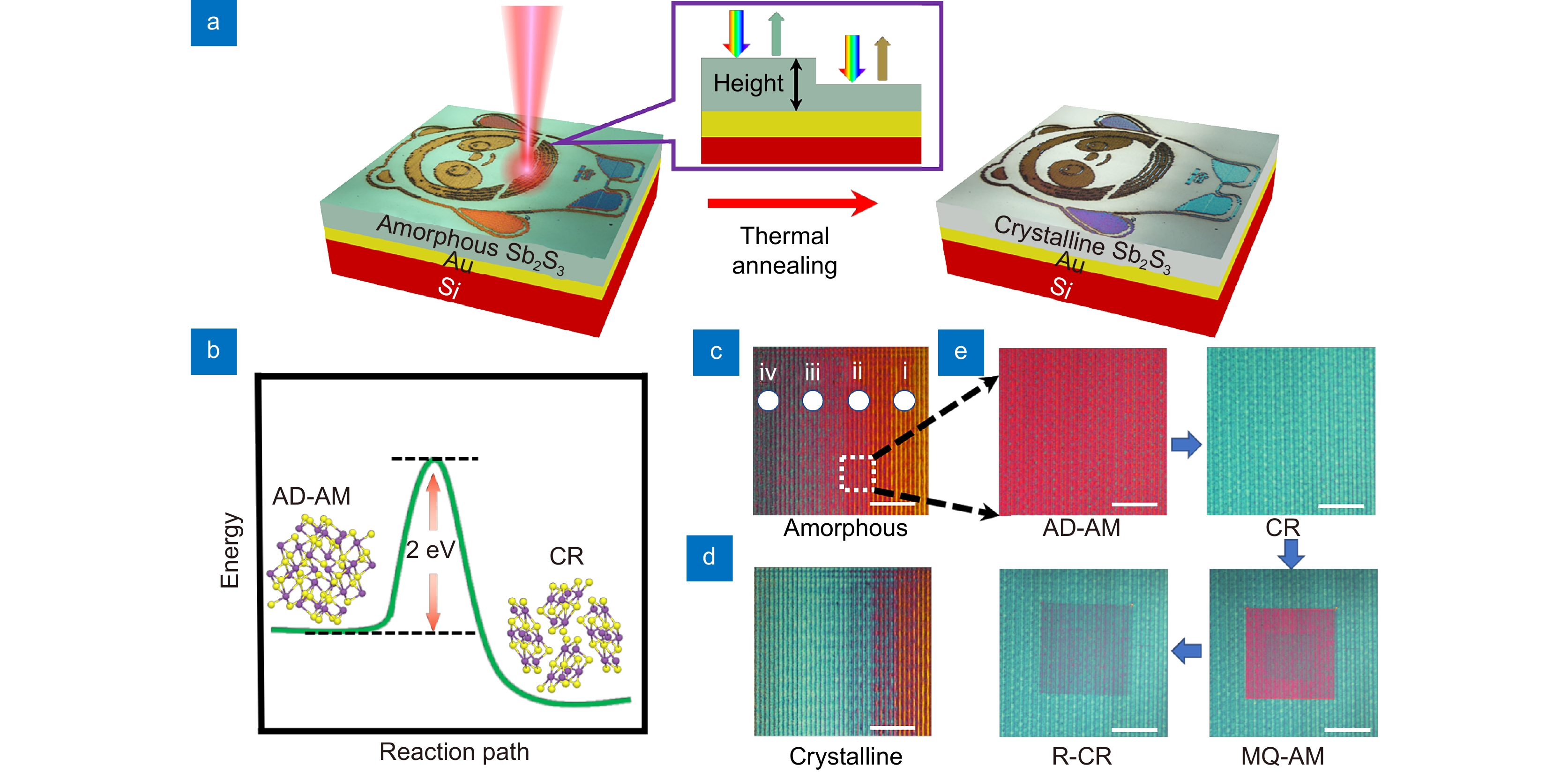
High-resolution multi-color printing relies upon pixelated optical nanostructures, which is crucial to promote color display by producing nonbleaching colors, yet requires simplicity in fabrication and dynamic switching. Antimony trisulfide (Sb2S3) is a newly rising chalcogenide material that possesses prompt and significant transition of its optical characteristics in the visible region between amorphous and crystalline phases, which holds the key to color-varying devices.
Herein, we proposed a dynamically switchable color printing method using Sb2S3-based stepwise pixelated Fabry-Pérot (FP) cavities with various cavity lengths. The device was fabricated by employing a direct laser patterning that is a less time-consuming, more approachable, and low-cost technique. As switching the state of Sb2S3 between amorphous and crystalline, the multi-color of stepwise pixelated FP cavities can be actively changed. The color variation is due to the profound change in the refractive index of Sb2S3 over the visible spectrum during its phase transition.
Moreover, we directly fabricated sub-50 nm nano-grating on ultrathin Sb2S3 laminate via microsphere 800-nm femtosecond laser irradiation in far field. The minimum feature size can be further decreased down to ~45 nm (λ/17) by varying the thickness of Sb2S3 film. Ultrafast switchable Sb2S3 photonic devices can take one step toward the next generation of inkless erasable papers or displays and enable information encryption, camouflaging surfaces, anticounterfeiting, etc.
Importantly, our work explores the prospects of rapid and rewritable fabrication of periodic structures with nano-scale resolution and can serve as a guideline for further development of chalcogenide-based photonics components.
Ultrafast all-optical modulation of wide-bandwidth pulses enabled by silicon-metasurfaces
Kaloyan Georgiev, Khosro Zangeneh Kamali, Anton A. Trifonov, Giulia Crotti, Lyuben Petrov, Stefan Georgiev, Hristo Iliev, Lei Xu, Unai Arregui Leon, Mohsen Rahmani, Giuseppe Della Valle, Ivan Buchvarov, Dragomir Neshev
Opto-Electronic Advances
2026-09-15
Physics-informed neural fields enable blind aberration correction for partially coherent quantitative phase imaging
Shun Zhou, Xingyu Huang, Linpeng Lu, Habib Ullah, Kaiyu Du, Maciej Trusiak, Malgorzata Kujawinska, Yuzhen Zhang, Yao Fan, Qian Chen, Qinrong Zhang, Chao Zuo
Opto-Electronic Science
2026-08-26
Heterogeneously integrated micro-ring with SnS₂ for dual-functional optical modulation and photodetection
Jinyi Du, Lidan Lu, Xu Zhang, Bofei Zhu, Wenbo Bo, Yingjie Xu, Guang Chen, Yanlin He, Guanghui Ren, Xiaoping Lou, Zheng You, Lianqing Zhu
Opto-Electronic Advances
2026-08-25
Hardware-aware lightweight photonic spiking neural network for pattern classification
Shuiying Xiang, Yahui Zhang, Shangxuan Shi, Haowen Zhao, Dianzhuang Zheng, Xingxing Guo, Yanan Han, Ye Tian, Liyue Zhang, Yuechun Shi, Yue Hao
Opto-Electronic Advances
2026-08-25
PhyspeNet: An empirical physics-aware network for adaptive speckle reconstructive spectrometry
Junrui Liang, Min Jiang, Jun Li, Zhongming Huang, Junhong He, Yanting Guo, Yanzhao Ke, Jun Ye, Jiangming Xu, Jinyong Leng, Pu Zhou
Opto-Electronic Advances
2026-08-25
A 36 × 240 Gbps hybrid mode/wavelength division multiplexing transmitter using lithium niobate on insulator
Mingyu Zhu, Weihan Wang, Ruitao Ma, Aoyun Gao, Chun Gao, Zexu Wang, Fei Huang, Zhenyuan Bao, Dajian Liu, Jiaxuan Gan, Zejie Yu, Huan Li, Weike Zhao, Daoxin Dai
Opto-Electronic Advances
2026-08-25