(Peer-Reviewed) Pattern recognition in multi-synaptic photonic spiking neural networks based on a DFB-SA chip
Yanan Han 韩亚楠 ¹, Shuiying Xiang 项水英 ¹, Ziwei Song 宋紫薇 ¹, Shuang Gao 高爽 ¹, Xingxing Guo 郭星星 ¹, Yahui Zhang 张雅慧 ¹, Yuechun Shi 施跃春 ², Xiangfei Chen 陈向飞 ³, Yue Hao 郝跃 ¹
¹ State Key Laboratory of Integrated Service Networks, State Key Discipline Laboratory of Wide Bandgap Semiconductor Technology, Xidian University, Xi'an 710071, China
中国 西安 西安电子科技大学 综合业务网国家重点实验室 宽带隙半导体技术国家重点学科实验室
² Yongjiang Laboratory, Ningbo 315202, China
中国 宁波 甬江实验室
³ Key Laboratory of Intelligent Optical Sensing and Manipulation, Ministry of Education, the National Laboratory of Solid State Microstructures, the College of Engineering and Applied Sciences, Institute of Optical Communication Engineering, Nanjing University, Nanjing 210023, China
中国 南京 南京大学光通信工程研究中心 智能光传感与调控技术教育部重点实验室 固体微结构物理国家重点实验室
Opto-Electronic Science
, 2023-11-15
Abstract
Spiking neural networks (SNNs) utilize brain-like spatiotemporal spike encoding for simulating brain functions. Photonic SNN offers an ultrahigh speed and power efficiency platform for implementing high-performance neuromorphic computing. Here, we proposed a multi-synaptic photonic SNN, combining the modified remote supervised learning with delay-weight co-training to achieve pattern classification. The impact of multi-synaptic connections and the robustness of the network were investigated through numerical simulations.
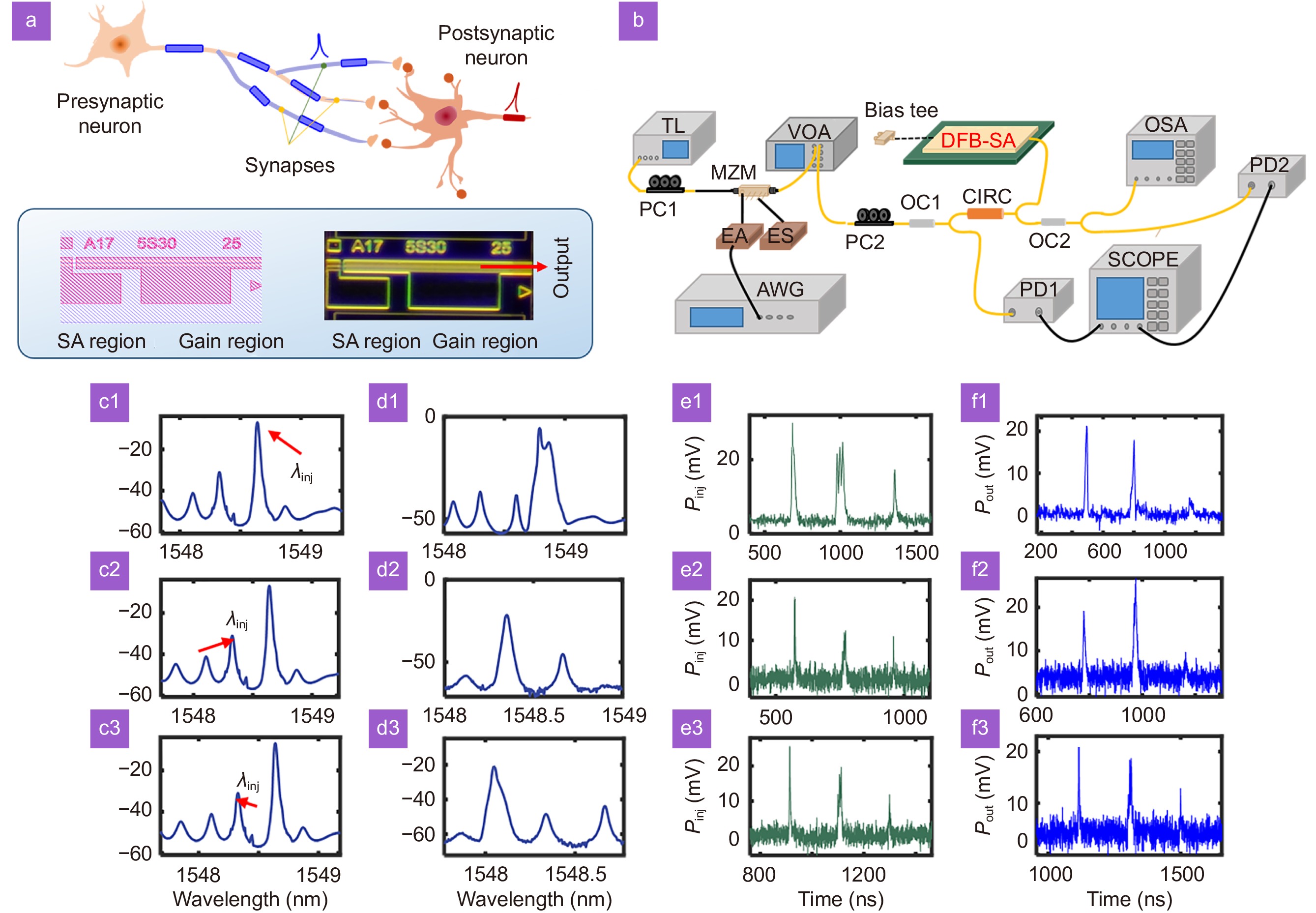
In addition, the collaborative computing of algorithm and hardware was demonstrated based on a fabricated integrated distributed feedback laser with a saturable absorber (DFB-SA), where 10 different noisy digital patterns were successfully classified. A functional photonic SNN that far exceeds the scale limit of hardware integration was achieved based on time-division multiplexing, demonstrating the capability of hardware-algorithm co-computation.
Ultrafast all-optical modulation of wide-bandwidth pulses enabled by silicon-metasurfaces
Kaloyan Georgiev, Khosro Zangeneh Kamali, Anton A. Trifonov, Giulia Crotti, Lyuben Petrov, Stefan Georgiev, Hristo Iliev, Lei Xu, Unai Arregui Leon, Mohsen Rahmani, Giuseppe Della Valle, Ivan Buchvarov, Dragomir Neshev
Opto-Electronic Advances
2026-09-15
Physics-informed neural fields enable blind aberration correction for partially coherent quantitative phase imaging
Shun Zhou, Xingyu Huang, Linpeng Lu, Habib Ullah, Kaiyu Du, Maciej Trusiak, Malgorzata Kujawinska, Yuzhen Zhang, Yao Fan, Qian Chen, Qinrong Zhang, Chao Zuo
Opto-Electronic Science
2026-08-26
Heterogeneously integrated micro-ring with SnS₂ for dual-functional optical modulation and photodetection
Jinyi Du, Lidan Lu, Xu Zhang, Bofei Zhu, Wenbo Bo, Yingjie Xu, Guang Chen, Yanlin He, Guanghui Ren, Xiaoping Lou, Zheng You, Lianqing Zhu
Opto-Electronic Advances
2026-08-25
Hardware-aware lightweight photonic spiking neural network for pattern classification
Shuiying Xiang, Yahui Zhang, Shangxuan Shi, Haowen Zhao, Dianzhuang Zheng, Xingxing Guo, Yanan Han, Ye Tian, Liyue Zhang, Yuechun Shi, Yue Hao
Opto-Electronic Advances
2026-08-25
PhyspeNet: An empirical physics-aware network for adaptive speckle reconstructive spectrometry
Junrui Liang, Min Jiang, Jun Li, Zhongming Huang, Junhong He, Yanting Guo, Yanzhao Ke, Jun Ye, Jiangming Xu, Jinyong Leng, Pu Zhou
Opto-Electronic Advances
2026-08-25
A 36 × 240 Gbps hybrid mode/wavelength division multiplexing transmitter using lithium niobate on insulator
Mingyu Zhu, Weihan Wang, Ruitao Ma, Aoyun Gao, Chun Gao, Zexu Wang, Fei Huang, Zhenyuan Bao, Dajian Liu, Jiaxuan Gan, Zejie Yu, Huan Li, Weike Zhao, Daoxin Dai
Opto-Electronic Advances
2026-08-25