(Peer-Reviewed) Continuous purification and culture of rat type 1 and type 2 alveolar epithelial cells by magnetic cell sorting
Di Liu 刘迪 ¹, Jian-Hui Sun 孙剑会 ², Hua-Cai Zhang 张华才 ¹, Jian-Xin Jiang 蒋建新 ¹, Ling Zeng 曾灵 ¹
¹ State Key Laboratory of Trauma, Burns and Combined Injuries, Daping Hospital, Army Medical University, Chongqing, 400042, China
中国 重庆 陆军军医大学大坪医院 创伤、烧伤与复合伤研究国家重点实验室
² Medical Center of Trauma and War injury, Daping Hospital, Army Medical University, Chongqing, 400042, China
中国 重庆 陆军军医大学大坪医院 战创伤医学中心
Purpose
The incidence of acute lung injury (ALI) in severe trauma patients is 48% and the mortality rate following acute respiratory distress syndrome evolved from ALI is up to 68.5%. Alveolar epithelial type 1 cells (AEC1s) and type 2 cells (AEC2s) are the key cells in the repair of injured lungs as well as fetal lung development. Therefore, the purification and culture of AEC1s and AEC2s play an important role in the research of repair and regeneration of lung tissue.
Methods
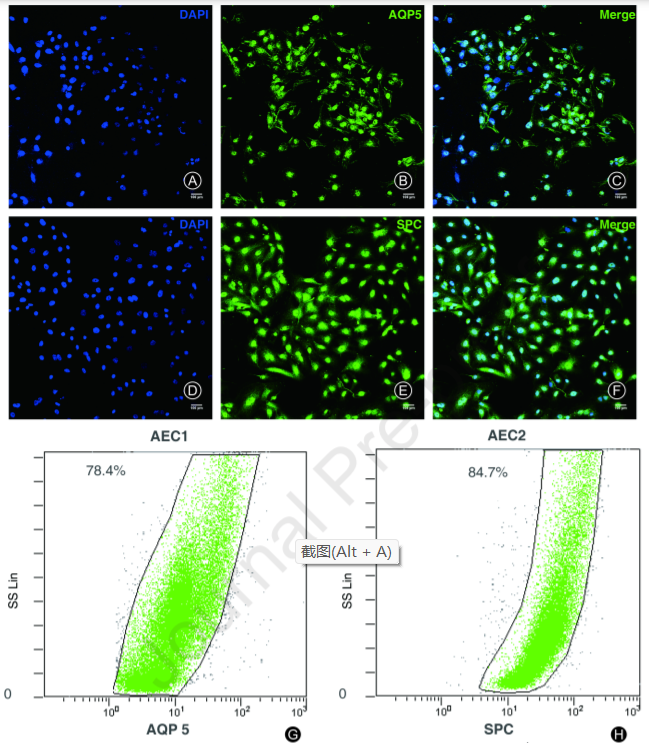
Sprague-Dawley rats (3-4 weeks, 120-150 g) were purchase for experiment. Dispase and DNase I were jointly used to digest lung tissue to obtain a single-cell suspension, and then magnetic bead cell sorting was used to isolate AEC1s from the single-cell suspension by using AEC1s cell membrane marker protein T1a. Afterwards, alveolar epithelial cell membrane marker protein EpCAM was used to sort the remaining AEC2s. Cell purity was identified by immunofluorescence staining and flow cytometry.
Results
The purity of AEC1s and AEC2s was 88.3% ± 3.8% and 92.6% ± 2.7%. The cell growth was observed as follows: AEC1s stretched within the 12 h-16 h, but the cells proliferated slowly; while AEC2s began to stretch after 24 h and proliferated rapidly from the 2nd day and began to differentiate after 3 days.
Conclusion
AEC1s and AEC2s sorted by this method have high purity and good viability. Therefore, our method provides a new approach for the isolation and culture of AEC1s and AEC2s as well as a new strategy for the research of lung repair and regeneration.
Ultrafast all-optical modulation of wide-bandwidth pulses enabled by silicon-metasurfaces
Kaloyan Georgiev, Khosro Zangeneh Kamali, Anton A. Trifonov, Giulia Crotti, Lyuben Petrov, Stefan Georgiev, Hristo Iliev, Lei Xu, Unai Arregui Leon, Mohsen Rahmani, Giuseppe Della Valle, Ivan Buchvarov, Dragomir Neshev
Opto-Electronic Advances
2026-09-15
Physics-informed neural fields enable blind aberration correction for partially coherent quantitative phase imaging
Shun Zhou, Xingyu Huang, Linpeng Lu, Habib Ullah, Kaiyu Du, Maciej Trusiak, Malgorzata Kujawinska, Yuzhen Zhang, Yao Fan, Qian Chen, Qinrong Zhang, Chao Zuo
Opto-Electronic Science
2026-08-26
Heterogeneously integrated micro-ring with SnS₂ for dual-functional optical modulation and photodetection
Jinyi Du, Lidan Lu, Xu Zhang, Bofei Zhu, Wenbo Bo, Yingjie Xu, Guang Chen, Yanlin He, Guanghui Ren, Xiaoping Lou, Zheng You, Lianqing Zhu
Opto-Electronic Advances
2026-08-25
Hardware-aware lightweight photonic spiking neural network for pattern classification
Shuiying Xiang, Yahui Zhang, Shangxuan Shi, Haowen Zhao, Dianzhuang Zheng, Xingxing Guo, Yanan Han, Ye Tian, Liyue Zhang, Yuechun Shi, Yue Hao
Opto-Electronic Advances
2026-08-25
PhyspeNet: An empirical physics-aware network for adaptive speckle reconstructive spectrometry
Junrui Liang, Min Jiang, Jun Li, Zhongming Huang, Junhong He, Yanting Guo, Yanzhao Ke, Jun Ye, Jiangming Xu, Jinyong Leng, Pu Zhou
Opto-Electronic Advances
2026-08-25
A 36 × 240 Gbps hybrid mode/wavelength division multiplexing transmitter using lithium niobate on insulator
Mingyu Zhu, Weihan Wang, Ruitao Ma, Aoyun Gao, Chun Gao, Zexu Wang, Fei Huang, Zhenyuan Bao, Dajian Liu, Jiaxuan Gan, Zejie Yu, Huan Li, Weike Zhao, Daoxin Dai
Opto-Electronic Advances
2026-08-25