(Peer-Reviewed) Plasmon-enhanced nanosoldering of silver nanoparticles for high-conductive nanowires electrodes
Yuan-Yuan Zhao 赵圆圆 ¹, Xue-Liang Ren ², Mei-Ling Zheng 郑美玲 ² ³, Feng Jin 金峰 ², Jie Liu 刘洁 ², Xian-Zi Dong 董贤子 ², Zhen-Sheng Zhao 赵震声 ², Xuan-Ming Duan 段宣明 ¹
¹ Guangdong Provincial Key Laboratory of Optical Fiber Sensing and Communications, Institute of Photonics Technology, Jinan University, Guangzhou 511443, China
中国 广州 暨南大学光子技术研究院 广东省光纤传感与通信技术重点实验室
² Laboratory of Organic NanoPhotonics and CAS Key Laboratory of Bio-Inspired Materials and Interfacial Science, Technical Institute of Physics and Chemistry, Chinese Academy of Sciences, Beijing 100190, China
中国 北京 中国科学院理化技术研究所 有机纳米光子学实验室 中国科学院仿生材料与界面科学重点实验室
³ School of Future Technologies, University of Chinese Academy of Sciences, Yanqihu Campus, Beijing 101407, China
中国 北京 中国科学院大学 雁栖湖校区 未来技术学院
Opto-Electronic Advances
, 2021-12-25
Abstract
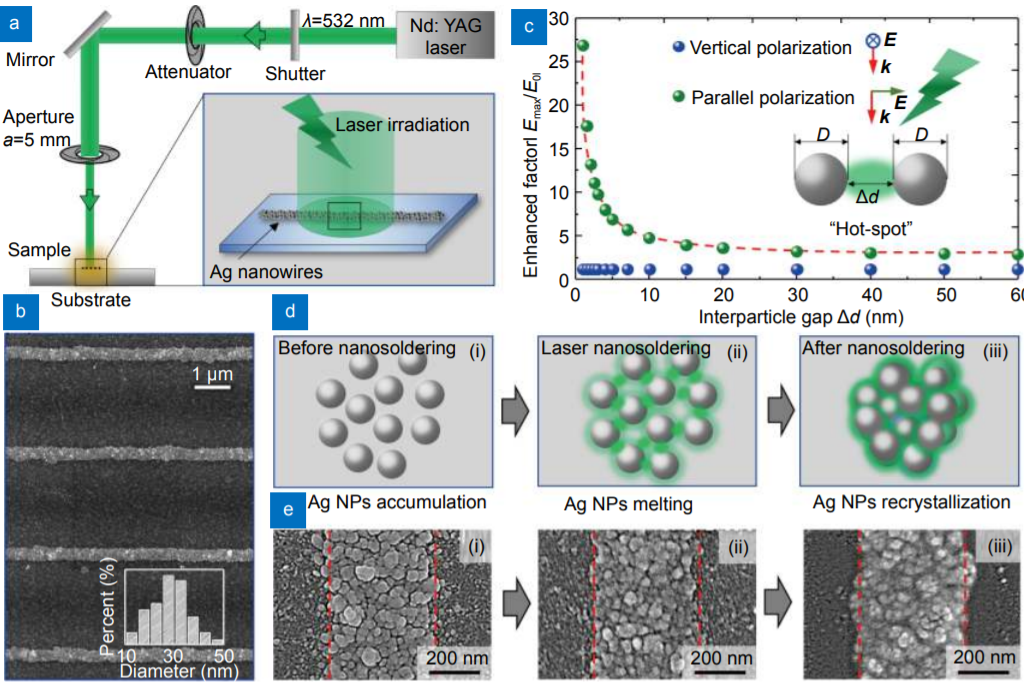
The silver nanowires (Ag NWs) electrodes, which consist of incompact Ag nanoparticles (NPs) formed by multi-photon photoreduction, usually have poor conductivities. An effective strategy for enhancing conductivity of the Ag NWs electrodes is plasmon-enhanced nanosoldering (PLNS) by laser irradiation. Here, plasmon-enhanced photothermal effect is used to locally solder Ag NPs and then aggregates of these NPs grow into large irregular particles in PLNS process.
Finite element method (FEM) simulations indicate that the soldering process is triggered by localized surface plasmon-induced electric field enhancement at “hot-spots”. The effectiveness of PLNS for enhancing conductivity depends on laser power density and irradiation time. By optimizing the conditions of PLNS, the electrical conductivity of Ag NWs is significantly enhanced and the conductivity σs is increased to 2.45×10⁷ S/m, which is about 39% of the bulk Ag. This PLNS of Ag NWs provides an efficient and cost-effective technique to rapidly produce large-area metal nanowire electrodes and capacitors with high conductivity, excellent uniformity, and good flexibility.
Ultrafast all-optical modulation of wide-bandwidth pulses enabled by silicon-metasurfaces
Kaloyan Georgiev, Khosro Zangeneh Kamali, Anton A. Trifonov, Giulia Crotti, Lyuben Petrov, Stefan Georgiev, Hristo Iliev, Lei Xu, Unai Arregui Leon, Mohsen Rahmani, Giuseppe Della Valle, Ivan Buchvarov, Dragomir Neshev
Opto-Electronic Advances
2026-09-15
Physics-informed neural fields enable blind aberration correction for partially coherent quantitative phase imaging
Shun Zhou, Xingyu Huang, Linpeng Lu, Habib Ullah, Kaiyu Du, Maciej Trusiak, Malgorzata Kujawinska, Yuzhen Zhang, Yao Fan, Qian Chen, Qinrong Zhang, Chao Zuo
Opto-Electronic Science
2026-08-26
Heterogeneously integrated micro-ring with SnS₂ for dual-functional optical modulation and photodetection
Jinyi Du, Lidan Lu, Xu Zhang, Bofei Zhu, Wenbo Bo, Yingjie Xu, Guang Chen, Yanlin He, Guanghui Ren, Xiaoping Lou, Zheng You, Lianqing Zhu
Opto-Electronic Advances
2026-08-25
Hardware-aware lightweight photonic spiking neural network for pattern classification
Shuiying Xiang, Yahui Zhang, Shangxuan Shi, Haowen Zhao, Dianzhuang Zheng, Xingxing Guo, Yanan Han, Ye Tian, Liyue Zhang, Yuechun Shi, Yue Hao
Opto-Electronic Advances
2026-08-25
PhyspeNet: An empirical physics-aware network for adaptive speckle reconstructive spectrometry
Junrui Liang, Min Jiang, Jun Li, Zhongming Huang, Junhong He, Yanting Guo, Yanzhao Ke, Jun Ye, Jiangming Xu, Jinyong Leng, Pu Zhou
Opto-Electronic Advances
2026-08-25
A 36 × 240 Gbps hybrid mode/wavelength division multiplexing transmitter using lithium niobate on insulator
Mingyu Zhu, Weihan Wang, Ruitao Ma, Aoyun Gao, Chun Gao, Zexu Wang, Fei Huang, Zhenyuan Bao, Dajian Liu, Jiaxuan Gan, Zejie Yu, Huan Li, Weike Zhao, Daoxin Dai
Opto-Electronic Advances
2026-08-25