(Peer-Reviewed) Continuous purification and culture of rat type 1 and type 2 alveolar epithelial cells by magnetic cell sorting
Di Liu 刘迪 ¹, Jian-Hui Sun 孙剑会 ², Hua-Cai Zhang 张华才 ¹, Jian-Xin Jiang 蒋建新 ¹, Ling Zeng 曾灵 ¹
¹ State Key Laboratory of Trauma, Burns and Combined Injuries, Daping Hospital, Army Medical University, Chongqing, 400042, China
中国 重庆 陆军军医大学大坪医院 创伤、烧伤与复合伤研究国家重点实验室
² Medical Center of Trauma and War injury, Daping Hospital, Army Medical University, Chongqing, 400042, China
中国 重庆 陆军军医大学大坪医院 战创伤医学中心
Purpose
The incidence of acute lung injury (ALI) in severe trauma patients is 48% and the mortality rate following acute respiratory distress syndrome evolved from ALI is up to 68.5%. Alveolar epithelial type 1 cells (AEC1s) and type 2 cells (AEC2s) are the key cells in the repair of injured lungs as well as fetal lung development. Therefore, the purification and culture of AEC1s and AEC2s play an important role in the research of repair and regeneration of lung tissue.
Methods
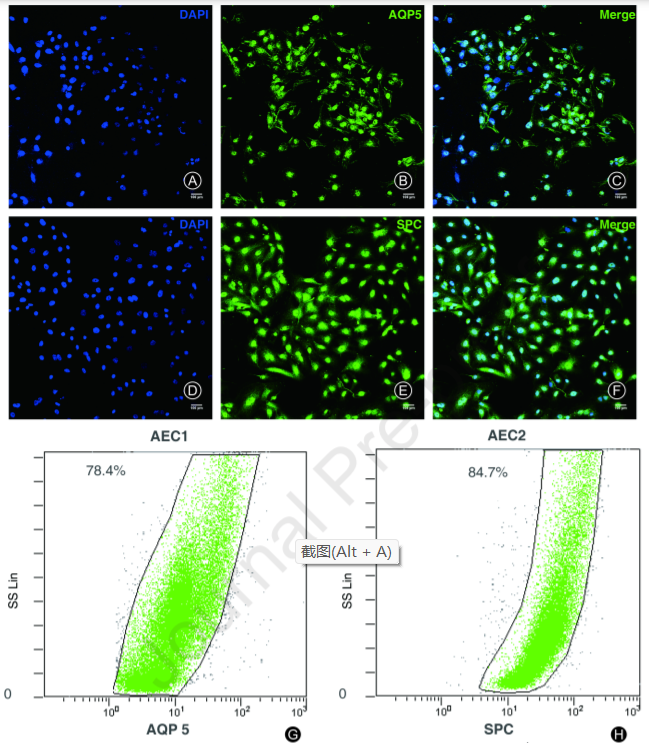
Sprague-Dawley rats (3-4 weeks, 120-150 g) were purchase for experiment. Dispase and DNase I were jointly used to digest lung tissue to obtain a single-cell suspension, and then magnetic bead cell sorting was used to isolate AEC1s from the single-cell suspension by using AEC1s cell membrane marker protein T1a. Afterwards, alveolar epithelial cell membrane marker protein EpCAM was used to sort the remaining AEC2s. Cell purity was identified by immunofluorescence staining and flow cytometry.
Results
The purity of AEC1s and AEC2s was 88.3% ± 3.8% and 92.6% ± 2.7%. The cell growth was observed as follows: AEC1s stretched within the 12 h-16 h, but the cells proliferated slowly; while AEC2s began to stretch after 24 h and proliferated rapidly from the 2nd day and began to differentiate after 3 days.
Conclusion
AEC1s and AEC2s sorted by this method have high purity and good viability. Therefore, our method provides a new approach for the isolation and culture of AEC1s and AEC2s as well as a new strategy for the research of lung repair and regeneration.
Unlocking home-based nocturnal health management: A fiber-optic approach for early detection of cardiorespiratory rhythm disorders
Hanyu Jin, Hao Li, Zhuolin Chen, Liangye Li, Zurui Wang, Kai Zhou, Weijian Hang, Zhipeng Chen, Junfeng Chen, Kai Shen, Jianfeng Wen, Chen Chen, Cunzheng Fan, Zhijun Yan, Feng Wang, Qizhen Sun
Opto-Electronic Advances
2026-07-10
A flexible wireless system for prospective photodynamic therapy applications
Rolan Mansour, Bhavani Yalagala, Vikas Vikas, Nikolas Bruce, Fawziye Tarhini, Georgios N. Arvanitakis, Mohammed Mughal, Jamie Blanche, Ahmad Taha, Jonathan Copper, Muhammad Imran, Karin Williams, Karin Oien, Mahmoud Wagih, Hadi Heidari, Robert Hadfield, David Flynn
Opto-Electronic Advances
2026-07-10
Parallel bright-field and multi-order edge imaging via wide field-of-view trichannel metalens
Xiaotong Li, Yeseul Kim, Youngsun Jeon, Junhwa Seong, Jaekyung Kim, Peng Tang, Shiqi Hu, Harit Keawmuang, Beomha Yang, Dongmin Jeon, Le Dai, Weiyan Li, Xiaodong Cai, Jinhui Shi, Yong-Sang Ryu, Trevon Badloe, Junsuk Rho
Opto-Electronic Advances
2026-07-10